

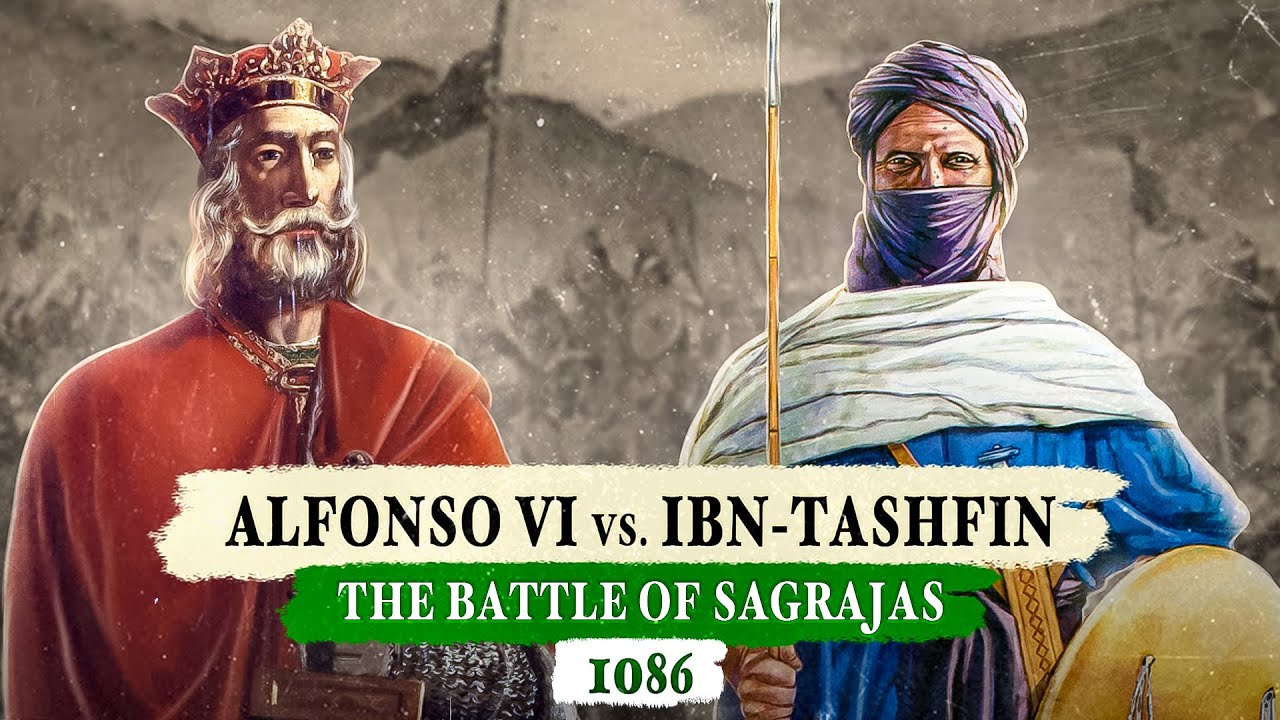
The Battle of Zallaqa stands as one of the most significant military engagements in medieval Islamic history, marking a crucial turning point in the struggle for Al-Andalus (Islamic Spain). This epic confrontation in 1086 CE between Muslim and Christian forces determined the fate of the Iberian Peninsula for decades and showcased the military brilliance of the Almoravid dynasty.
The Road to the Battle of Zallaqa
The Battle of Zallaqa emerged from the political chaos of 11th-century Iberia. After the Umayyad Caliphate of Córdoba collapsed in 1031, Islamic Spain fragmented into small kingdoms called Taifas. These wealthy but militarily weak states faced increasing pressure from Christian kingdoms in the north, particularly Castile under King Alfonso VI.
The crisis reached its peak in 1085 when Alfonso VI captured Toledo, one of the most important Muslim cities. This devastating loss made it clear that the divided Taifa kingdoms could not resist Christian expansion alone. Facing extinction, the Taifa rulers made a desperate decision that would lead to the Battle of Zallaqa—they invited Yusuf ibn Tashfin, leader of the powerful Almoravid Empire in North Africa, to cross the Strait of Gibraltar and help them.
Al-Mu’tamid of Seville, who championed this decision, famously declared: “I would rather be a camel herder in Africa than a swineherd in Castile.” This choice, while saving them from immediate Christian conquest, would ultimately cost the Taifa kings their independence.
Yusuf ibn Tashfin and the Almoravids
Yusuf ibn Tashfin, the commander who would lead Muslim forces at the Battle of Zallaqa, was a remarkable figure. The founder of Marrakech and ruler of a vast North African empire, Yusuf was known for his military genius, personal piety, and austere lifestyle. His Almoravid warriors were battle-hardened Berber tribesmen renowned for discipline and fighting prowess.
In 1086, Yusuf crossed the strait with a substantial army, answering the Andalusian Muslims’ call for help. The stage was set for the Battle of Zallaqa, which would test whether the combined Muslim forces could halt the Christian advance.
The Battle of Zallaqa: October 23, 1086
The Battle of Zallaqa took place near the fortress of Sagrajas (Arabic: Zallaqa) in southwestern Spain on Friday, October 23, 1086. The Muslim coalition included Yusuf’s disciplined Almoravid troops from North Africa alongside armies from various Taifa kingdoms, likely numbering 20,000-30,000 men total.
Alfonso VI’s Christian forces were equally formidable, including veteran knights from the Toledo conquest and mercenary contingents. Alfonso approached the Battle of Zallaqa with high confidence, perhaps excessively so, expecting another triumph over the divided Muslims.
The Battle Unfolds
The Battle of Zallaqa began with Alfonso’s forces launching a powerful assault on the Andalusian Muslim frontlines. The Taifa troops, less experienced than their Almoravid allies, wavered under the Christian onslaught. Alfonso’s knights pressed their advantage, and for a time, Christian victory seemed likely.
However, Yusuf ibn Tashfin had anticipated this scenario. As the Christian forces became overextended pursuing the retreating Andalusians, the Almoravid commander executed a masterful tactical maneuver. While Alfonso engaged the Andalusian contingents, Yusuf led his elite Almoravid cavalry in a wide flanking movement around the Christian army.
The turning point of the Battle of Zallaqa came when Yusuf’s cavalry struck Alfonso’s forces from an unexpected direction. Caught between rallying Andalusian forces in front and Almoravid cavalry behind, the Christian army found itself in a desperate situation. Fierce hand-to-hand combat erupted as Alfonso himself was wounded in the leg. His bodyguards fought desperately to extract their king from the collapsing battle.
Victory and Immediate Aftermath
The Battle of Zallaqa ended in a decisive Muslim victory. Alfonso VI’s army was thoroughly routed, suffering thousands of casualties. The King of Castile barely escaped with his life, fleeing with only a small group of survivors. His aura of invincibility was shattered, and the Christian Reconquista suffered a major setback.
Following the Battle of Zallaqa, Yusuf chose not to immediately press his advantage, instead returning to North Africa. This decision allowed the Christian kingdoms time to recover, though Alfonso adopted more cautious strategies afterward.
Long-Term Consequences of the Battle of Zallaqa
The Battle of Zallaqa had far-reaching consequences beyond the immediate military outcome. While saving the Taifa kingdoms from Christian conquest, it ultimately led to their absorption into the Almoravid Empire. By 1090, Yusuf had conquered most of the Taifa kingdoms, justifying his actions by citing their rulers’ weakness.
For the Christian kingdoms, the Battle of Zallaqa served as a sobering reminder that the Reconquista would be a long, difficult struggle. The defeat forced Christian rulers to reconsider their strategies and seek broader alliances, leading to increased European involvement in Iberian affairs.
The Battle of Zallaqa influenced military thinking throughout the medieval Mediterranean. Yusuf’s tactics—using lighter troops as bait while keeping elite forces in reserve for a decisive flanking strike—demonstrated sophisticated understanding of battlefield psychology and mobile warfare. These lessons were studied by subsequent commanders on both sides.
Historical Significance
The Battle of Zallaqa occupies an important place in Islamic historical consciousness. For centuries, it was remembered as a glorious victory, with Yusuf ibn Tashfin celebrated as a heroic defender of the faith. In Christian historiography, the battle represented a temporary setback in the broader Reconquista narrative.
Modern analysis recognizes the Battle of Zallaqa as a pivotal moment that delayed but did not ultimately prevent Christian reconquest of the peninsula. The battle’s tactical lessons remain studied in military academies as an example of effective battlefield leadership.
The Battle of Zallaqa also raises questions about alliances and unintended consequences. The Taifa kings’ invitation to Yusuf, while saving them from Alfonso, ultimately cost them their independence—a historical lesson about the risks of inviting powerful external forces to resolve internal crises.
Conclusion
The Battle of Zallaqa, fought on October 23, 1086, near Sagrajas in southwestern Spain, stands as a pivotal moment in medieval Iberian history. The battle pitted the combined forces of Yusuf ibn Tashfin’s Almoravid Empire and Andalusian Taifa kingdoms against Alfonso VI of Castile’s Christian armies.
Through brilliant tactical leadership, particularly a decisive flanking maneuver, Yusuf achieved a crushing Muslim victory. Alfonso’s forces were routed, and the king himself barely escaped with his life. The Battle of Zallaqa temporarily halted Christian expansion and demonstrated the continuing effectiveness of Islamic military traditions.
However, the long-term consequences proved complex. While saving the Taifas from Christian conquest, the battle led to their eventual absorption into the Almoravid Empire. For Christian kingdoms, it forced strategic reassessment but did not end the Reconquista. The Battle of Zallaqa remains studied today for its military lessons and its reflection of the complex dynamics between Islamic and Christian civilizations in medieval Iberia.
FAQs
What was the Battle of Zallaqa and when did it occur?
The Battle of Zallaqa was a major military engagement fought on October 23, 1086, near the fortress of Sagrajas in southwestern Spain. The battle pitted Muslim forces—the North African Almoravid army under Yusuf ibn Tashfin combined with Andalusian Taifa kingdom troops—against the Christian armies of Alfonso VI of Castile. It occurred during a critical period when Christian kingdoms were expanding into Islamic territories, and resulted in a decisive Muslim victory that temporarily halted the Christian Reconquista.
Why did the Taifa kings invite Yusuf ibn Tashfin before the Battle of Zallaqa?
The Taifa kings invited Yusuf ibn Tashfin because they faced imminent conquest by Christian forces and lacked military strength to defend themselves. After Alfonso VI captured Toledo in 1085, it became clear the divided Muslim kingdoms could not stop Christian expansion alone. Faced with choosing between Christian conquest or seeking help from the powerful Almoravids, the Taifa rulers invited Yusuf despite knowing this might compromise their independence. This fateful decision led directly to the Battle of Zallaqa.
What tactics led to victory at the Battle of Zallaqa?
Yusuf ibn Tashfin employed brilliant tactics at the Battle of Zallaqa. He used Andalusian troops as the frontline, knowing they might retreat under Christian assault. When Alfonso's forces advanced aggressively to exploit this weakness, they became overextended. Yusuf then executed a decisive flanking maneuver, leading elite Almoravid cavalry around the Christian army to strike from behind. This pincer movement caught Alfonso's forces between rallying Andalusian troops and Almoravid cavalry, leading to their complete defeat.
What were the immediate results of the Battle of Zallaqa?
The Battle of Zallaqa ended in decisive Muslim victory. Alfonso VI's Christian army was routed with thousands of casualties, and Alfonso himself was wounded, barely escaping with a small group of survivors. The immediate consequence was a major setback for the Christian Reconquista and the end of Alfonso's reputation for invincibility. However, Yusuf chose to return to North Africa after the battle rather than pressing his advantage, giving Christian kingdoms time to recover.
What was the long-term significance of the Battle of Zallaqa?
The Battle of Zallaqa had profound long-term consequences. While temporarily saving Taifa kingdoms from Christian conquest, it led to their absorption into the Almoravid Empire by 1090. For Christian kingdoms, the battle demonstrated that Reconquista would be a protracted struggle, leading to better organization and broader European involvement in Iberian affairs. Militarily, the battle influenced tactical thinking throughout the medieval Mediterranean. It delayed Christian reconquest by decades and ensured Islamic civilization's continuation in Iberia for centuries, preserving Al-Andalus as one of medieval Europe's most advanced societies.