
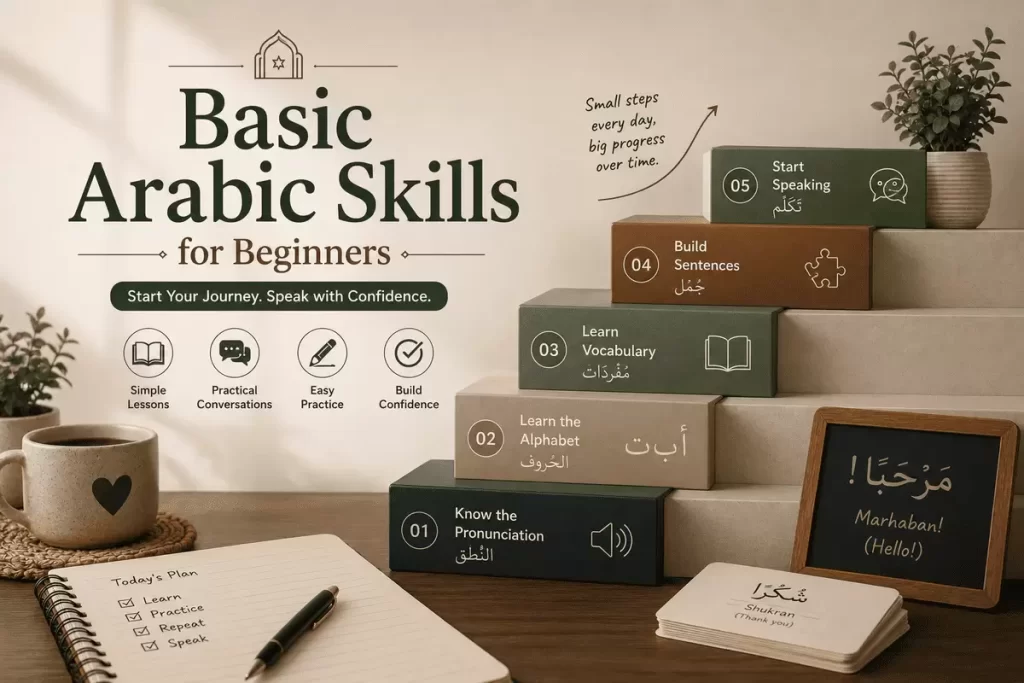
Arabic is not just a language; it is a key that unlocks centuries of civilization, scholarship, and divine revelation. For millions around the world, the desire to learn it runs deep, yet the first step always feels the hardest. The truth is that building basic Arabic skills for beginners is far more approachable than it appears. With the right foundation, every letter learned opens a door, every word memorized builds a bridge, and every sentence understood brings you closer to one of the world’s most powerful and beautiful languages.
What are the basic Arabic skills for beginners?
Mastering a new language begins with a solid foundation, and Arabic is no exception. The basic Arabic skills for beginners typically include alphabet recognition, pronunciation mastery, vocabulary building, and basic grammar structures. Each of these skills is interconnected, meaning progress in one area often enhances understanding in others.
The Arabic language, with its 28-letter alphabet and unique script, may seem daunting at first. However, breaking it down into manageable steps, such as learning letters in groups, practicing pronunciation with native speakers, and applying vocabulary in real-life contexts,s makes the process enjoyable and effective.
- Alphabet recognition: The Arabic script is written from right to left, and recognizing each letter in its distinct shapes (initial, medial, final, and isolated forms) is crucial. For example, the letter “ب” (ba) changes shape depending on its position, such as in “باب” (bāb, meaning “door”).
- Pronunciation mastery: Arabic pronunciation relies heavily on vowel sounds and consonant clusters. Mispronouncing letters like “ق” (qaf) or “ع” (ain) can alter word meanings entirely, making accurate pronunciation essential from the start.
- Vocabulary building: Starting with high-frequency words such as greetings, numbers, and common nouns provides immediate practical use. Knowing “مرحبا” (marhaba) and “شكرا” (shukran) allows beginners to engage in basic conversations right away.
- Basic grammar structures: Understanding sentence patterns, verb conjugations, and noun-adjective agreements is essential. For example, Arabic verbs change based on gender and number, so learning “كتب” (kataba, “he wrote”) versus “كتبت” (katabat, “she wrote”) is key.
Importance of building basic Arabic skills
The decision to learn Arabic extends beyond linguistic curiosity, opening doors to cultural, religious, and professional opportunities. For Muslims, the importance of learning Arabic in Islam cannot be overstated, as the Quran is written in Arabic and understanding its language deepens one’s connection to faith. Beyond religious significance, Arabic is the fifth most spoken language globally, with over 300 million native speakers, unlocking access to literature, media, and business markets across the Middle East and North Africa.
Learners who invest time in mastering these basics gain confidence to navigate everyday situations, from ordering food in an Arabic-speaking country to reading signs and labels. These foundational skills also serve as a springboard for advanced learning, such as studying classical Arabic or specializing in dialects like Egyptian or Levantine Arabic:
- Cultural connection: Understanding even basic phrases allows learners to appreciate traditional music, literature, and storytelling, enhancing cultural immersion and engagement with Arabic heritage.
- Career advancement: In fields like diplomacy, international business, and translation, Arabic proficiency is a valuable asset that can lead to roles in global organizations or Middle Eastern markets.
- Religious and spiritual growth: For Muslims, even basic Arabic skills enable believers to follow along during prayers, understand Quranic verses, and engage more meaningfully with Islamic teachings.
- Travel and communication: Basic Arabic skills foster smoother interactions in Arabic-speaking countries, reducing reliance on translation tools and enriching the overall travel experience.
Overview of the Arabic alphabet

The Arabic alphabet consists of 28 letters, each with unique sounds and shapes that connect to form a fluid and continuous writing system. Unlike English’s Latin-based script, Arabic letters vary in form depending on their position in a word, making systematic practice essential for beginners.
One of the first challenges learners face is distinguishing between similar-looking letters like “ب” (ba) and “ت” (ta), which differ in pronunciation and usage. Some letters, such as “ج” (jim), have sounds that don’t exist in English, requiring special attention and consistent practice with visual aids and writing exercises.
- Letter groups by sound:
- Emphatic letters: “ض” (dhad), “ص” (sad), “ط” (ta), “ظ” (dhah), “ع” (ain), “غ” (ghain), “ق” (qaf) — pronounced with a strong breath and emphasis.
- Soft letters: “ب” (ba), “ت” (ta), “ث” (tha), “ج” (jim), “د” (dal), “ذ” (dhal), “ر” (ra), “ز” (za), “س” (sin), “ش” (sheen), “ف” (fa), “ك” (kaf), “ل” (lam), “م” (meem), “ن” (nun), “ه” (ha), “و” (waw), “ي” (ya) — pronounced with a softer breath.
- Vowels and diacritics: Arabic uses three short vowels: fatha (فَتْحَة), kasra (كَسْرَة), and damma (ضَمَّة), represented above or below letters to indicate pronunciation. For example, “كتاب” (kitāb) has a fatha under the “ب” and a damma above the “ت”.
- Practical writing exercises:
- Write each letter in isolation, then in words.
- Practice connecting letters to form simple words like “كتاب” (kitāb) or “قلم” (qalam).
- Use writing drills to reinforce muscle memory.
- Common mistakes to avoid:
- Confusing similar-looking letters like “ب” (ba) and “ت” (ta).
- Forgetting to write from right to left.
- Overlooking the importance of diacritics in pronunciation.
Understanding Arabic pronunciation
Pronunciation in Arabic is governed by precise rules that distinguish between subtle sounds, some of which do not exist in English. Mastering pronunciation early on ensures clarity in speech and comprehension, and developing an ear for the language’s melodic rhythm is essential for producing sounds accurately.
One of the most critical aspects of Arabic pronunciation is the concept of “emphasis” or ghunnah, where certain letters are pronounced with a guttural sound, such as the “ع” (ain) in “عسل” (asl, “honey”). Other letters like “ح” (ha) require a throaty sound that takes consistent practice to perfect.
Tips for Memorizing Vocabulary Effectively

Building a strong vocabulary is one of the most rewarding aspects of learning Arabic, directly impacting speaking, reading, and comprehension. The key is to move beyond rote memorization and focus on understanding how words function in sentences and conversations.
One of the most effective methods is the spaced repetition system (SRS), which schedules reviews of words at optimal intervals to ensure natural retention. Combined with thematic grouping, where words are organized by topics such as food, travel, or daily routines, vocabulary acquisition becomes both efficient and enjoyable.
Effective vocabulary learning strategies:
- Use mnemonics and word associations: Arabic words often share common roots, simplifying memorization. For example, the root “ك-ت-ب” (k-t-b) appears in “كتاب” (kitāb, “book”), “كاتب” (kātib, “writer”), and “كتب” (kataba, “wrote”).
- Learn words in context: Practice words in full sentences rather than in isolation. For example, instead of memorizing “شكرا” alone, practice “شكرا جزيلا” (shukran jazīlan, “thank you very much”).
- Leverage flashcards and apps: Digital tools like Anki, Memrise, or Quizlet allow learners to create personalized flashcard decks with audio pronunciations to master sounds alongside meaning.
- Practice with native speakers: Engaging in real conversations accelerates vocabulary acquisition and introduces new words in natural contexts.
High-frequency words to prioritize:
- Greetings: “مرحبا” (marhaba), “شكرا” (shukran), “من فضلك” (min fadlak)
- Numbers and time: “واحد” (wāhid), “ثلاثة” (thalātha), “ساعة” (sā’a)
- Common nouns: “ماء” (mā’), “طعام” (ta’am), “منزل” (manzil)
- Verbs of action: “أكل” (akal), “شرب” (sharab), “ذهب” (dhahaba)
Using word roots to expand vocabulary:
- Root “ك-ت-ب”: كتاب (book), كاتب (writer), مكتب (office)
- Root “د-ر-س”: دارس (student), دروس (lessons), مدرسة (school)
- Root “ح-ب-ب”: حبيب (beloved), محبة (love), محب (lover)
- Root “ق-ر-أ”: قراءة (reading), مقرأ (reading place), مقرئ (reader)
Incorporating vocabulary into daily routines:
- Label objects in your home with Arabic sticky notes.
- Listen to Arabic music, podcasts, or TV shows and note down unfamiliar words.
- Keep a vocabulary journal with new words, meanings, and example sentences.
- Review words before bedtime, as sleep enhances memory consolidation.
How does the Arabian Tongue shape your journey of learning the Quran and Arabic?
At Arabian Tongue, we help you understand the Quran deeply and connect with its meanings through simple and effective teaching methods. Our courses are designed to make your learning journey clear, engaging, and spiritually enriching.
Guidance from the Quran and Hadith
قال الله تعالى: “وَكَذَٰلِكَ أَنزَلْنَاهُ حُكْمًا عَرَبِيًّا” — سورة الرعد :37
Allah said: “And thus We have revealed it as an Arabic legislation.” — Ar-Ra’d: 37
قال رسول الله ﷺ: “مَنْ قَرَأَ حَرْفًا مِنْ كِتَابِ اللَّهِ فَلَهُ بِهِ حَسَنَةٌ، وَالْحَسَنَةُ بِعَشْرِ أَمْثَالِهَا” — رواه الترمذي، عن ابن مسعود رضي الله عنه
The Prophet ﷺ said: “Whoever reads a letter from the Book of Allah will receive a reward, and that reward will be multiplied by ten.” — Narrated by At-Tirmidhi, on the authority of Ibn Masud (may Allah be pleased with him)
FAQs
How long does it take to learn basic Arabic skills?
Most beginners can develop a functional grasp of the Arabic alphabet and basic vocabulary within two to three months of consistent daily practice. Reaching conversational confidence, however, typically takes six months to a year, depending on dedication, learning methods, and prior language experience.
What is the best way to learn the Arabic alphabet?
The most effective approach is to group letters by similarity in shape and sound, practicing each letter in its four positional forms through writing drills and visual aids. Combining this with audio recordings of native speakers helps reinforce both recognition and correct pronunciation simultaneously.
How can pronunciation in Arabic be improved?
Consistent listening to native speakers through podcasts, recordings, and conversations is the most effective way to train the ear and develop accurate pronunciation. Focusing on challenging sounds such as ع (ain) and ح (ha) through targeted repetition exercises, ideally with feedback from a qualified teacher, accelerates improvement significantly.
What vocabulary should beginners focus on first?
Beginners should prioritize high-frequency words that appear most often in everyday conversations, such as greetings, numbers, common nouns, and basic action verbs. Learning these words in context rather than in isolation, combined with understanding Arabic root systems, builds a strong and expandable vocabulary foundation from the very start.