
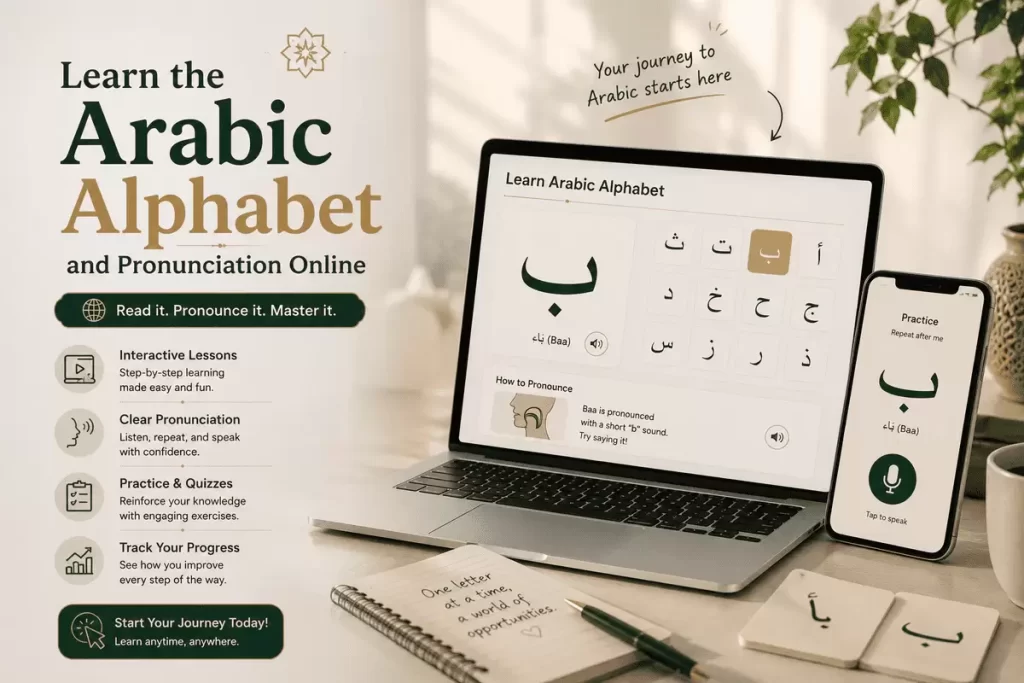
Every great journey in the Arabic language begins with a single letter. The Arabic alphabet is not just a writing system; it is the gateway to one of the richest, most ancient, and most spiritually significant languages in human history. Choosing to learn the Arabic alphabet and pronunciation online today means stepping into a world where every sound carries meaning, every letter has a soul, and every word connects you to over a billion people and fourteen centuries of civilization. Your journey starts here.
How to Learn the Arabic Alphabet and Pronunciation Online?
Mastering the Arabic alphabet is your first step toward unlocking the rich world of the Arabic language. Whether you’re preparing for a trip to an Arabic-speaking country, studying the Quran, or simply fascinated by one of the world’s most influential languages, understanding how to learn the Arabic alphabet and pronunciation online opens doors to new cultural experiences and opportunities.
The beauty of modern technology is that you no longer need to rely solely on traditional textbooks or in-person classes. Online platforms offer interactive tools, audio guides, and personalized learning paths that cater to all skill levels. This guide will walk you through everything you need to know to start your journey, from recognizing the shapes of Arabic letters to perfecting their pronunciation.
Importance of Correct Pronunciation in Arabic
One of the most challenging yet rewarding aspects of learning the Arabic alphabet and pronunciation online is mastering the correct sounds. Arabic is a phonetic language, meaning words are pronounced exactly as they are written, making pronunciation crucial for effective communication.
Incorrect pronunciation can lead to misunderstandings, especially when learning to read Arabic online. For example, the letter “ق” (qaf) has a guttural sound that doesn’t exist in English, and mispronouncing it could turn a simple word like “قلم” (pen) into something entirely different. Similarly, the distinction between “ض” (dhad) and “ظ” (dhah) is subtle but critical in spoken Arabic.
For those interested in the importance of learning Arabic in Islam, accurate pronunciation is not just about communication; it is about respect, as many religious texts and prayers require precise articulation to convey their true meaning. Here is why pronunciation matters:
- Clarity in communication: Speakers will understand you better, reducing frustration in conversations.
- Cultural respect: Proper pronunciation shows respect for the language and its speakers.
- Confidence boost: Mastering sounds correctly builds confidence in your abilities.
- Foundation for fluency: Accurate pronunciation paves the way for advanced grammar and vocabulary.
To achieve this, focus on listening to native speakers and repeating sounds aloud, as audio exercises help train your ear and mouth to produce the correct sounds.
Overview of Arabic Letters and Their Shapes
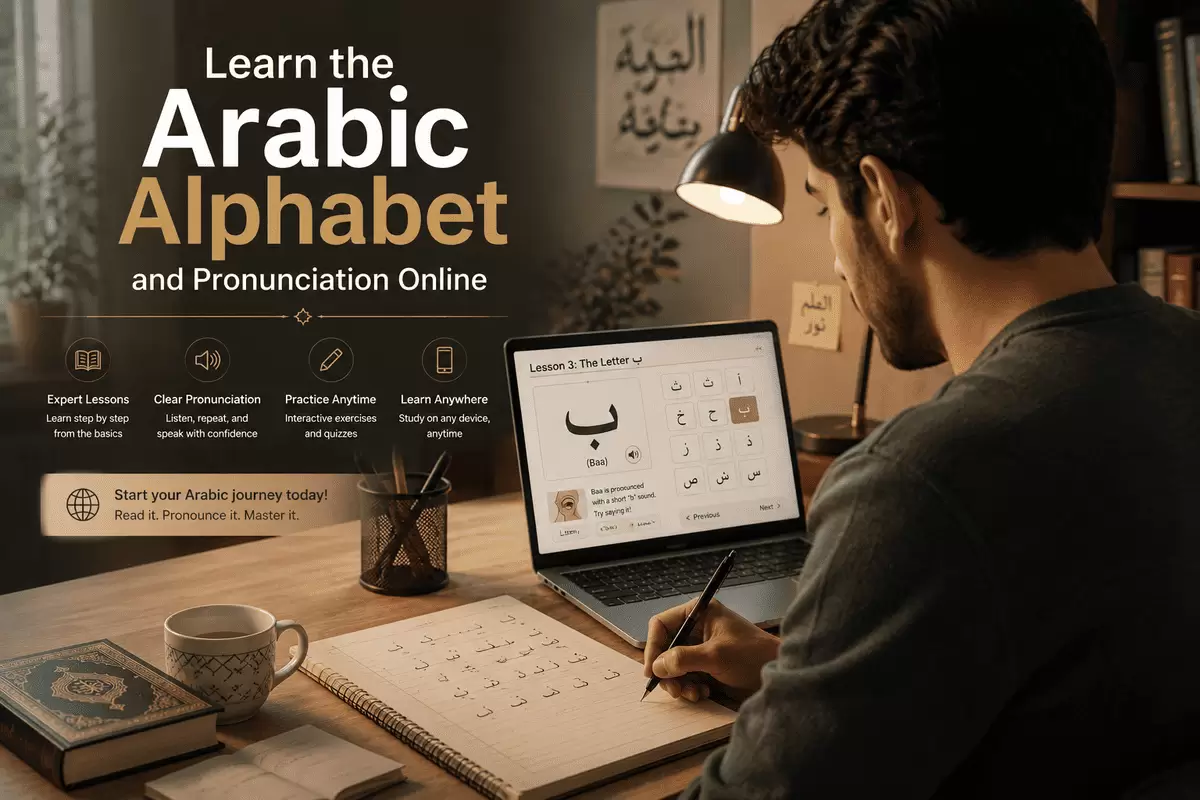
The Arabic alphabet consists of 28 letters, each with unique shapes that change depending on their position in a word. Unlike English, where letters maintain the same shape regardless of position, Arabic letters can transform dramatically. For instance, the letter “ب” (beh) looks different at the beginning, middle, and end of a word:
- Isolated form: How the letter looks when standing alone (e.g., ب).
- Initial form: The shape when the letter starts a word (e.g., بـ).
- Medial form: The shape when the letter appears in the middle of a word (e.g., ـبـ).
- Final form: The shape when the letter ends a word (e.g., ـب).
Some letters like “ا” (alif) and “و” (waw) only appear in three forms, while others, such as “ك” (kaf), have all four. Understanding these variations is key to Arabic reading and writing online.
Many online courses use color-coding or animations to show how letters connect. For example, the letter “ل” (lam) has a distinctive curve that connects to the next letter in a word, and practicing with flashcards or writing exercises helps memorize these shapes more effectively.
If you’re starting with free Arabic lessons online for beginners, focus on mastering a few letters at a time by breaking them into groups based on similarity in shape or sound. For example, the letters “ب” (beh), “ت” (teh), and “ث” (theh) all have straight lines and are pronounced with the tongue touching the upper teeth.
Understanding Letter Positions (Beginning, Middle, End)
The position of a letter in a word drastically changes its appearance, which is why learning the Arabic alphabet and pronunciation online often emphasizes positional drills:
Letters with Four Forms
These letters change shape depending on whether they appear at the beginning, middle, or end of a word, or when standing alone:
- ب (beh): ب (isolated), بـ (initial), ـبـ (medial), ـب (final)
- ك (kaf): ك (isolated), كـ (initial), ـكـ (medial), ـك (final)
Letters with Three Forms
Some letters like “ا” (alif) and “و” (waw) only have three forms because they don’t appear in the middle of a word:
- ا (alif): ا (isolated/initial/final)
- و (waw): و (isolated/initial/final), ـو (final)
Letters with Two Forms
A few letters, such as “ض” (dhad) and “ظ” (dha), have only two forms because they don’t appear at the beginning of a word:
- ض (dhad): ض (isolated/final), ـض (medial/final)
To practice, write out words and focus on how each letter changes:
- Write “كتاب” (kitab) and observe how “ك” changes from initial to medial.
- Write “باب” (bab) and note the final form of “ب.”
- Write “مدرسة” (madrasa) and see how “د” appears in the middle.
Using worksheets or digital tools that highlight these changes can make the process more engaging and effective.
Arabic Sounds and How They Differ from English
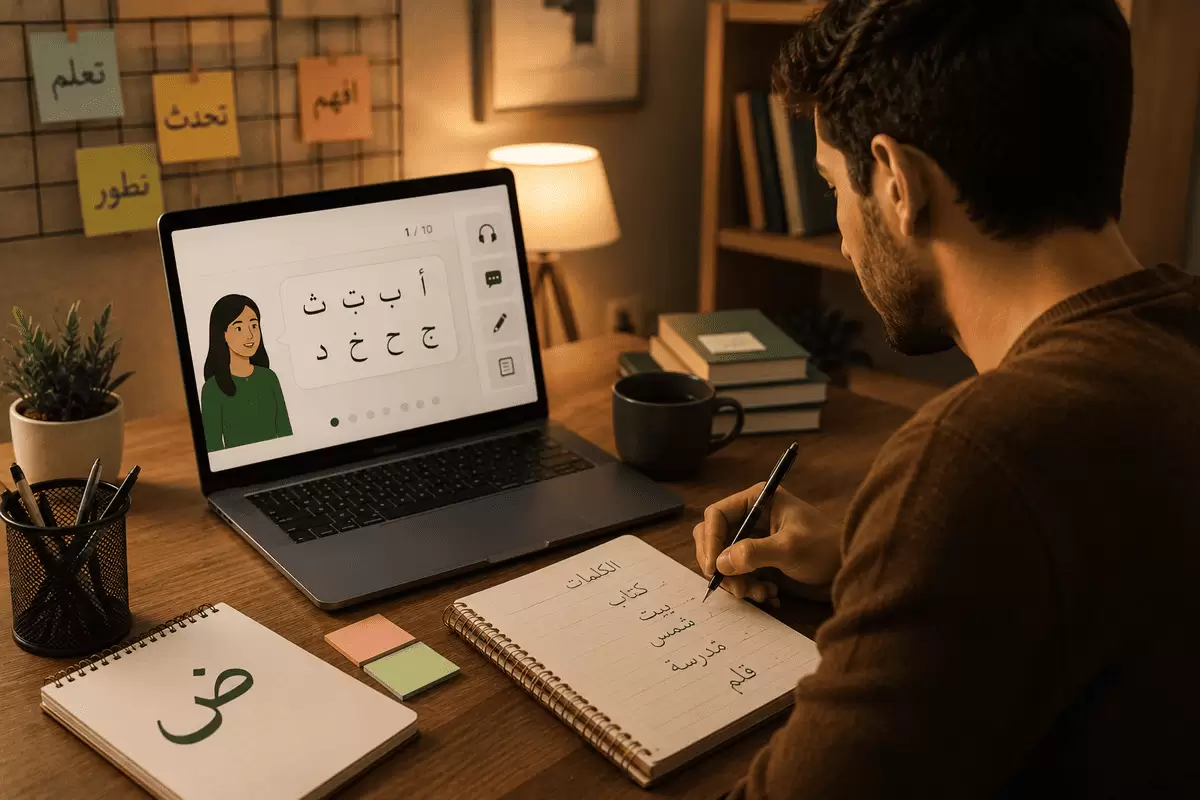
One of the biggest challenges in learning the Arabic alphabet and pronunciation online is mastering sounds that don’t exist in English. Arabic has a rich array of phonemes, some of which require specific tongue and throat placements:
Unique Arabic Sounds
- ع (ain): A guttural sound made deep in the throat, often described as a cross between “a” and “r.”
- ح (ha): A breathy sound, similar to the “ch” in Scottish “loch” but deeper.
- غ (ghain): A throaty “g” sound, like the “r” in French “rouge” but guttural.
- ق (qaf): A harsh “k” sound produced at the back of the throat.
- خ (kha): A sound like the “ch” in Scottish “loch” but with more friction.
Similar but Subtle Differences
- ض (dhad) vs. ظ (dhah): Both are throaty “d” sounds, but “dhah” is slightly softer.
- ص (sad) vs. ث (theh): “Theh” is a sharp “th” like in “think,” while “sad” is a guttural “s.”
- ج (jeem): A soft “j” sound, like the “s” in “treasure” but with the tongue curled back.
To practice these sounds, start by listening to native speakers and mimicking their pronunciation:
- Listen to “عالم” (alam) and focus on the “ع” sound.
- Repeat “حلم” (halm) to practice the “ح” sound.
- Say “غلام” (ghulam) to work on the “غ” sound.
Using a mirror can help visualize tongue and lip positions, and dedicating 10–15 minutes daily to pronunciation drills yields significant improvements over time.
How does the Arabian Tongue shape your journey of learning the Quran and Arabic?
At Arabian Tongue, we help you understand the Quran deeply and connect with its meanings through simple and effective teaching methods. Our courses are designed to make your learning journey clear, engaging, and spiritually enriching.
Guidance from the Quran and Hadith
قال الله تعالى: “إِنَّا أَنزَلْنَاهُ قُرْآنًا عَرَبِيًّا لَّعَلَّكُمْ تَعْقِلُونَ” — سورة يوسف :2
Allah said: “Indeed, We have sent it down as an Arabic Quran that you might understand.” — Yusuf: 2
قال رسول الله ﷺ: “تَعَلَّمُوا الْعَرَبِيَّةَ وَعَلِّمُوهَا النَّاسَ” — رواه الطبراني، عن عمر بن الخطاب رضي الله عنه
The Prophet ﷺ said: “Learn Arabic and teach it to the people.” — Narrated by At-Tabarani, on the authority of Umar ibn Al-Khattab (may Allah be pleased with him)
FAQs
How long does it take to learn the Arabic alphabet?
Most beginners can recognize and write all 28 Arabic letters within two to four weeks of consistent daily practice. However, mastering their different positional forms and correct pronunciation typically takes a few additional months of dedicated effort.
Are online Arabic courses effective for beginners?
Online Arabic courses are highly effective for beginners, offering interactive tools, audio guides, and structured lesson plans that cater to all skill levels. The flexibility to learn at your own pace, combined with instant feedback and access to native speaker recordings, makes online learning a practical and efficient choice.
How can the pronunciation of Arabic letters be improved?
The most effective approach is to listen to native speakers repeatedly and mimic their pronunciation, paying close attention to tongue and throat placement for sounds that don't exist in English. Dedicating 10–15 minutes daily to focused pronunciation drills, using a mirror to monitor lip and tongue positions, significantly accelerates improvement over time.
Can I learn the Arabic alphabet without a teacher?
Yes, self-study is entirely possible with the right resources, as structured online courses, audio tools, and interactive exercises provide comprehensive guidance through the alphabet and its positional forms. However, occasional feedback from a qualified teacher is recommended to correct any pronunciation habits early, before they become difficult to unlearn.