
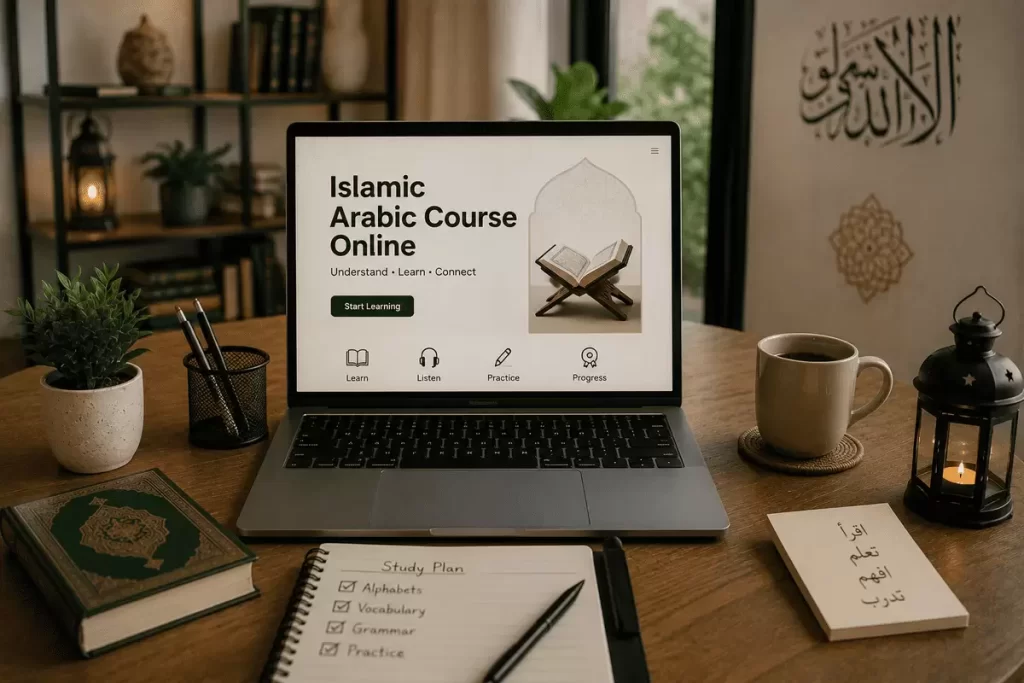
Every Muslim recites Arabic daily, yet most have never truly understood what they are saying. The gap between recitation and comprehension is one of the most profound disconnects in the lives of millions of believers worldwide. An Islamic Arabic course online exists to close that gap, transforming Arabic from a series of familiar sounds into a living language that speaks directly to the heart, unlocking the Quran, the Hadith, and fourteen centuries of Islamic wisdom.
What is Islamic Arabic?
Islamic Arabic refers to the specific dialect and linguistic style used in Islamic texts, particularly the Quran and Hadith. Unlike Modern Standard Arabic (MSA), Islamic Arabic focuses on the classical form of the language as it was spoken during the time of the Prophet Muhammad ﷺ, preserving the original meanings and nuances intended by the authors.
For those seeking to engage with Islamic teachings, learning Islamic Arabic is not just about acquiring a new language; it is about connecting with the spiritual and cultural heritage of Islam. The Arabic used in the Quran and Hadith is rich in poetic and rhetorical devices often lost in translation, and by mastering it, learners gain direct access to the original texts, allowing them to pray, recite, and study with greater accuracy and devotion.
At its core, Islamic Arabic is a bridge between the past and present, enabling modern Muslims to engage with the timeless wisdom of their faith in its purest form. Understanding the distinctions between Islamic Arabic and other forms of the language is crucial for anyone looking to embark on this spiritual and linguistic journey.
Importance of learning Arabic for Islamic studies
The importance of learning Arabic for Islamic studies cannot be overstated. Arabic is not merely a language; it is the key to unlocking the profound meanings of the Quran, the Hadith, and centuries of Islamic scholarship. Without it, learners risk missing the nuances, rhetorical depth, and spiritual dimensions that translations simply cannot replicate:
- Direct connection with the Quran: Reciting and understanding the Quran in its original Arabic provides a spiritual experience that transcends translation, preserving the rhythmic structure, melodic flow, and intricate grammar deeply intertwined with its message.
- Accurate understanding of Hadith: Arabic is the language of the Prophet’s ﷺ sayings and actions, and without it, learners risk misinterpreting nuances that directly affect their spiritual practice and daily conduct.
- Appreciation of linguistic depth: Arabic words carry layers of meaning beyond their literal translation. For example, the word “Islam” itself encompasses dimensions of meaning that no single translation can fully convey.
- Cultural and historical immersion: Studying Arabic connects learners to the civilization that produced the world’s greatest scholars, poets, and thinkers, enriching both religious knowledge and cultural heritage.
- Access to original scholarly works: Proficiency in Arabic opens doors to classical Islamic texts and contemporary scholarly works in theology, law, and history that remain inaccessible without the language.
Benefits of taking an Islamic Arabic course online

Enrolling in an Islamic Arabic course online offers numerous advantages that make it an ideal choice for learners at all levels:
- Flexibility: Online courses allow learners to study at their own pace, fitting lessons around work, family, and other commitments without the constraints of fixed class timings.
- Access to high-quality resources: Structured curricula designed by experienced instructors include interactive lessons, video tutorials, practice exercises, and audio recordings of Quranic recitation that enhance listening and pronunciation skills.
- Cost-effectiveness: Online courses are significantly more affordable than traditional language schools, with many platforms offering comprehensive learning packages and even free Arabic lessons online for beginners to explore the language before committing.
- Global community: Discussion forums, live Q&A sessions, and group projects connect learners with peers and instructors from around the world, exposing them to different accents, dialects, and cultural perspectives that enrich the overall learning experience.
Quranic Arabic vs Modern Standard Arabic
While both Quranic Arabic and Modern Standard Arabic share a common linguistic root, they serve distinct purposes and have evolved differently over time. Recognizing these differences is essential for learners seeking to engage authentically with Islamic texts:
| Quranic Arabic | Modern Standard Arabic (MSA) | |
| Purpose | Religious and scholarly study of the Quran and Hadith | Formal communication, media, academic texts, and official documents |
| Time Period | Reflects the linguistic norms of the 7th century Arabia | Contemporary formal Arabic is used across the modern Arab world |
| Grammar | Highly structured classical grammar, including unique constructions like the jussive verb form | Simplified grammar based on Classical Arabic for modern accessibility |
| Vocabulary | Archaic and specialized theological terms such as فقه, كلام, and تفسير | Incorporates modern terms like “كومبيوتر” and “إنترن.ت” |
| Style | Poetic and rhetorical, employing parallelism, inversion, and metaphorical language | Straightforward and practical, suited for modern communication |
| Who Studies It | Muslims and scholars seeking deep engagement with Islamic texts | Anyone learning Arabic for communication, travel, or professional use |
| Sufficiency for Islamic Study | Essential and irreplaceable for accurate Quranic interpretation | Insufficient alone for a thorough study of Islamic texts |
Essential Arabic grammar for understanding Islamic texts

To effectively engage with Islamic texts, learners must develop a strong foundation in Arabic grammar, particularly the aspects unique to Quranic Arabic. Grammar serves as the backbone of the language, providing the rules and structures that govern how words are formed, combined, and used in sentences. Five critical areas define this foundation:
1. Verb Conjugations and Moods in Quranic Arabic
Arabic verbs are among the most complex elements of the language, and Quranic Arabic introduces unique forms that differ from Modern Standard Arabic. Key verb forms and moods that appear frequently in Islamic texts include:
- Jussive mood (المجزوم): Used for commands, prohibitions, and subjunctive clauses. Example: “Do not worship except Allah” (لا تعبدوا إلا الله).
- Imperative mood (الأمر): Direct authoritative commands, such as “Pray to your Lord” (اصلي ربك).
- Narrative past tense (الماضي): Describes completed actions foundational to the Quran’s historical and prophetic narratives, such as “Allah created the heavens and earth” (خلق الله السموات والأرض).
- Active and passive participles (المصادر والمشتقات): Describe ongoing actions or states, such as “the one who believes” (المؤمن) and “the one who is guided” (المهتدى).
2. Noun Cases and Sentence Structure
Arabic nouns change their endings to indicate their grammatical role in a sentence. The three primary noun cases are:
- Nominative case (المرفوع): Marks the subject. Example: “Allah is the Most Merciful” (الله الرحمن).
- Accusative case (المنصوب): Marks the direct object. Example: “We created man from clay” (خلقنا الإنسان من طين).
- Genitive case (المجرور): Indicates possession or objects of prepositions. Example: “The house of Allah” (بيت الله).
3. Particles and Conjunctions in Quranic Arabic
Particles and conjunctions serve as the connective tissue of Quranic Arabic, each carrying subtle meanings that alter tone or emphasis:
- Prepositions (حروف الجر): Such as “في” (in), “من” (from), and “إلى” (to), introducing phrases that modify nouns.
- Conjunctions (حروف العطف): Such as “و” (and), “أو” (or), and “ثم” (then), connecting clauses and ideas.
- Negation particles (حروف النفي): Such as “ما” (not) and “لا” (do not). Example: “Do not associate anything with Allah” (ولا تشركوا بالله شيئا).
- Interrogative particles (حروف الاستفهام): Such as “هل” (whether) and “ما” (what), introducing questions and rhetorical statements.
4. Unique Quranic Vocabulary and Root-Based Learning
Quranic Arabic includes a vast vocabulary built on triconsonantal roots that carry core meanings:
- Triconsonantal roots (الأصوات الثلاثية): Most Arabic words derive from three consonants, such as “ق-ر-أ” (to read) or “س-م-ع” (to hear).
- Derived forms (المشتقات): The root “ح-م-د” (to praise) gives “حمد” (praise), “محمود” (praised), and “محمد” (one who is praised).
- Quran-specific terms: Words unique to the Quran, such as “الرحمن” (The Most Merciful) and “المنان” (The Bestower of Favors), carry theological meanings not found in everyday Arabic.
5. Pronunciation and Tajweed for Accurate Recitation
Tajweed ensures the Quran is recited with correct articulation, rhythm, and melody. Key aspects include:
- Harakat (vowel marks): Short vowels (fatha, kasra, damma) indicate how letters should be pronounced.
- Tashkeel (vocalization): Long vowels and their combinations affect pronunciation, such as “آ” pronounced as a long “a” sound.
- Qalqalah (echo letters): Letters like “ق” (qaf), “ط” (ta), and “ب” (ba) produce a vibrating sound when pronounced at rest.
How does the Arabian Tongue shape your journey of learning the Quran and Arabic?
At Arabian Tongue, we help you understand the Quran deeply and connect with its meanings through simple and effective teaching methods. Our courses are designed to make your learning journey clear, engaging, and spiritually enriching.
Guidance from the Quran and Hadith
قال الله تعالى: “فَلَوْلَا نَفَرَ مِن كُلِّ فِرْقَةٍ مِّنْهُمْ طَائِفَةٌ لِّيَتَفَقَّهُوا فِي الدِّينِ وَلِيُنذِرُوا قَوْمَهُمْ إِذَا رَجَعُوا إِلَيْهِمْ” — سورة التوبة: ١٢٢
Allah said: “So why did not a group from every section of them go out to obtain understanding in religion and to warn their people when they return to them.” — At-Tawbah: 122
قال رسول الله ﷺ: “مَنْ يُرِدِ اللَّهُ بِهِ خَيْرًا يُفَقِّهْهُ فِي الدِّينِ” — رواه البخاري ومسلم، عن معاوية بن أبي سفيان رضي الله عنه
The Prophet ﷺ said: “Whoever Allah wishes good for, He gives him understanding of the religion.” — Narrated by Al-Bukhari and Muslim, on the authority of Muawiyah ibn Abi Sufyan (may Allah be pleased with him)
FAQs
Can Islamic Arabic be learned effectively online?
Yes, online Islamic Arabic courses have proven highly effective through structured curricula, qualified instructors, and multimedia resources that replicate and often surpass the traditional classroom experience. The key is choosing a reputable platform that combines Tajweed training, grammar instruction, and Quranic vocabulary in a progressive and well-organized program.
What skills are taught in an Islamic Arabic course?
A comprehensive Islamic Arabic course covers alphabet recognition, Tajweed rules, Quranic grammar, including verb conjugations and noun cases, root-based vocabulary, and the ability to read and interpret Islamic texts. Advanced courses also develop skills in Quranic exegesis, classical prose analysis, and understanding the theological terminology of the Quran and Hadith.
How long does it take to learn Islamic Arabic?
Most learners can grasp foundational skills such as the alphabet, basic grammar, and common Quranic vocabulary within six months to a year of consistent study. Reaching a level where one can read and interpret Islamic texts independently typically requires two to three years of dedicated, structured learning combined with regular practice and recitation.
Are online Islamic Arabic courses suitable for children and adults?
Yes, reputable online platforms offer courses tailored to both age groups, with child-friendly programs using engaging visuals and simplified explanations, while adult courses focus on grammatical depth and theological context. The self-paced nature of online learning makes it equally accessible and effective for learners of all ages and backgrounds.