
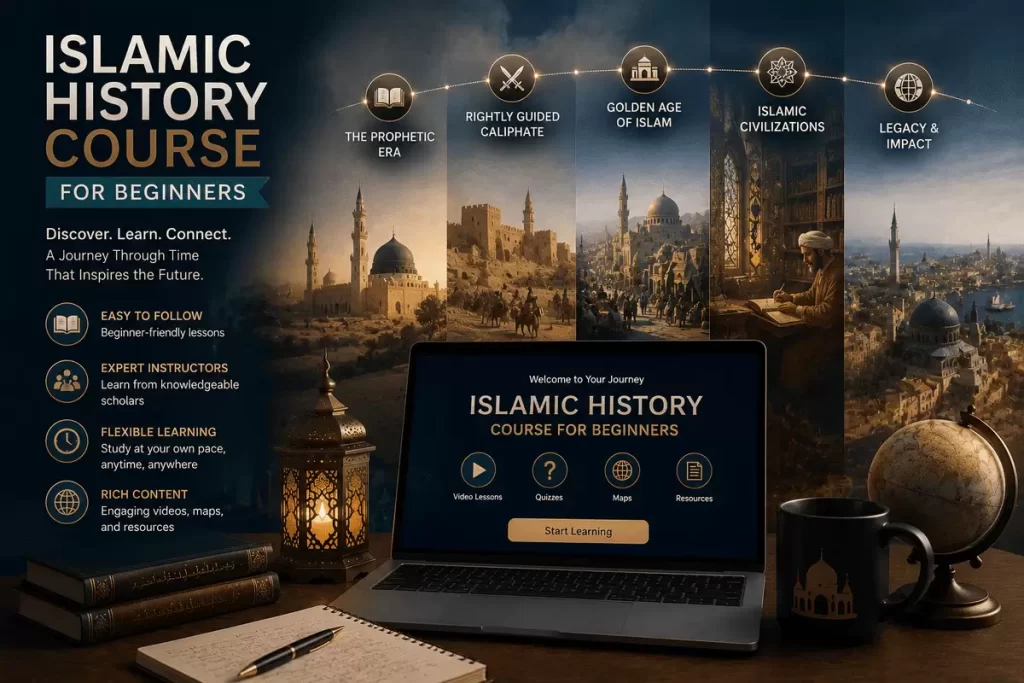
Fourteen centuries of civilization, scholarship, prophecy, and transformation, all waiting to be understood. Islamic history is not a collection of distant dates and forgotten names; it is the living story of how a single message changed the course of humanity forever. An Islamic history course for beginners is your invitation to that story, from the streets of Mecca before revelation, to the empires that carried its light across continents. Every chapter you read will change the way you see the world.
Why learning Islamic history is important?
Understanding Islamic history is not just an academic exercise; it is a journey into the roots of one of the world’s most influential civilizations. An Islamic history course for beginners serves as a foundation, offering clarity on how Islam shaped global politics, science, art, and social structures. Without this knowledge, many miss the context behind Islamic teachings, traditions, and the modern challenges faced by Muslim communities worldwide.
The significance of studying Islamic history extends beyond religious boundaries, fostering critical thinking by examining how societies evolved under Islamic rule. By exploring the past, students gain insights into present-day issues such as cultural preservation, interfaith dialogue, and the role of Islam in contemporary society:
- Strengthening faith and identity: Understanding the historical context of Islamic teachings deepens personal faith, fosters a sense of belonging, and helps distinguish between authentic traditions and modern misconceptions.
- Cultural and intellectual growth: Islamic history reveals contributions to mathematics, medicine, and philosophy, connecting historical events from the Umayyad and Abbasid eras to modern Islamic thought and practices.
- Global perspective and interfaith understanding: Studying Islamic history provides context for interactions between Islamic and non-Islamic civilizations, encouraging respect for diversity and showcasing the multicultural nature of early Islamic societies.
- Practical application in daily life: Historical knowledge aids in interpreting Quranic verses and Hadith in their original context, builds resilience by understanding early Muslims’ struggles, and equips learners with tools for informed discussions about Islamic heritage.
Arabia before Islam
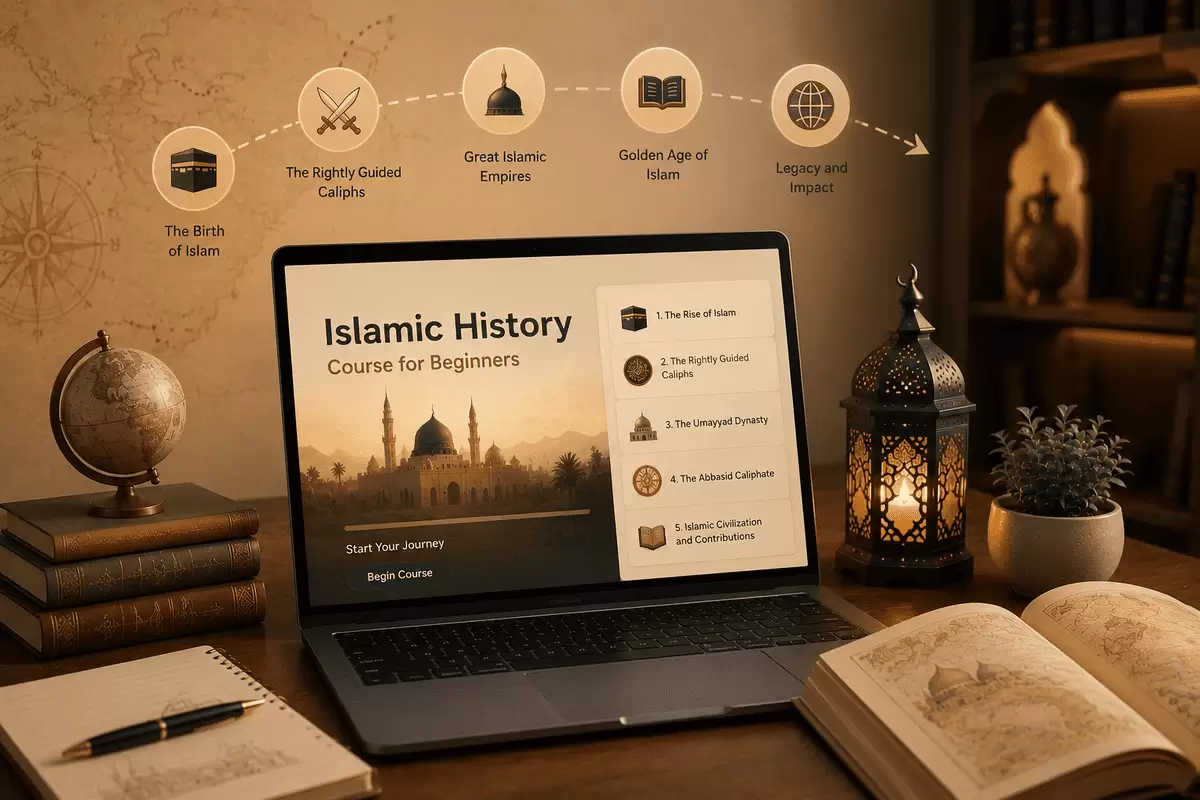
Before the rise of Islam, the Arabian Peninsula was a region of diverse tribes, trade routes, and cultural exchanges. This era, known as Jahiliyyah (Age of Ignorance), was marked by polytheistic beliefs, tribal conflicts, and a thriving merchant economy. Cities like Mecca and Medina became central hubs for trade, pilgrimage, and cultural exchange, long before Islam unified the region under a single faith.
The social structure of pre-Islamic Arabia was tribal, with each group following its own customs, deities, and leadership. The Quraysh tribe, based in Mecca, was particularly influential due to its control over the Kaaba, a sacred site that attracted pilgrims from across the region. Despite the chaos, there were also pockets of wisdom and poetry, with figures like the poet Imru’ al-Qais gaining fame for their eloquence.
1. Religious landscape of pre-Islamic Arabia:
- Polytheism was dominant, with tribes worshipping idols like Hubal, Lat, and Manat.
- Some tribes practiced monotheistic beliefs, such as the Hanifs, who worshipped Allah alone.
- The Kaaba in Mecca housed hundreds of idols and served as a major pilgrimage site even before Islam.
2. Economic and trade significance:
- Mecca’s location made it a key stop on the Incense Route, connecting Arabia to Rome, Persia, and India.
- Trade caravans transported spices, silk, and precious metals, enriching merchant families.
- The Quraysh tribe’s wealth came from managing the Kaaba and taxing pilgrims.
3. Cultural and literary contributions:
- Oral poetry was highly valued, with poets like Tarfa and Al-A’sha serving as storytellers and historians.
- Tribal honor and revenge were central themes in pre-Islamic literature.
- Festivals like the Majlis were common social events for poetry and debate.
4. Challenges and inequalities:
- Female infanticide and the burial of daughters alive were practiced in some tribes.
- Orphans and the poor were often marginalized, lacking protection under tribal laws.
- Slavery existed, though its scale varied between tribes.
Life of Prophet Muhammad (PBUH)
The life of Prophet Muhammad ﷺ is the cornerstone of Islamic history, offering lessons in leadership, morality, and resilience. Born in Mecca in 570 CE, he was an orphan raised by his grandfather and later his uncle, Abu Talib. Known from a young age for his honesty and integrity, he earned the nickname Al-Amin (The Trustworthy), and his marriage to Khadijah provided him with stability and support as he began receiving divine revelations.
The revelation of the Quran began in 610 CE when the angel Gabriel appeared to him in the Cave of Hira, marking the start of his prophethood. His message of monotheism faced fierce opposition from the Quraysh tribe, leading to years of persecution, yet he continued to preach patience, compassion, and justice throughout.
1. Early life and character traits:
- Orphaned at a young age and raised with strong moral values by his uncle.
- Worked as a merchant and became a mediator in Mecca, known for fairness.
- Spent time in seclusion in the Cave of Hira, reflecting on life’s purpose.
2. The call to prophethood:
- Received his first revelation at age 40, beginning with the verse: “Read in the name of your Lord.”
- Began preaching monotheism publicly, challenging the polytheistic norms of Mecca.
- Faced ridicule, physical abuse, and economic boycotts from the Quraysh elite.
3. Migration to Medina and the formation of the first Islamic state:
- Migrated to Medina in 622 CE (the Hijrah) after years of persecution.
- Established the first Islamic state based on justice, charity, and brotherhood.
- Unified the tribes of Medina under the Constitution of Medina.
4. Later years and legacy:
- Conquered Mecca peacefully in 630 CE, destroying the idols in the Kaaba.
- Delivered his final sermon emphasizing equality, accountability, and the unity of humanity.
- Passed away in 632 CE, leaving behind a legacy of compassion, wisdom, and a complete way of life.
Islamic history course for beginners
The early years of Islam were marked by rapid growth in both faith and territory, with the Constitution of Medina laying the foundation for a society built on justice, mutual defense, and the protection of religious minorities.
1. Key diplomatic and military campaigns:
- Treaty of Hudaybiyyah (628 CE): Demonstrated strategic patience and later led to the peaceful conquest of Mecca.
- Conquest of Mecca (630 CE): Muslims entered without bloodshed, marking the end of polytheism in the city.
- Battle of Khaybar (628 CE): Secured Medina’s food supplies and strengthened the Muslim economy.
- Farewell Pilgrimage (632 CE): Emphasized unity, equality, and the rejection of tribalism.
2. Expansion under the Rightly Guided Caliphs:
- Abu Bakr: Consolidated the community through the Riddah Wars.
- Umar ibn al-Khattab: Expanded into Persia, Syria, and Egypt.
- Uthman ibn Affan: Extended reach into North Africa and the Balkans.
- Ali ibn Abi Talib: Reinforced Islamic legal principles amid internal conflicts.
3. Cultural and intellectual growth:
- Translation of Greek and Persian texts at Bayt al-Hikma.
- Scientific contributions by Al-Khwarizmi and Ibn Sina.
- Architectural landmarks include the Great Mosque of Damascus and the Dome of the Rock.
- Development of fiqh schools by Imam Abu Hanifa and Imam Malik.
4. Challenges and internal divisions:
- The First Fitna led to the rise of the Umayyad Caliphate.
- Disputes over leadership gave rise to Shia and Sunni Islam.
- Economic disparities created social tensions over the distribution of Fay.
- Rapid cultural assimilation raised questions about the Arabic language and Islamic identity.
How does the Arabian Tongue shape your journey of learning the Quran and Arabic?
At Arabian Tongue, we help you understand the Quran deeply and connect with its meanings through simple and effective teaching methods. Our courses are designed to make your learning journey clear, engaging, and spiritually enriching.
Guidance from the Quran and Hadith
قال الله تعالى: “لَقَدْ كَانَ فِي قَصَصِهِمْ عِبْرَةٌ لِّأُولِي الْأَلْبَابِ” — سورة يوسف: ١١١
Allah said: “There was certainly in their stories a lesson for those of understanding.” — Yusuf: 111
قال رسول الله ﷺ: “خَيْرُ النَّاسِ قَرْنِي، ثُمَّ الَّذِينَ يَلُونَهُمْ، ثُمَّ الَّذِينَ يَلُونَهُمْ” — رواه البخاري ومسلم، عن عبدالله بن مسعود رضي الله عنه
The Prophet ﷺ said: “The best of people are my generation, then those who follow them, then those who follow them.” — Narrated by Al-Bukhari and Muslim, on the authority of Abdullah ibn Masud (may Allah be pleased with him)
FAQs
Why is Islamic history important to study?
Studying Islamic history provides essential context for understanding Islamic teachings, traditions, and the modern challenges faced by Muslim communities worldwide. It also fosters critical thinking, interfaith understanding, and a deeper connection to faith and cultural identity.
Who was Prophet Muhammad ﷺ?
Prophet Muhammad ﷺ was born in Mecca in 570 CE and is the final messenger of Allah, receiving divine revelation at age 40 through the angel Gabriel. His life of compassion, justice, and wisdom transformed the Arabian Peninsula and laid the foundation for a civilization that would shape global history across centuries.
What were the major events in early Islamic history?
The major events include the first revelation in the Cave of Hira, the Hijrah to Medina, the establishment of the first Islamic state, the peaceful conquest of Mecca, and the expansion under the Rightly Guided Caliphs into Persia, Syria, Egypt, and North Africa. These events collectively shaped the political, cultural, and spiritual foundations of the Islamic world.
What is the significance of the Hijrah?
The Hijrah marked the beginning of the Islamic calendar and the establishment of the first Muslim state in Medina, representing a turning point from persecution to empowerment. It demonstrated the values of sacrifice, brotherhood, and trust in divine guidance, and its legacy continues to inspire Muslims as a symbol of resilience and transformation.