
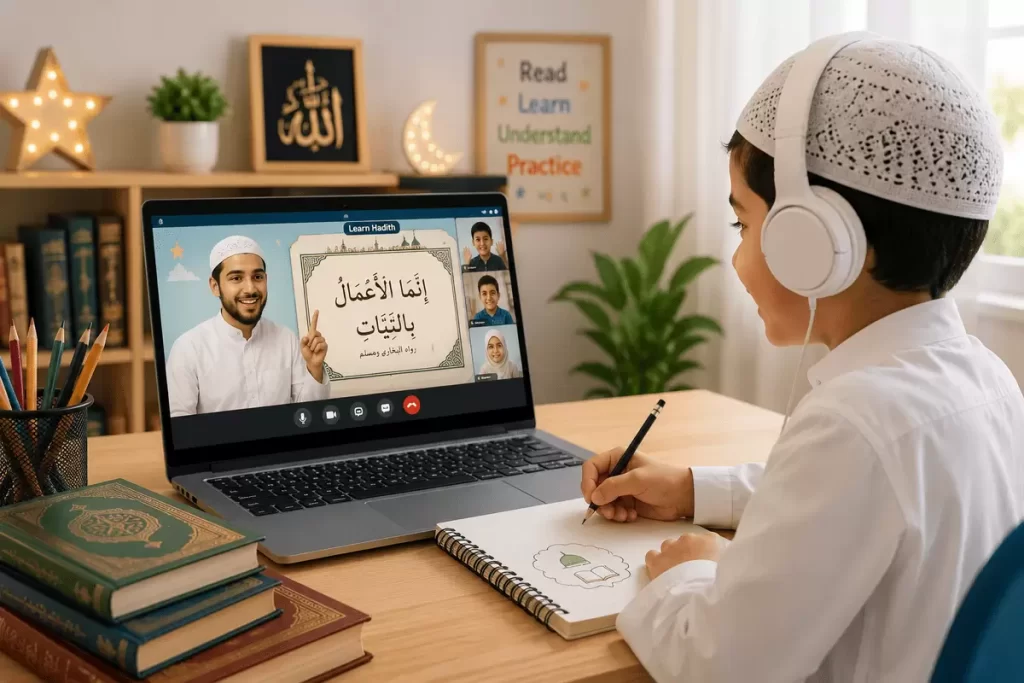
Every parent dreams of raising a child who carries the wisdom of the Prophet (PBUH) in their heart. The good news is that you no longer need to wait for the perfect Islamic school or the right teacher to walk through your door. Today, you can learn hadith online for kids through engaging, structured, and age-appropriate programs that bring the Prophet’s teachings to life. The earlier a child connects with these lessons, the deeper and more lasting that connection becomes.
Importance of Learning Hadith at a Young Age
The foundation of a child’s spiritual and moral development begins with early exposure to Islamic teachings. Unlike adults who may approach religious studies with preconceived notions, children absorb knowledge naturally, making this the perfect age to instill values rooted in the Prophet’s (PBUH) wisdom. Early engagement with hadith is not just about memorization; it is about nurturing empathy, discipline, and a sense of purpose.
Research in child psychology confirms that early learning enhances retention and comprehension. Stories from the Prophet’s (PBUH) life, such as his kindness to animals or his patience in adversity, become relatable lessons that children can apply in their daily lives. Parents and educators who prioritize hadith education are essentially giving their children a toolkit for navigating life’s challenges with Islamic wisdom.
Another critical aspect is the role of hadith in preserving the Sunnah, which complements the Quran. While the Quran is the literal word of Allah, hadith provides the practical application of its teachings. When children learn about hadith, they begin to see Islam as a holistic way of life, one that balances spirituality with worldly responsibilities. This early exposure also fosters a sense of identity and belonging, especially in a world where moral values are often overshadowed by materialism.
Benefits of Online Hadith Learning for Children

The digital age has revolutionized education, making online hadith learning for children more accessible and engaging than ever. Online platforms offer unparalleled convenience, allowing children to learn at their own pace, revisit lessons, and engage with interactive content regardless of location or schedule.
- Flexibility: Children can learn at their own pace and revisit lessons as needed, ideal for families with busy schedules or limited access to Islamic schools.
- Multimedia Tools: Animations, videos, and gamified learning make the process engaging and improve retention, as children remember information better through dynamic and interactive formats.
- Qualified Scholars Worldwide: Online platforms connect children with tutors who specialize in teaching hadith in a child-friendly manner using age-appropriate language and storytelling techniques.
- Relatable Examples: Tutors simplify complex concepts through real-life scenarios, helping children grasp the relevance of hadith in their everyday interactions.
- Progress Tracking: Online courses provide tools for parents to monitor their child’s development and adjust the learning pace accordingly.
What Makes Hadith Lessons Kid-Friendly
Not all hadith lessons are created equal. The most effective programs for children understand that they learn best through play, storytelling, and repetition. Here is what sets kid-friendly hadith lessons apart.
- Storytelling Approach: Instead of presenting hadith as dry texts, lessons are framed as stories that capture attention and make teachings memorable. For example, the hadith about the Prophet (PBUH) smiling at his companions can be turned into an interactive tale where children imagine themselves in the scene.
- Interactive Activities: Games, puzzles, and coloring activities related to hadith reinforce learning while keeping children engaged, such as matching hadith quotes to their meanings or completing puzzles featuring scenes from the Prophet’s (PBUH) life.
- Visual Aids: Illustrations, videos, and infographics help explain abstract concepts, making it easier for children to understand and retain what they have learned.
- Positive Reinforcement: Badges, certificates, and virtual rewards celebrate milestones such as memorizing a new hadith, boosting confidence, and making the learning process enjoyable.
- Simplified Language: Complex Islamic terms are broken down into simple, relatable phrases, ensuring that children grasp concepts without feeling overwhelmed.
How Can Kids Learn Hadith Online Effectively?

Effective hadith learning for children requires a structured approach that balances engagement with consistency.
1. Choose the Right Platform :
Look for platforms that offer age-appropriate content, qualified tutors with experience in teaching children, interactive tools like quizzes and videos, and progress tracking for parents.
2. Set a Routine :
Dedicate a specific time each day for hadith lessons, whether 15 minutes after school or during weekend mornings. A routine helps children develop a habit and ensures steady progress.
3. Use Multisensory Learning :
Combine visual, auditory, and kinesthetic methods by watching hadith story videos, listening to audio recitations, and writing or drawing scenes from the hadith.
4. Encourage Participation :
Make learning a family activity where parents join their children for lessons, ask questions, and discuss what they have learned. This reinforces the material while strengthening family bonds.
5. Reinforce with Real-Life Applications :
Help children connect hadith lessons to their daily lives. If they learn a hadith about kindness, encourage them to perform an act of kindness that day, deepening their understanding and making lessons more meaningful.
6. Track Progress :
Monitor your child’s advancement and celebrate small victories such as memorizing a new hadith or understanding a new concept to keep motivation high.
Age-Appropriate Teaching Methods
Teaching hadith to children requires adapting methods to suit different age groups. Here is how to tailor lessons for children of varying ages.
Ages 3–6 (Preschoolers)
- Focus on storytelling and simple hadith with clear moral lessons.
- Use puzzles, coloring books, and songs to introduce basic concepts.
- Keep sessions short, between 5 and 10 minutes, to match their attention span.
Ages 7–10 (Early Elementary)
- Introduce short hadith with clear meanings, such as those about honesty or gratitude.
- Use interactive games like matching hadith quotes to their meanings.
- Encourage role-playing scenes from the Prophet’s (PBUH) life.
Ages 11–14 (Pre-Teens)
- Begin memorization of shorter hadith with the help of mnemonics and rhymes.
- Discuss the context and lessons behind each hadith to deepen understanding.
- Use debates or discussions to explore the practical applications of hadith in modern life.
Ages 15+ (Teens)
- Transition to a detailed study of hadith classifications, including Sahih, Hasan, and Da’if.
- Encourage critical thinking by discussing the reliability and relevance of hadith.
- Introduce advanced memorization techniques such as spaced repetition and chunking.
How does the Arabian Tongue shape your journey of learning the Quran and Arabic?
At Arabian Tongue, we help you understand the Quran deeply and connect with its meanings through simple and effective teaching methods. Our courses are designed to make your learning journey clear, engaging, and spiritually enriching.
Guidance from the Quran and Hadith
قال الله تعالى: «يَا أَيُّهَا الَّذِينَ آمَنُوا قُوا أَنفُسَكُمْ وَأَهْلِيكُمْ نَارًا» — سورة التحريم، الآية 6
Allah (SWT) said: “O you who believe, protect yourselves and your families from a Fire.” — Surah At-Tahrim:6
قال رسول الله صلى الله عليه وسلم: «مُرُوا أَوْلَادَكُمْ بِالصَّلَاةِ وَهُمْ أَبْنَاءُ سَبْعِ سِنِينَ» — سنن أبي داود
The Prophet (PBUH) said: “Command your children to pray when they are seven years old.” — Sunan Abi Dawud
FAQs
What teaching methods work best for children?
Storytelling, interactive games, and multisensory activities such as drawing, listening, and role-playing are the most effective methods for teaching children. Combining these approaches with positive reinforcement like badges and certificates keeps children motivated and makes learning enjoyable.
How long should kids study hadith each day?
Preschoolers benefit from sessions as short as 5–10 minutes, while older children can handle 15–30 minutes of focused study. Consistency matters more than duration, so a short daily session is far more effective than occasional longer ones.
Should kids focus on memorizing or understanding hadith first?
Understanding should always come before memorization, as children retain information better when they grasp its meaning and relevance. Once a child understands the lesson behind a hadith, memorizing its words becomes a natural and effortless next step.
What qualifications should a hadith tutor for kids have?
A hadith tutor for children should have a solid background in Islamic sciences, ideally with an ijazah or certification from a recognized scholar. Experience in teaching children is equally important, as the ability to simplify complex concepts and maintain a child's engagement requires specialized pedagogical skills.