

Every time you open the Quran, you are holding the literal words of Allah, and every word deserves to be recited as it was revealed. Yet for many Muslims, the rules of Tajweed feel distant, complicated, or simply out of reach. The truth is that you can learn Tajweed online for beginners step by step, at your own pace, from the comfort of your home. All it takes is the right guidance, a little patience, and the willingness to begin.
What does “Learn Tajweed Online For Beginners” mean?
The phrase “learn Tajweed online for beginners” refers to acquiring the fundamental rules of Tajweed, the art of reciting the Quran correctly, through structured digital learning methods. Tajweed is not just about reading the Quran but mastering its pronunciation, rhythm, and melody to ensure the words are recited as revealed by Allah.
Traditionally, Tajweed was taught in person by scholars, but the digital age has made it more accessible than ever. Online platforms now offer interactive lessons, video tutorials, and personalized feedback, allowing learners to progress at their own pace without geographical or time constraints.
At its core, learning Tajweed online for beginners involves:
- Mastering the Arabic alphabet and its unique sounds.
- Applying Tajweed rules to letters and words.
- Practicing recitation with proper elongation, stops, and connections.
- Receiving corrections from qualified instructors or AI tools.
The journey begins with patience and consistency. The goal is not perfection from day one but building a strong foundation, focusing on one rule at a time and gradually applying what has been learned to longer verses.
Benefits of Learning Tajweed Online
The shift from traditional classrooms to online Tajweed learning has revolutionized how beginners approach Quranic recitation.
1. Flexibility in Learning
- Learn at your own pace, whether early in the morning or late at night.
- Access lessons from anywhere with an internet connection.
- Pause, rewind, and revisit difficult concepts without pressure.
2. Cost-Effective Education
- Many free Tajweed resources are available online, eliminating the need for expensive in-person tutors.
- Pay only for what you need with no hidden fees for travel or materials.
3. Access to Qualified Instructors
- Connect with certified Tajweed teachers from around the world.
- Receive personalized feedback on your recitation through video submissions.
- Join live sessions where you can ask questions in real time.
4. Interactive Learning Tools
- Use audio and video recordings to compare your recitation with experts.
- Practice with interactive quizzes and exercises that reinforce rules.
- Access animated visuals that explain complex concepts like idgham or qalqalah.
5. Community and Support
- Join online forums and discussion groups with fellow learners.
- Participate in challenges and competitions to improve motivation.
- Share progress and receive encouragement from a global Muslim community.
6. Structured Curriculum for Beginners
- Beginner-friendly courses follow a clear progression, starting with the basics before advancing to complex rules.
- Step-by-step modules ensure no critical foundational knowledge is missed.
One of the most significant benefits of learning Tajweed is that it enhances the spiritual experience of reciting the Quran. When recited correctly, every word carries its intended meaning and emotional weight, deepening one’s connection with the divine message.
Basic Tajweed Rules Every Beginner Should Know

Before diving into advanced Tajweed, beginners must grasp the foundational rules that govern Quranic recitation. These rules ensure clarity, correctness, and beauty in pronunciation.
1. Noon Sakinah and Tanween
Two of the most common Tajweed rules involve noon sakinah and tanween, which require special attention when followed by certain letters.
Rules of Noon Sakinah
- When noon sakinah is followed by ba, the rule of idgham applies, merging the sounds into a single pronunciation.
- If followed by meem, the rule of iqlaab applies, changing noon to a meem sound.
Rules of Tanween
- Tanween is a nasal vowel that follows a letter.
- When followed by ba or meem, the same rules as noon sakinah apply.
Common Mistakes to Avoid
- Swallowing the noon or tanween sound, making it disappear.
- Overemphasizing the nasal sound.
- Ignoring the rules and reciting without applying them.
2. Meem Sakinah
The letter meem sakinah is another critical rule, especially when followed by ba.
- Idgham with Meem Sakinah: When meem sakinah is followed by ba, the two letters merge into a single sound.
- Ikhfa (Hidden Pronunciation): If meem sakinah is followed by a letter other than ba, it is pronounced softly without exaggeration.
- Iqlaab: Unlike noon sakinah, meem sakinah does not change into another letter when followed by ba; instead, it merges.
3. Rules of Madd (Elongation)
Madd governs the lengthening of vowels in Quranic recitation, ensuring the recitation adheres to its rules and enhances its melodic beauty.
Types of Madd
- Madd Al-Tabee (Natural Elongation): Occurs when a vowel is followed by another vowel of the same type. The elongation is typically 2–6 counts.
- Madd Al-Ard (Elongation of One Count): Happens when a vowel is followed by a sukoon. The elongation is 1 count.
- Madd Al-Mutlaq (Absolute Elongation): Occurs when a vowel is followed by waaw or yaa, not connected to the previous word. The elongation is 4–6 counts.
- Madd Al-Muqaddam (Anticipated Elongation): Happens when a vowel is followed by waaw or yaa connected to the next word. The elongation is 2 counts.
Common Mistakes in Madd
- Under-elongation: Reciting vowels too quickly and missing the required counts.
- Over-elongation: Stretching vowels beyond the necessary duration.
- Inconsistent counting: Failing to maintain a consistent count across different types of madd.
4. Qalqalah
Qalqalah involves the vibration or resonance of certain letters when they are isolated or followed by a sukoon.
Letters of Qalqalah The six letters that exhibit qalqalah are Qaf (ق), Ta (ط), Jeem (ج), Dal (د), Dhah (ظ), and Dad (ض). These letters must be pronounced with a vibrating sound when at the end of a word,d followed by a suko, on, or when isolated in recitation.
Rules of Qalqalah
- When reciting a qalqalah letter at the end of a word with sukoon, it should be pronounced with a light shake or vibration.
- If the qalqalah letter is followed by another letter without sukoon, the shaking does not apply.
Common Mistakes in Qalqalah
- Over-emphasizing the shake, making it sound forced or unnatural.
- Ignoring the shake when it should be applied.
- Applying qalqalah when the letter is not followed by a sukoon.
- Inconsistent practice leading to weak pronunciation.
Common Mistakes Beginners Make in Tajweed
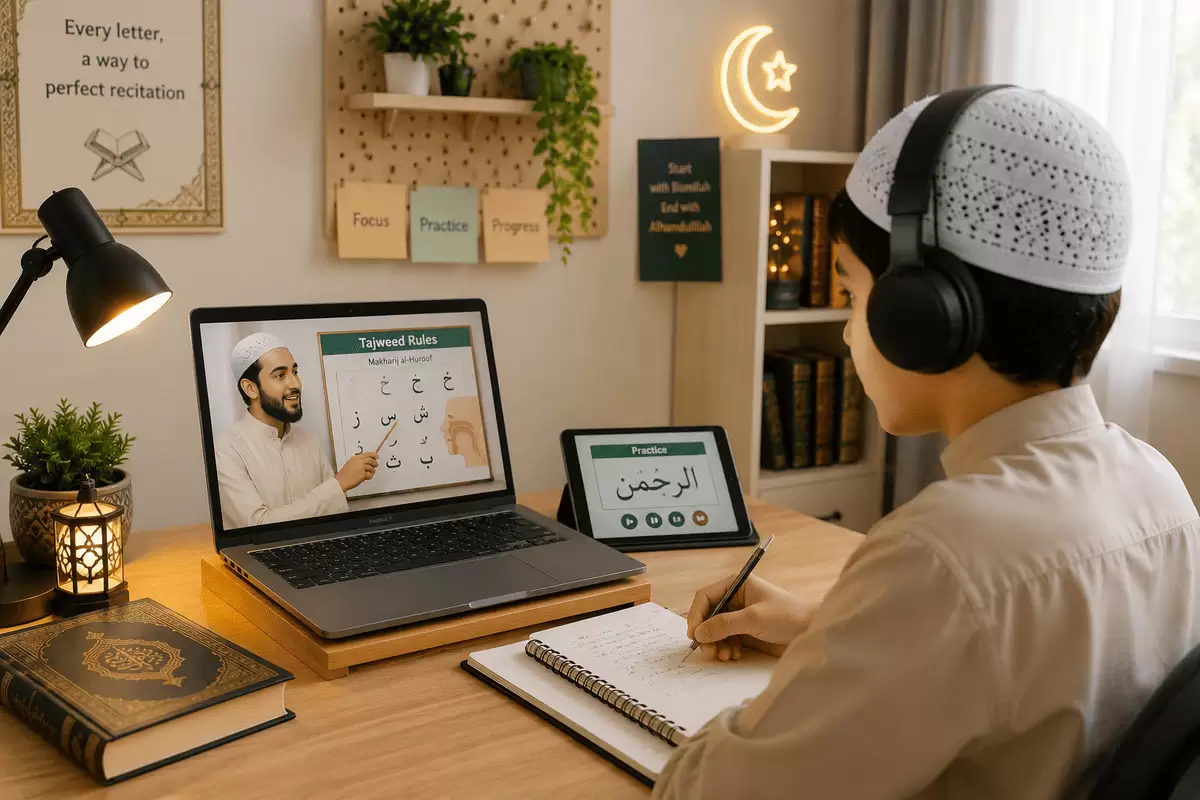
Common mistakes in Tajweed are often the biggest barrier between a beginner and beautiful, accurate recitation. Recognizing these errors early allows learners to correct them before they become habits that are difficult to break.
- Mispronouncing Arabic letters by substituting similar-sounding letters, such as confusing Qaf with Kaf or Dal with Dhal.
- Ignoring vowel marks can lead to incorrect pronunciation, which can alter the meaning of words.
- Rushing through recitation without applying Tajweed rules, causing letters and words to blur together.
- Neglecting the rules of noon sakinah and tanween results in swallowed or overemphasized nasal sounds.
- Applying qalqalah incorrectly, either ignoring the vibration entirely or exaggerating it beyond its natural sound.
- Under-elongating or over-elongating madd letters disrupts the rhythm and flow of recitation.
- Failing to practice consistently, which leads to forgetting rules and developing incorrect habits over time.
How does the Arabian Tongue shape your journey of learning the Quran and Arabic?
At Arabian Tongue, we help you understand the Quran deeply and connect with its meanings through simple and effective teaching methods. Our courses are designed to make your learning journey clear, engaging, and spiritually enriching.
Guidance from the Quran and Hadith
قال الله تعالى: «وَرَتِّلِ الْقُرْآنَ تَرْتِيلاً» — سورة المزمل، الآية 4
Allah (SWT) said: “And recite the Quran with measured recitation.” — Surah Al-Muzzammil:4
قال رسول الله صلى الله عليه وسلم: «الَّذِي يَقْرَأُ الْقُرْآنَ وَهُوَ مَاهِرٌ بِهِ مَعَ السَّفَرَةِ الْكِرَامِ الْبَرَرَةِ، وَالَّذِي يَقْرَأُ الْقُرْآنَ وَيَتَتَعْتَعُ فِيهِ وَهُوَ عَلَيْهِ شَاقٌّ لَهُ أَجْرَانِ» — صحيح مسلم
The Prophet (PBUH) said: “The one who is proficient in reciting the Quran will be with the noble and obedient angels, and the one who recites it with difficulty will have a double reward.” — Sahih Muslim.
FAQs
How long does it take to learn Tajweed for beginners?
A beginner can grasp the basic Tajweed rules within three to six months of consistent daily practice, while achieving fluency and natural application typically takes one to two years. The key factor is consistency; even 15–20 minutes of focused daily practice accelerates progress significantly.
Can I learn Tajweed online without a teacher?
While self-study through apps, videos, and written resources can build a foundational understanding, learning under a qualified teacher is strongly recommended. A teacher identifies and corrects mistakes in pronunciation that self-learners often cannot detect on their own, preventing bad habits from becoming ingrained.
What are the best platforms to learn Tajweed online?
Reputable platforms for learning Tajweed online include those offering certified instructors, structured curricula, and interactive tools such as live sessions and audio feedback. Look for platforms with verified scholar credentials, student reviews, and beginner-friendly progression to ensure quality and authenticity.
How do I improve my Quran pronunciation quickly?
The fastest way to improve pronunciation is to listen to professional reciters daily and shadow their recitation, repeating each phrase immediately after hearing it. Combining this with regular feedback from a qualified teacher and focused practice on problematic letters ensures rapid and lasting improvement.