

There is a profound difference between reading the Quran and truly reciting it. That difference is Tajweed, and the fastest path to mastering it runs directly through the hands of those who have dedicated their lives to its science. Choosing to learn Tajweed rules with expert Islamic teachers is not just an educational decision; it is a commitment to honoring every word of Allah’s Book with the precision, beauty, and reverence it deserves. The right teacher does not just correct your tongue; they transform your entire relationship with the Quran.
learn tajweed rules with expert Islamic teachers
Tajweed, derived from the Arabic root meaning “to improve” or “to make better,” refers to the set of rules governing the proper pronunciation, articulation, and recitation of the Quran. These rules ensure that every letter is recited with its correct phonetic value, maintaining the integrity of the divine text as revealed to Prophet Muhammad ﷺ.
At its core, Tajweed is not merely about reading the Quran but about reciting it in a way that honors its linguistic perfection. The rules encompass the articulation of letters, the application of madd (elongation), ghunnah (nasalization), and iqamah (stopping). For example, the letter qaf must be pronounced with a deep throaty sound, while thad and dhad require precise tongue placement to distinguish between them.
1. The Three Pillars of Tajweed
Tajweed is divided into three main categories:
- Makharij (Points of Articulation): The specific locations in the mouth, throat, or nasal cavity where sounds are produced.
- Sifat (Characteristics): The qualities of sounds, such as whether a letter is voiced or voiceless and how it is articulated.
- Idgham, Ikhfa, and Iqlab (Rules of Letter Combination): How certain letters interact when they appear consecutively in the Quranic text.
2. Common Misconceptions About Tajweed
Many people mistakenly believe that Tajweed is only for advanced reciters or that it complicates the recitation process. In reality, Tajweed simplifies recitation by providing clear guidelines. Another misconception is that Tajweed is optional; however, the Prophet ﷺ emphasized the importance of reciting the Quran correctly, highlighting that Tajweed is not just about aesthetics but about spiritual connection and obedience to Allah.
For those new to Tajweed, starting with the basics, such as learning the correct pronunciation of each letter and understanding simple rules like noon saakinah and tanwin, can make the journey more manageable. The key is consistency and guidance from qualified teachers who can correct mistakes in real time.
How to choose the right Tajweed teacher or course?
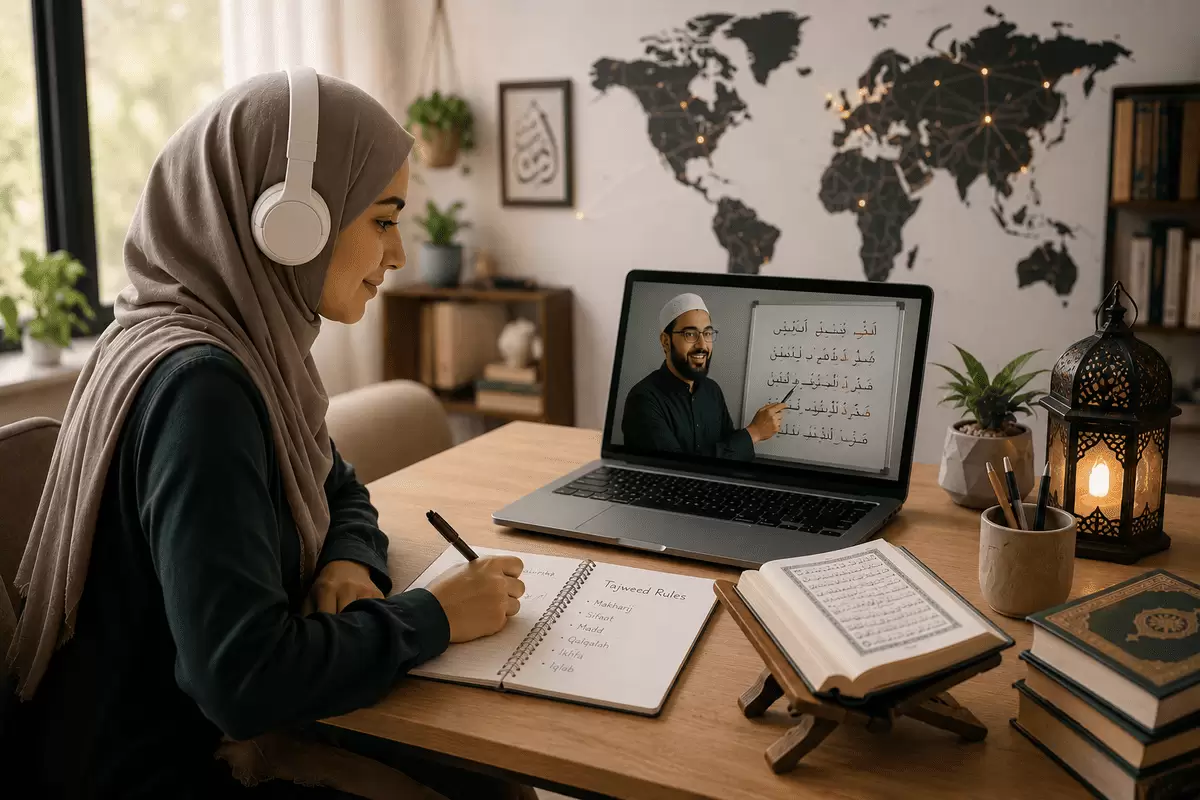
Selecting the right Tajweed teacher or course is a critical step in ensuring a smooth and effective learning experience. With the rise of online Tajweed classes, learners now have access to a global pool of qualified instructors, but not all courses or teachers are created equal. The wrong choice can lead to frustration, incorrect habits, or mispronunciations that are difficult to unlearn later.
First and foremost, consider the qualifications and experience of the teacher. A genuine Tajweed instructor should have:
- Certification from a recognized Islamic institution, such as Al-Azhar University or other reputable madrasas.
- Years of teaching experience, particularly in Tajweed rather than general Quranic studies.
- Positive student testimonials or reviews that provide insight into their teaching style and effectiveness.
- Fluency in both Arabic and the language of instruction, ensuring clarity in explanations.
Another crucial factor is the teaching methodology. A balanced approach, where theory is explained clearly and then immediately applied, often yields the best results. For example, a teacher who demonstrates the correct pronunciation of a letter like qaf and then has students mimic it in real time will help learners internalize the sound more quickly than one who only describes it.
Key questions to ask before enrolling:
- Does the course offer personalized feedback on your recitation, or is it a one-size-fits-all program?
- Are recordings or live sessions provided for practice outside of class?
- Does the curriculum cover beginner to advanced levels, or is it tailored to a specific skill set?
- Is there flexibility in scheduling, especially for learners with busy lifestyles?
Group classes can be beneficial for motivation and shared learning, but individual lessons may be preferable for those who need more personalized attention. Ultimately, the best teacher or course aligns with your learning style, pace, and goals.
How do expert teachers improve recitation skills?
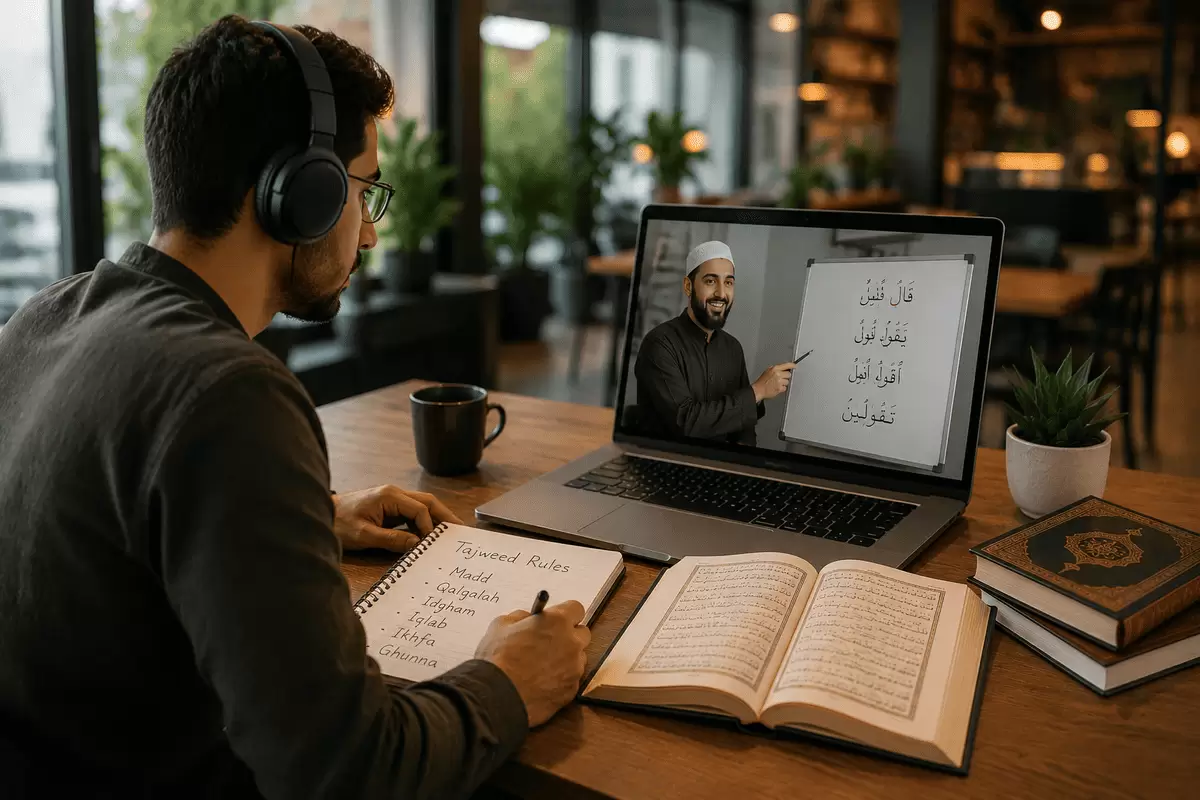
Expert Tajweed teachers possess a unique ability to transform a learner’s recitation from basic to exceptional. Unlike self-study methods, a skilled teacher provides real-time corrections, tailored feedback, and motivational guidance that accelerate progress.
One of the most significant ways expert teachers enhance recitation skills is through individualized assessments. Rather than assuming a student’s strengths and weaknesses, they conduct initial evaluations to identify specific areas needing improvement. For instance, a teacher might notice that a student consistently mispronounces the letter sheen (ش) and design a customized exercise regimen to correct it.
Techniques expert teachers use:
- Slow and gradual progression: Teachers avoid overwhelming students by breaking down complex rules into manageable steps, starting with basic noon saakinah rules before introducing advanced concepts like idgham mutamaththil.
- Audio-visual learning: Many experts use recording tools to let students hear their own recitation and compare it to a model recitation by a qualified qari, providing invaluable auditory feedback for self-correction.
- Repetitive drills: Teachers assign specific verses or words for daily practice, gradually increasing difficulty as the student improves.
- Cultural and spiritual motivation: Expert teachers emphasize the spiritual significance of Tajweed, reminding students that every correct pronunciation is an act of worship.
Another critical aspect is the teacher’s ability to adapt to different learning styles. Some students are auditory learners who benefit from listening to correct pronunciations, while others are kinesthetic learners who need physical guidance to position their tongues and lips correctly. A versatile teacher will employ a mix of verbal instructions, visual aids, and hands-on adjustments to cater to each student’s needs, fostering a supportive environment where learners feel encouraged to ask questions and make mistakes without fear of judgment.
Benefits of learning Tajweed with expert teachers
Learning Tajweed with expert teachers offers advantages that self-study simply cannot replicate, providing both technical precision and spiritual depth to your recitation journey:
- Personalized feedback that identifies and corrects individual pronunciation mistakes in real time.
- Customized lesson plans tailored to each learner’s strengths, weaknesses, and learning pace.
- Guidance on advanced rules that are difficult to grasp through books or videos alone.
- Spiritual motivation that keeps learners connected to the deeper purpose of Quranic recitation.
- Structured progression from foundational to advanced Tajweed rules without gaps in knowledge.
- Accountability and consistency through scheduled sessions that prevent stagnation.
- Access to certified instructors with recognized qualifications and years of teaching experience.
Key Tajweed Rules Every Learner Should Know
Mastering Tajweed requires a systematic understanding of its fundamental rules, which serve as the building blocks for accurate Quranic recitation. These rules not only refine pronunciation but also deepen the connection between the reciter and the divine text.
1. Rules of Makharij (Points of Articulation)
Each Arabic letter has a specific point of articulation (makhraj) that ensures clarity in recitation:
- Lips (Shifawi): Baa (ب), Mim (م), Waw (و)
- Tongue and teeth (Shinniyyah): Ta (ت), Thaa (ث), Dhaal (ذ)
- Throat (Huruf al-Halq): Haa (ح), Kha (خ), Ain (ع)
Common mistakes to avoid:
- Mispronouncing Thaa (ث) and Dhaal (ذ) by not controlling airflow.
- Articulating Qaf (ق) from the front of the throat instead of the back.
- Weakening Ghayn (غ) by not pressing the tongue fully against the throat.
- Confusing Sheen (ش) and Sin (س) due to incorrect tongue placement.
2. Rules of Sifat (Characteristics of Letters)
Key rules to master:
- Ikhfa: Noon saakinah before qaf (ق) or ghayn (غ) is lightly pronounced but not fully merged.
- Iqlab: Noon saakinah before baa (ب) changes to meem (م).
- Idgham Bilaghunnah: Noon saakinah before meem (م) or noon (ن) merges with a nasal sound.
- Idgham Bila Ghunnah: Noon saakinah before ya (ي) or waaw (و) merges without nasalization.
3. Rules of Madd (Elongation)
- Madd Al-Tabii: Natural elongation when a vowel is followed by alif, ya, or waaw.
- Madd Al-Lazim: Obligatory elongation for 4–6 counts.
- Madd Al-Mutlaq: Fixed elongation predetermined by the Quranic text for 6 counts.
How does the Arabian Tongue shape your journey of learning the Quran and Arabic?
At Arabian Tongue, we help you understand the Quran deeply and connect with its meanings through simple and effective teaching methods. Our courses are designed to make your learning journey clear, engaging, and spiritually enriching.
Guidance from the Quran and Hadith
قال الله تعالى: “الَّذِينَ آتَيْنَاهُمُ الْكِتَابَ يَتْلُونَهُ حَقَّ تِلَاوَتِهِ” — سورة البقرة :121
Allah said: “Those to whom We have given the Book recite it with its true recital.” — Al-Baqarah: 121
قال رسول الله ﷺ: “زَيِّنُوا الْقُرْآنَ بِأَصْوَاتِكُمْ” — رواه أبو داود، عن البراء بن عازب رضي الله عنه
The Prophet ﷺ said: “Beautify the Quran with your voices.” — Narrated by Abu Dawud, on the authority of Al-Bara’ ibn Azib (may Allah be pleased with him)
FAQs
Why is Tajweed important for Quran recitation?
Tajweed ensures every letter is pronounced correctly, preserving the intended meaning of the Quranic verses and honoring the linguistic perfection of the divine text. It is also a spiritual obligation, as the Prophet ﷺ emphasized reciting the Quran correctly, making Tajweed an act of worship that deepens the reciter's connection with Allah.
Can Tajweed be learned online effectively?
Yes, online Tajweed learning has proven highly effective through structured courses, audio-visual tools, and live sessions with qualified instructors that replicate the traditional classroom experience. The key is choosing a program that offers personalized feedback and certified teachers who can correct mistakes in real time.
How long does it take to master the Tajweed rules?
Most learners can grasp the foundational rules within a few months of consistent daily practice, while full mastery of advanced rules typically takes one to two years. The timeline varies depending on dedication, prior knowledge of Arabic, and the quality of guidance received.
What are the basic Tajweed rules for beginners?
Beginners should start with the correct pronunciation of each letter from its articulation point (makhraj), followed by the rules of noon saakinah and tanwin, and the basic types of elongation (madd). These foundational rules build the necessary framework for tackling more complex Tajweed concepts with confidence.