
Arabic Grammer Course for Easy Learning
Every language has a surface and a depth. The surface is what you hear in conversation, what you read in simple texts, what you pick…
Every language has a surface and a depth. The surface is what you hear in conversation, what you read in simple texts, what you pick up from immersion and repetition. The depth is something different — it is the underlying architecture of the language, the system of rules that governs why every word is the way it is, why sentences are structured the way they are, and how meaning shifts with the smallest grammatical change.
In Arabic, that depth has a name. It is called Nahw (النحو) — the science of Arabic grammar. And it is one of the most elegant, precise, and intellectually rich grammatical systems that any human language has ever produced.
At Arabian Tongue, our Arabic Grammar Course is designed to take you into that depth — step by step, rule by rule, with certified native teachers who make complex concepts genuinely understandable. Whether you are a beginner who wants to build a solid foundation from the start, or an intermediate learner who can read Arabic but wants to understand what they are reading, this course will transform your relationship with the language.
And if your ultimate goal is to understand the Quran — this course is not optional. It is essential.
Allah (SWT) says:
“Indeed, We have sent it down as an Arabic Quran so that you may understand.” (Yusuf: 2)
The word “understand” here is key. Hearing the Quran is one thing. Reciting it is another. But truly understanding it — grasping the precise meaning of every word, every construction, every grammatical choice — requires knowledge of the language in which it was revealed. That knowledge begins with grammar.
What Is Arabic Grammar and Why Does It Matter?
Arabic grammar is traditionally divided into two interconnected sciences:
- Nahw (النحو) — Syntax and Case Endings Nahw deals with the structure of sentences — how words relate to one another, what role each word plays in a sentence, and how the endings of words change to reflect those roles. This system — known as I’rab (الإعراب) — is what makes Arabic simultaneously precise and flexible. A single word can shift meaning based on its grammatical position, and a trained reader can identify that shift instantly from the word’s ending.
- Sarf (الصرف) — Morphology and Word Formation Sarf deals with the internal structure of words — specifically the root-and-pattern system that is the backbone of Arabic vocabulary. Almost every Arabic word is derived from a three-letter root. Understanding how roots combine with patterns to produce nouns, verbs, adjectives, and other word forms gives you a master key to the language — because once you know a root, you can often deduce the meaning of dozens of words derived from it.
Together, Nahw and Sarf give you the ability to do something that no amount of vocabulary memorization alone can give you: read Arabic correctly, understand it precisely, and analyze it independently.
The classical scholars of Islam considered grammar to be a religious obligation for anyone serious about understanding the Quran and the Sunnah. Imam Al-Shafi’i said:
“It is obligatory upon every Muslim to learn the Arabic language to the degree that enables him to fulfill his religious duties.”
Our Learn Arabic Grammar course fulfills that obligation — and takes you well beyond it.
Who Is This Course For?
Our Arabic Course Online is designed for a range of students:
- Complete Beginners who want to start right — Some students prefer to build their Arabic foundation on a grammatical scaffold from the very beginning. If that is your learning style, we accommodate it. You will learn to read and understand Arabic simultaneously, with grammar giving meaning to every word from day one.
- Intermediate learners who can read but don’t fully understand — This is the most common profile for our grammar students. You can read Arabic text, perhaps even recite the Quran, but when you finish reading a sentence you are not sure what it actually said. Grammar is what bridges that gap.
- Students of Quranic Arabic — If your primary goal is to understand the Quran directly — without relying on translation — then Arabic grammar is the most important academic investment you can make. The Quran’s miraculous nature is expressed largely through its language, and you cannot fully access that miracle without grammatical knowledge.
- Islamic Studies students and teachers — Scholars, students of knowledge, and Islamic Studies educators who want to strengthen their classical Arabic reading ability and engage more directly with Arabic source texts.
- Advanced learners pursuing fluency — Students who want to read classical Arabic literature, pre-Islamic poetry, Islamic legal texts, or the works of classical scholars need a strong grammatical foundation. This course provides it.
What Will You Learn? — Full Course Curriculum
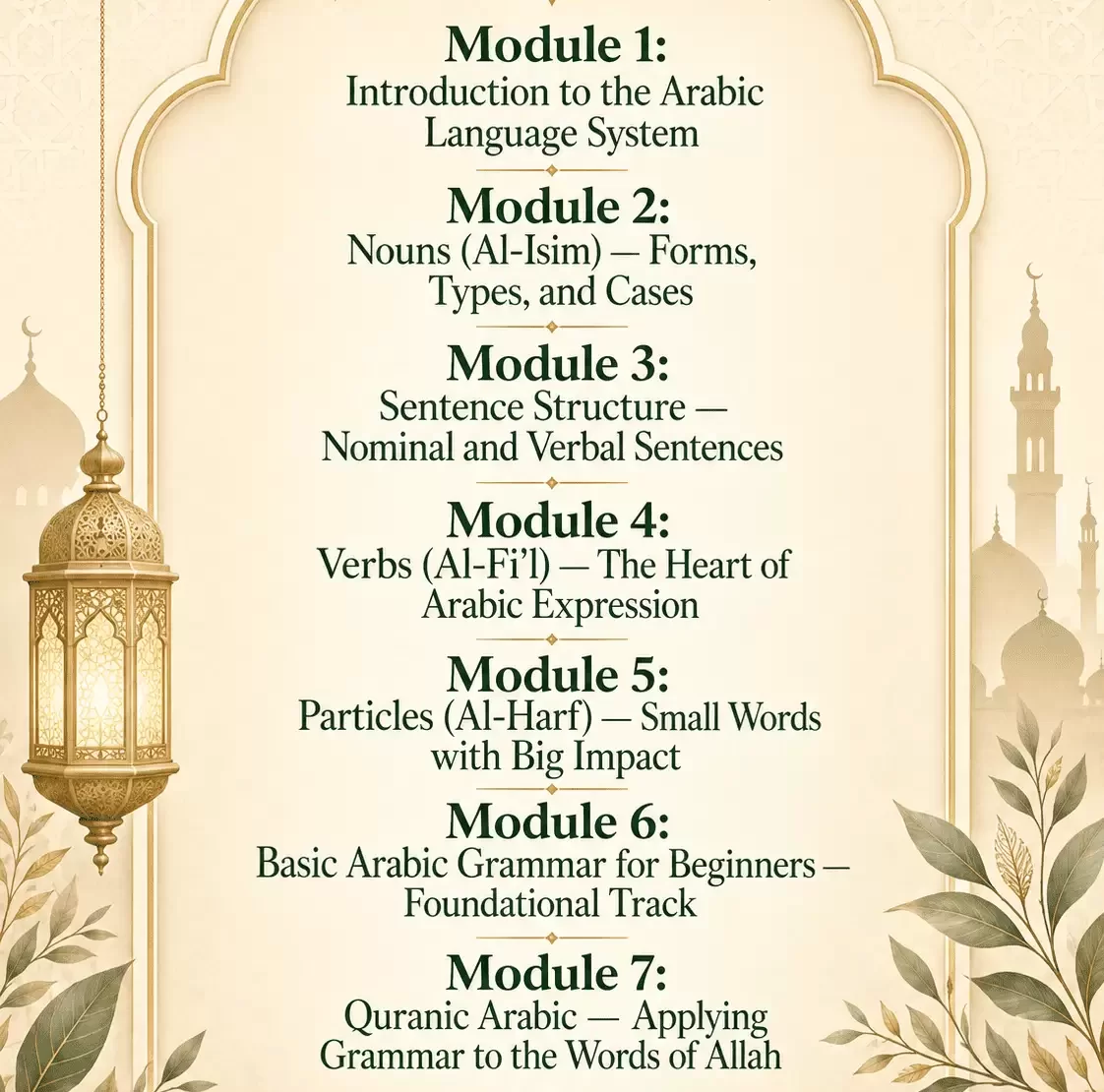
Here’s a clear look at what this course covers, from recognizing Arabic letters to reading and writing them with confidence. Follow the curriculum step by step to build a strong foundation in the Arabic alphabet.
Module 1: Introduction to the Arabic Language System
Before diving into rules, students need to understand the framework:
- The three-letter root system — the foundation of all Arabic vocabulary
- The three categories of Arabic words: Isim (noun/adjective), Fi’l (verb), and Harf (particle)
- Why every Arabic word belongs to one of these three categories and why it matters
- Introduction to I’rab — the concept of grammatical case endings
- Formal Arabic (Fusha) versus spoken dialects — understanding what you are learning and why
- The relationship between Quranic Arabic and Modern Standard Arabic
Module 2: Nouns (Al-Isim) — Forms, Types, and Cases
Arabic nouns are rich with grammatical information. This module covers:
- Gender: masculine (Mudhakkar) and feminine (Mu’annath) — rules and exceptions
- Number: singular (Mufrad), dual (Muthanna), and plural — sound plurals and broken plurals
- Definiteness: the definite article Al- and its rules, including solar and lunar letters
- The three grammatical cases: Raf’ (nominative), Nasb (accusative), and Jarr (genitive)
- How and why nouns change their endings based on their role in the sentence
- Diptotes (Al-Mamnu’ min Al-Sarf) — nouns that do not take Tanween
- Pronouns: personal, demonstrative, and relative pronouns in full detail
Module 3: Sentence Structure — Nominal and Verbal Sentences
Arabic has two fundamental sentence types, each with its own rules:
Nominal Sentence (Jumlah Ismiyyah):
- Structure: Subject (Mubtada) + Predicate (Khabar)
- Rules governing case endings of each element
- Expanded predicates, prepositional phrases as predicates, and verbal predicates
- Kana and its sisters — verbs that alter the case endings of nominal sentences
- Inna and its sisters — particles that alter the case endings of nominal sentences
Verbal Sentence (Jumlah Fi’liyyah):
- Structure: Verb (Fi’l) + Subject (Fa’il) + Object (Maf’ul Bihi)
- Agreement rules between verb and subject
- Direct and indirect objects
- Prepositional phrases and adverbs of time and place
- The Maf’ul Al-Mutlaq and other advanced object types
Module 4: Verbs (Al-Fi’l) — The Heart of Arabic Expression
Arabic verbs are among the most complex and most rewarding aspects of the language. This module covers:
- The three tenses: past (Madi), present/future (Mudari’), and command (Amr)
- Verb conjugation across all persons, genders, and numbers — the full conjugation table
- The ten derived verb forms (Al-Awzan Al-Af’al) — Form I through Form X
- How each verb form carries a predictable meaning modification
- Weak verbs — verbs containing Waw, Ya, or Alif in the root — and their conjugation patterns
- Doubled verbs and Hamzated verbs
- Active and passive voice construction
- The subjunctive (Nasb) and jussive (Jazm) moods of the present verb
Module 5: Particles (Al-Harf) — Small Words with Big Impact
Arabic particles are few in number but enormous in grammatical consequence. Students learn:
- Prepositions (Huruf Al-Jarr) and their effect on the nouns that follow them
- Coordinating conjunctions — Waw, Fa, Thumma, and others
- Conditional particles — In, Idha, Man, Ma, and the conditional sentence structure
- Interrogative particles — Hal, Hamzah, and the rules of Arabic questions
- Negation particles — La, Lam, Lan, Laysa — and how each operates differently
- Emphasis particles and their grammatical effects
Module 6: Basic Arabic Grammar for Beginners — Foundational Track
For students who need to build from the ground up, this dedicated track within the course covers:
- Reading Arabic script with full vowelization
- Understanding short vowels and their grammatical significance
- Building and reading simple sentences
- Core vocabulary organized around grammatical categories
- The 50 most important Arabic roots and their derivatives
- Basic conversational structures in Fusha
- Reading short Quranic verses with grammatical analysis
This track moves at a pace appropriate for beginners and transitions naturally into the full grammar curriculum as students develop confidence and competence.
Module 7: Quranic Arabic — Applying Grammar to the Words of Allah
This is where everything comes together. In this module, students apply everything they have learned to actual Quranic text:
- Reading selected verses with full grammatical analysis (I’rab)
- Identifying the grammatical role of every word in a verse
- Understanding how grammatical choices affect meaning and interpretation
- Reading classical Tafsir commentaries that use grammatical analysis
- Building the ability to approach any Quranic verse and understand its structure independently
Allah (SWT) says:
“Do they not then reflect on the Quran? Had it been from any other than Allah, they would have found in it many inconsistencies.” (An-Nisa: 82)
Reflection (Tadabbur) on the Quran is not fully possible without the tools to understand its language. Grammar is one of the most important of those tools.
Learning Arabic Language — The Arabian Tongue Approach
Discover how Arabian Tongue makes learning Arabic easier through a clear, step-by-step approach designed for beginners. This section explains how learners move from basic understanding to confident Arabic practice.
Why Grammar-First Works?
There is a debate in language pedagogy about whether to teach grammar explicitly or to let students absorb it naturally through immersion. For spoken, everyday language acquisition, immersion has its merits. But for classical Arabic — the language of the Quran, of Islamic scholarship, and of the great literary tradition — explicit grammar instruction is not just useful. It is the only method that has ever produced serious readers of the classical tradition.
Every scholar in Islamic history who could read and understand the Quran and the classical texts with real depth had received explicit grammar instruction. The science of Nahw was developed precisely because early Muslims recognized that without it, the language would drift and the Quran would become inaccessible. Grammar is the preservation mechanism of classical Arabic.
Taught in Arabic — Immersion Without Sacrifice
Our teachers explain grammar concepts in Arabic, using carefully chosen vocabulary that is accessible to the student’s level. This approach has two benefits: it reinforces the language while teaching the rules, and it develops the student’s ability to think grammatically in Arabic rather than mentally translating from English.
One-on-One Attention for Complex Material
Grammar is the subject in which individual attention matters most. Mistakes in grammatical understanding compound — a misunderstood concept at Module 2 will create errors throughout everything that follows. In our private sessions, your teacher identifies exactly where your understanding is solid and where it needs reinforcement, and adjusts the teaching accordingly. No student falls through the cracks.
The Connection Between Arabic Grammar and the Quran
It is impossible to overstate how deeply Arabic grammar and Quranic understanding are connected. The classical scholars who developed the science of Nahw did so largely in service of the Quran — to preserve its correct reading, to explain its meaning, and to protect Muslims from misunderstanding the words of Allah.
When Imam Ali ibn Abi Talib (RA) instructed Abu Al-Aswad Al-Du’ali to systematize Arabic grammar, his motivation was clear: protect the language so that the Quran remains correctly understood. Every rule in Arabic grammar has examples drawn from the Quran. Every verse of the Quran is a grammatical text of the highest order.
Students who complete our Arabic Grammar Course consistently describe the same experience: they begin to hear the Quran differently. Verses they have recited hundreds of times suddenly reveal layers of meaning they had never noticed. The choice of a particular case ending, the use of a specific verb form, the placement of a word at the beginning of a sentence — all of these carry meaning, and all of it becomes accessible when you know the grammar.
The Prophet Muhammad ﷺ said:
“Love the Arabs for three reasons: because I am Arab, because the Quran is in Arabic, and because the language of the people of Paradise is Arabic.” (Al-Tabarani)
Learning the grammar of Arabic is an act of love for this language — and through it, a deeper connection to everything the language carries.
FAQs
Do I need to be able to read Arabic before starting the grammar course?
For most students, yes — basic reading ability makes the grammar course significantly more effective. If you cannot yet read Arabic script, we recommend starting with our Arabic for Beginners course and transitioning to grammar once you have foundational reading skills. However, students who prefer to learn reading and grammar simultaneously can do so through our Beginner Grammar track.
Is this course suitable for someone who wants to understand the Quran?
It is the single most important course for that goal. Quranic Arabic is classical Arabic, and understanding it deeply requires grammatical knowledge. By the end of this course, students can read Quranic verses and identify the grammatical role of every word — a skill that transforms how you experience your recitation and your prayer.
How is Arabic grammar different from English grammar?
Significantly different in several ways. Arabic grammar is primarily expressed through word endings rather than word order, which gives Arabic much greater flexibility in sentence structure. The root-and-pattern system has no real equivalent in English. The verb system, with ten derived forms and complex conjugation, is far more elaborate. These differences make Arabic grammar a genuinely new intellectual experience — challenging, but deeply satisfying once it clicks.
How long does the course take to complete?
This varies by student and session frequency. Students attending two to three sessions per week can work through the foundational grammar curriculum in approximately 12 to 18 months. Reaching the level where you can read and analyze Quranic Arabic with confidence typically takes two to three years of consistent study. The investment is significant — and so is the return.
Will the course be taught in English or Arabic?
Our teachers explain concepts through Arabic immersion, with support in English when necessary to ensure understanding. As your Arabic develops, the proportion of English explanation decreases. By the intermediate and advanced stages, sessions are conducted almost entirely in Arabic.
Can I take this course alongside the Quran courses?
Absolutely — and we actively encourage it. Students who study Arabic grammar alongside Tajweed or Quran memorization find that the two reinforce each other powerfully. Your Quranic recitation becomes more meaningful when you understand what you are reciting, and your grammar learning becomes more motivated when you see its direct application in the Quran.

30-minute class · No credit card needed
Why Arabian Tongue?
Al-Azhar Certified Teachers
Our teachers graduated from Al-Azhar University, the world's most prestigious Islamic institution.
Engaging & Innovative Teaching
We use proven, creative methods to make learning engaging and effective for every student.
Comprehensive Monitoring
Regular progress reports and assessments so parents and students can track every milestone.
Benefits of Learning with Arabian Tongue
Common Questions
No prior knowledge is needed. We accept complete beginners and design a personalized plan for every student.
You book a 30-minute 1-on-1 session with a certified teacher. No payment or commitment required.
Yes! We have both male and female certified teachers available to accommodate all preferences.
We teach students of all ages — from young children (4+) to adults. Our approach adapts to each age group.
All lessons are conducted live online via Zoom or Google Meet. You only need a device with camera and microphone.