
Online Arabic Alphabet Course For Beginners
Every journey begins with a single step. And in Arabic, that step has a name — it is called Alif. The Arabic alphabet is where…
Every journey begins with a single step. And in Arabic, that step has a name — it is called Alif.
The Arabic alphabet is where everything begins. Before you can read the Quran, you need the alphabet. Before you can understand a single verse, you need the alphabet. Before grammar, before vocabulary, before conversation — there is the alphabet. It is not just the entry point to a language. It is the entry point to a civilization, a faith, and a relationship with the words of Allah (SWT) that can last a lifetime.
At Arabian Tongue, our Arabic Alphabet Course is designed to take you from complete unfamiliarity with Arabic script to confident, accurate reading of Arabic letters — with correct pronunciation, proper connection rules, and a foundation strong enough to support everything that comes after. Whether you are an adult starting from zero, a parent enrolling a young child, or a revert to Islam taking their first steps toward reading the Quran, this course is built for you.
Allah (SWT) says:
“Read in the name of your Lord who created.” (Al-Alaq: 1)
The very first word revealed to the Prophet Muhammad ﷺ was a command to read. Reading begins with letters. And letters begin here.
Why the Arabic Alphabet Deserves Serious Attention?
Many students approach the Arabic Course expecting to get through it quickly — a few weeks, a handful of lessons, and then move on to the “real” learning. This is one of the most common and most costly mistakes in Arabic language learning.
The Arabic alphabet is not simply a list of symbols to memorize. It is a system — a phonetic and visual system with rules of connection, rules of pronunciation, and characteristics of sound that have no equivalent in English or most European languages. A student who rushes through the alphabet without mastering it will carry the consequences of that rush through every stage of their learning:
- Mispronounced letters that become habits
- Confusion between similar-looking letters
- Slow reading that never becomes fluent
- Inability to recognize words even after learning their meaning
- Errors in Quranic recitation that could alter the meaning
Our Arabic Alphabet for Beginners course gives the alphabet the attention it deserves — building a foundation that is solid, accurate, and permanent.
What Makes Arabic Letters Unique
Before we describe the course curriculum, it is worth understanding what makes Arabic script genuinely different from Latin-based alphabets — because this shapes everything about how we teach it.
- Arabic is written right to left. This is the first adjustment students make — and it becomes natural faster than most people expect.
- Arabic letters change shape depending on their position in a word. Every Arabic letter has up to four forms: isolated, initial (beginning of a word), medial (middle of a word), and final (end of a word). Learning a letter means learning all its forms.
- Arabic script is cursive by nature. Unlike English, where printed letters are separate and cursive is an optional style, Arabic letters connect as a rule, with only six letters that do not connect to the letter following them. Reading Arabic means reading connected script from the very beginning.
- Arabic has sounds that do not exist in English. The emphatic consonants (Saad, Daad, Taa, Dhaa), the guttural sounds (Ain, Ghain), the deep throat sounds (Ha, Kha), and the glottal stop (Hamzah) are all sounds that require deliberate practice to produce correctly. This is why learning Athe rabic alphabet with pronunciation is not just about recognizing shapes — it is about training your mouth to produce sounds it has never made before.
- Short vowels are often not written. In fully vowelized texts like the Quran and children’s books, short vowels appear as small marks above and below letters. In most other Arabic texts, they are absent, and the reader must know the word well enough to supply the correct vowel. This makes a strong phonetic foundation at the alphabet stage even more important.
Who Is This Course For?
Our Arabic Alphabet Course is designed for:
- Complete beginners of all ages who have never studied Arabic and want to start from the very beginning with no prior knowledge required.
- Reverts to Islam who want to learn to read the Quran in its original language and need to start with the script before anything else.
- Muslim children whose parents want them to develop a relationship with Arabic and the Quran from an early age.
- Adults who tried to learn Arabic before and got stuck at the alphabet stage due to poor instruction or inadequate practice.
- Students preparing for Quran courses who have been advised to strengthen their letter recognition and pronunciation before beginning Tajweed or memorization.
- Non-Muslim students of Arabic who want to learn the language for cultural, academic, or professional reasons and need to start with the script.
There is no wrong reason to learn the Arabic alphabet. And there is no point at which it is too late to start.
What Will You Learn? — Full Course Curriculum
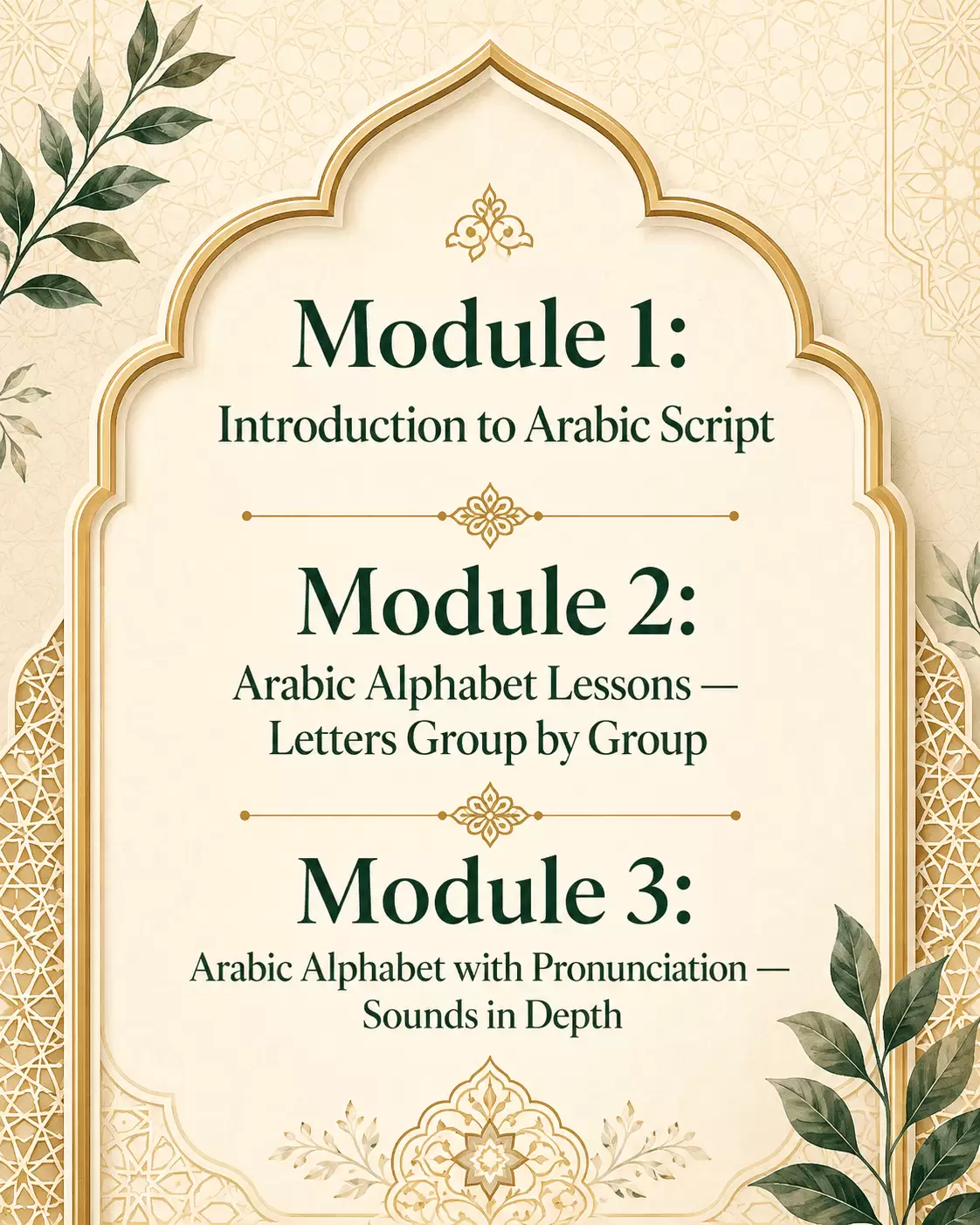
Explore the full course curriculum and see how each lesson builds your Arabic skills step by step. You’ll start with the alphabet basics, then move toward pronunciation, writing, and simple reading practice.
Module 1: Introduction to Arabic Script
Before a single letter is introduced, students need to understand the writing system they are entering:
- The direction of Arabic writing — right to left, and what that means practically
- The concept of connected script — why Arabic letters join together
- The difference between fully vowelized text (like the Quran) and unvowelized text
- An overview of the 28 Arabic letters and the phonetic categories they fall into
- How Arabic letters are grouped by shape — understanding that many letters share a base form and are distinguished only by dots
- Introduction to the concept of short vowels (Harakat): Fatha, Kasra, and Damma
Module 2: Arabic Alphabet Lessons — Letters Group by Group
Rather than introducing all 28 letters in sequence, our method groups letters by shared shape — making it significantly easier to learn and distinguish between them:
- Group One — Letters sharing the Baa shape: Ba (ب), Ta (ت), Tha (ث). These three letters share an identical base form. What distinguishes them is the number and position of dots: one dot below for Ba, two dots above for Ta, three dots above for Tha. Students learn the base shape first, then the dots, then the sounds of each.
- Group Two — The Jiim family: Jiim (ج), Ha (ح), Kha (خ) Same base shape, different dots and different sounds — including the deep, breathy Ha sound and the guttural Kha that has no English equivalent.
- Group Three — The Daal family: Daal (د), Dhaal (ذ.) Two of the six non-connecting letters. Simple in shape but important to distinguish.
- Group Four — The Raa family: Raa (ر), Zayn (.ز). Both non-connecting letters have a flowing, curved shape.
- Group Five — The Siin family: Siin (س), Shiin (ش). The distinctive “teeth” shape with varying dots.
- Group Six — The emphatic consonants: Saad (ص), Daad (ض). Heavy, emphatic sounds that are among the most distinctive features of Arabic phonology. The Daad is so uniquely Arabic that the language is sometimes called “Lughat Al-Daad” — the language of the Daad.
- Group Seven — The Taa/Dhaa emphatics: Taa (ط), Dhaa (ظ). More emphatic consonants require specific mouth positioning.
- Group Eight — The deep throat letters: Ain (ع), Ghain (غ). The Ain is one of the most challenging letters for non-native speakers — a constricted throat sound that requires significant practice. The Ghain is the guttural sound similar to the French “r.”
- Group Nine — The Faa/Qaaf family: Faa (ف), Qaaf (ق.) Similar base, different tones, and different sounds — including the deep back-of-throat Qaaf.
- Group Ten — The Kaaf, Laam, Miim, Nuun family: Kaaf (ك), Laam (ل), Miim (م), Nuun (ن). Each is distinct in shape but often confused by beginners. Detailed shape and sound practice for each.
- Group Eleven — The remaining letters: Ha (ه), Waw (و), Ya (ي). Including the long vowel carriers Waw and Ya, which play a special role in Arabic phonology.
The Hamzah (ء) and Alif: The glottal stop — one of the most misunderstood elements of Arabic script — and its various carriers: Alif, Waw, Ya, and the standalone Hamzah.
For each letter group, students practice:
- Recognizing the letter in all four positions (isolated, initial, medial, final)
- Writing the letter correctly with proper stroke order
- Producing the correct sound with teacher feedback and correction
- Reading simple words and short phrases that use the letters learned so far
Module 3: Arabic Alphabet with Pronunciation — Sounds in Depth
This module is dedicated entirely to Arabic phonetics — the sounds of the language and how to produce them correctly:
The articulation points (Makharij Al-Huruf): Where in the mouth, throat, or nasal cavity each sound originates. Students learn:
- Throat letters (Halqiyyah): Hamzah, Ha, Ain, Ghain, Kha, Ha — produced in different parts of the throat
- Tongue letters (Lisaniyyah): the majority of Arabic letters, each produced with the tongue in a specific position
- Lip letters (Shafawiyyah): Ba, Miim, Waw, Fa
- Nasal letters: sounds produced with air flowing through the nasal passage
Heavy and light letters: Arabic distinguishes between “heavy” (emphatic/velarized) letters — Saad, Daad, Taa, Dhaa, and some others in certain contexts — and “light” letters. The difference in sound is significant and affects the pronunciation of surrounding vowels. Students learn to hear this distinction and produce it.
Letters that sound similar to non-native ears:
- Ha (ح) versus Ha (ه) — two completely different letters often confused by beginners
- Siin (س) versus Saad (ص) — the plain versus emphatic pair
- Daal (د) versus Daad (ض) — another plain-emphatic pair
- Taa (ت) versus Taa (ط) — plain versus emphatic
- Dhaal (ذ) versus Dhaa (ظ) — plain versus emphatic
Detailed, patient practice on each of these pairs is a core feature of our pronunciation module.
Module 4: Short Vowels, Sukoon, and Shaddah
Arabic vowelization marks — the small symbols written above and below letters — are the key to reading correctly:
- Fatha (َ ) — the “a” sound, written above the letter
- Kasra (ِ ) — the “i” sound, written below the letter
- Damma (ُ ) — the “u” sound, written above the letter
- Sukoon (ْ ) — indicates the letter carries no vowel sound
- Shaddah (ّ ) — indicates the letter is doubled, with the first occurrence carrying Sukoon and the second carrying a vowel
- Tanween — the doubling of a vowel mark at the end of a word, producing an “n” sound
Students practice reading fully vowelized Arabic text — which is exactly how the Quran is written — until they can move through vowelized text at a confident, consistent pace.
Module 5: Long Vowels and Letter Combinations
Arabic has three long vowels, each formed by combining a short vowel with a letter:
- Long “aa” — Fatha + Alif
- Long “ii” — Kasra + Ya
- Long “uu” — Damma + Waw
Students learn to recognize and produce these long vowels in the context of full words and to distinguish them clearly from their short vowel counterparts — a distinction that is both phonetically and grammatically significant.
Module 6: Reading Practice — From Letters to Words to Sentences
Once all 28 letters are learned and phonetics are solidified, students begin progressive reading practice:
- Simple two-letter and three-letter words
- Common Arabic words in Islamic context — names of Allah, basic du’a vocabulary, Surah titles
- Short sentences in fully vowelized Arabic
- Selected short Quranic verses — Surah Al-Fatiha, Al-Ikhlas, Al-Falaq, An-Nas
- Building reading speed gradually while maintaining accuracy
- Introduction to reading without full vowelization — preparing for unvowelized Arabic text
Arabic Alphabet Lessons — Our Teaching Method
Learn Arabic alphabet lessons through a simple, interactive teaching method that makes each letter easy to recognize, pronounce, and write. Our approach helps beginners build confidence step by step.
Shape Before Sound, Then Both Together
Our methodology introduces letter shapes and sounds together, but prioritizes shape recognition first — because students need to identify a letter before they can practice its sound. Once a shape is recognized reliably, sound production becomes the focus.
Grouping by Shape — Not by Alphabetical Order
The traditional alphabetical order (Alif, Ba, Ta…) is not the most effective teaching sequence. Grouping letters by shared base shape dramatically reduces confusion and speeds up recognition — because students learn to see the base form and then distinguish letters by their dots and additional marks.
Repetition With Variety
Repetition is essential in alphabet learning, but repetition of the same exercise becomes boring and ineffective quickly. Our teachers use varied practice formats: dictation, reading aloud, writing, recognition exercises, and reading real Arabic words — keeping sessions engaging while building solid retention.
Immediate Correction in Real Time
Pronunciation errors that go uncorrected become habits. Habits become very difficult to unlearn. In our one-on-one live sessions, your teacher hears every sound you produce and corrects errors the moment they occur — gently, clearly, and consistently. This real-time correction is the single most valuable feature of live instruction over recorded courses.
Learn Arabic Alphabet — Why Online Learning Works for This
Some students wonder whether the Arabic alphabet can really be learned effectively online, especially the pronunciation component. The answer, based on the experience of thousands of our students, is an emphatic yes.
Video call technology gives your teacher a clear view of your face — including your mouth position — and clear audio of your pronunciation. Our teachers are experienced in giving pronunciation feedback through video, and they know exactly what to listen for and how to describe the adjustments needed.
In some ways, online instruction is superior to a physical classroom for alphabet and pronunciation learning — because the intimacy of a one-on-one video call means your teacher’s complete focus is on you, your sounds, and your progress. There is nowhere to hide, no possibility of nodding along without actually practicing, and no other students whose progress you are waiting for.
The Relationship Between the Arabic Alphabet and the Quran
The Arabic alphabet is not just a functional tool. It carries within it a profound spiritual significance for every Muslim.
The Quran itself draws attention to the mysterious power of individual letters. Many Surahs begin with what are called the Muqatta’at — disconnected letters whose full meaning is known only to Allah. Surah Al-Baqarah begins with Alif Laam Miim (الم). Surah Maryam begins with Kaaf Ha Ya Ain Saad (كهيعص). These letters, standing alone at the opening of divine revelation, remind us that the very building blocks of language — the letters themselves — are instruments in the hands of Allah.
The scholars have noted that one of the rhetorical challenges of the Quran is that it is composed of the same letters available to every Arab speaker — yet no human being has ever been able to produce anything comparable to it. The letters are ordinary. What Allah does with them is extraordinary.
When you learn the Arabic alphabet, you are learning the raw material of revelation. Every letter you master is another key to the door of the Quran.
Allah (SWT) says:
“This is the Book about which there is no doubt, a guidance for those conscious of Allah.” (Al-Baqarah: 2)
That Book is written in letters. These letters. The ones you are about to learn.
FAQs
How long does it take to learn the Arabic alphabet?
Most students with consistent weekly sessions can learn to recognize all 28 Arabic letters in all their forms within 4 to 8 weeks. Reaching the level of confident, flowing reading of fully vowelized text typically takes 3 to 6 months of regular practice. The variation depends on session frequency, daily practice outside of sessions, and the student's prior experience with non-Latin scripts.
Is it difficult to learn the Arabic alphabet as an adult?
It is genuinely learnable at any age. The initial challenge for most adult beginners is the unfamiliar direction of writing and the shapes of letters — both of which become natural with practice. The more significant challenge is pronunciation — specifically the sounds that do not exist in English. This is exactly why live instruction with a native teacher is so valuable. A teacher can correct your pronunciation in real time in ways that no app or recording can.
My child is 5 years old. Can they start this course?
Yes. We teach children from age 4 upward. Young children learn letters through a more visual, playful approach — with games, songs, colorful materials, and shorter sessions that match their attention span. Children this age often learn letter shapes and sounds faster than adults, and the habits they build now will serve them for life.
Do I need to buy any materials or books for this course?
No special materials are required to begin. Your teacher will guide you on any simple materials that would support your learning as you progress — typically a practice notebook for writing and access to a printed or digital Arabic alphabet chart. All core instruction happens in the live session.
Can I go directly from this course into Quran reading or Tajweed?
Yes — this is precisely what the Arabic Alphabet Course prepares you for. Upon completing the course, students have the letter recognition, pronunciation foundation, and basic reading skills needed to begin our Tajweed Course and start reading the Quran with proper recitation. The transition is natural, and the two courses are designed to connect seamlessly.
Will learning the alphabet help me with spoken Arabic as well?
Absolutely. The phonetic foundation built in the alphabet course — correct letter pronunciation, sound articulation, and vowel awareness — is the same foundation that supports spoken Arabic. Students who learn the alphabet properly find that their speaking and listening skills develop faster when they begin conversational Arabic study.

30-minute class · No credit card needed
Why Arabian Tongue?
Al-Azhar Certified Teachers
Our teachers graduated from Al-Azhar University, the world's most prestigious Islamic institution.
Engaging & Innovative Teaching
We use proven, creative methods to make learning engaging and effective for every student.
Comprehensive Monitoring
Regular progress reports and assessments so parents and students can track every milestone.
Benefits of Learning with Arabian Tongue
Common Questions
No prior knowledge is needed. We accept complete beginners and design a personalized plan for every student.
You book a 30-minute 1-on-1 session with a certified teacher. No payment or commitment required.
Yes! We have both male and female certified teachers available to accommodate all preferences.
We teach students of all ages — from young children (4+) to adults. Our approach adapts to each age group.
All lessons are conducted live online via Zoom or Google Meet. You only need a device with camera and microphone.