
Online Islamic Course for All Learners
There is a difference between being Muslim and understanding Islam. Millions of Muslims around the world pray, fast, give Zakat, and love their faith deeply…
There is a difference between being Muslim and understanding Islam. Millions of Muslims around the world pray, fast, give Zakat, and love their faith deeply — yet many carry within them a quiet longing for something more. A longing to understand what they believe, not just practice it. To know the story of the faith they were born into or chose. To connect with the life of the Prophet ﷺ in a way that goes beyond what they heard as children. To engage with Islamic history, Islamic thought, and Islamic values with the depth and seriousness those subjects deserve.
At Arabian Tongue, our Online Islamic Course exists to answer that longing. It is a structured, certified, and comprehensive program in Islamic Studies — taught by qualified scholars trained at Al-Azhar University — that takes you from foundational knowledge to a genuine understanding of your faith.
Whether you are a Muslim who wants to deepen your connection to Islam, a revert seeking systematic knowledge of your new faith, a parent who wants to raise children with strong Islamic foundations, or a curious non-Muslim who wants to understand one of the world’s great religious traditions, this course is designed for you.
Allah (SWT) says:
“Allah will raise those who have believed among you and those who were given knowledge by degrees.” (Al-Mujadila: 11)
Knowledge in Islam is not a luxury. It is an elevation. And it begins with seeking.
Why Islamic Studies Matters More Than Ever?
We live in a time of extraordinary information — and extraordinary confusion. Muslims today face questions about their faith from every direction: from non-Muslim colleagues and friends, from their own children who encounter challenging ideas at school, from online content that ranges from inspiring to deeply misleading, and from within themselves as they try to reconcile their faith with the complexity of modern life.
The answer to confusion is never less knowledge. It is always more — but the right kind. Authentic, grounded, scholarly knowledge transmitted by qualified teachers who are themselves connected to a living tradition of Islamic learning.
The Prophet Muhammad ﷺ said:
“Seeking knowledge is an obligation upon every Muslim.” (Ibn Majah)
This hadith does not say “upon every scholar” or “upon every student at a madrasa.” It says every Muslim. The obligation to seek knowledge — to understand your faith, its history, its values, and its guidance — belongs to every one of us.
Our Islamic Studies Course Online makes fulfilling that obligation possible from anywhere in the world, at any time that suits your life.
What Does the Course Cover?
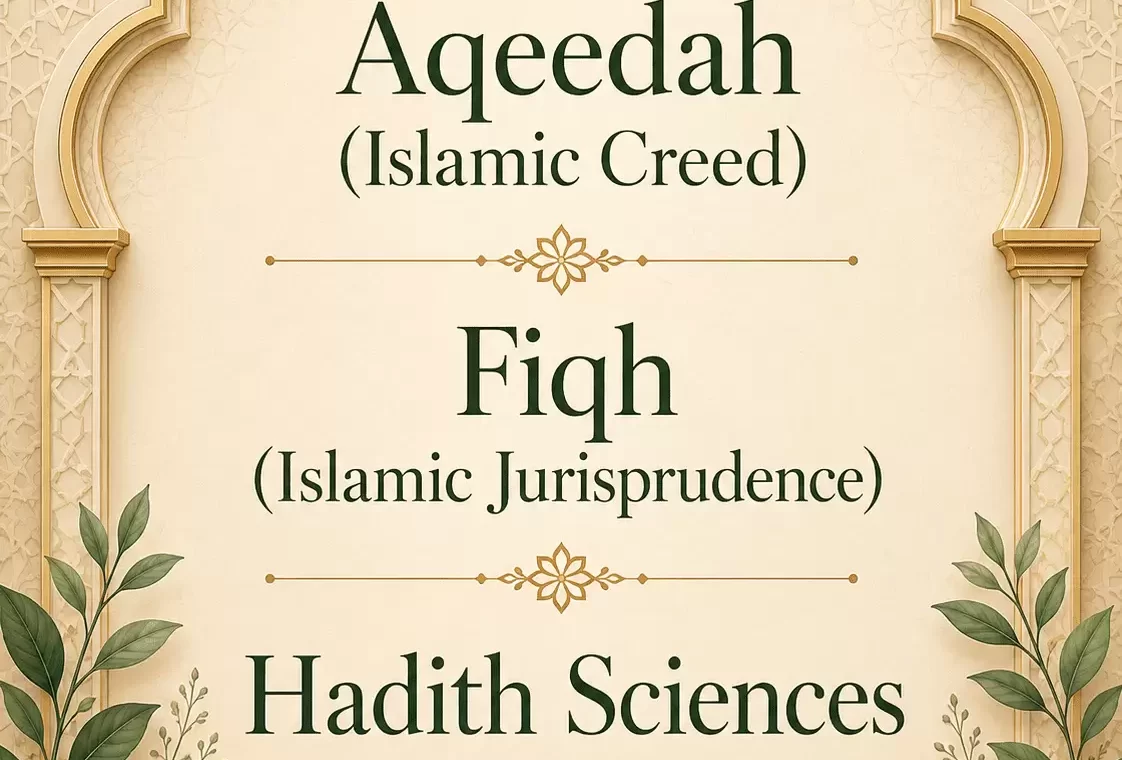
Our Online Islamic Course is built around three interconnected pillars of Islamic knowledge — each essential, each enriching the others, and each designed to give you a living, applicable understanding of Islam rather than a purely academic one.
Pillar One: Islamic Studies — Foundations of the Faith
Aqeedah (Islamic Creed)
The foundation of everything a Muslim believes. Students study:
- Tawheed — the absolute oneness of Allah in His essence, His attributes, and His right to be worshipped alone. Understanding Tawheed is not just theology — it is the core of Islamic identity and the lens through which every aspect of life is understood.
- The Six Pillars of Iman — belief in Allah, His angels, His books, His messengers, the Last Day, and divine decree (Qadar) — studied in depth, not just as a list to memorize but as a living framework for understanding existence
- The names and attributes of Allah (Al-Asma Al-Husna) — the 99 beautiful names, their meanings, their implications for how we understand Allah, and how knowing them transforms worship
- The unseen (Al-Ghayb) — the angels, the Jinn, the soul, Barzakh, the Day of Judgment, Paradise, and Hell — as described in the Quran and authentic Sunnah
- Common misconceptions and deviations — understanding what the correct Islamic creed is also means understanding what it is not, and why certain beliefs deviate from the straight path
Fiqh (Islamic Jurisprudence)
The practical dimension of Islam — how the faith’s principles translate into daily life:
- Tahara (Purification) — the rules of physical and ritual purity, Wudu, Ghusl, and Tayammum
- Salah (Prayer) — the conditions, pillars, obligations, and Sunnah acts of the five daily prayers, Friday prayer, prayer in congregation, and prayer in special circumstances
- Sawm (Fasting) — the rules of Ramadan fasting, what breaks the fast, the Fidyah and Kaffarah system, and voluntary fasting
- Zakat — who it is obligatory upon, how it is calculated, who receives it, and its spiritual significance
- Hajj — the rituals, their sequence, their conditions, and their profound spiritual meaning
- Halal and Haram — foundational principles of what is permitted and what is prohibited, with an emphasis on understanding the wisdom behind Islamic rulings
- Contemporary Fiqh issues — questions that arise in modern life for which students need grounded, scholarly answers
Hadith Sciences
The Sunnah of the Prophet ﷺ is the second source of Islamic guidance, and understanding it requires knowing how hadith were preserved, classified, and authenticated:
- Introduction to Hadith terminology — Sahih, Hasan, Da’if, and other classifications
- The major Hadith collections — Sahih Al-Bukhari, Sahih Muslim, the four Sunan, and others
- How scholars evaluated narrators and chains of transmission
- Study of selected hadith from the foundational collections with an explanation of meaning and application
- The relationship between the Quran and the Sunnah — how they complement and explain each other
Pillar Two: Seerah Course Online — The Life of the Prophet Muhammad ﷺ
If there is one subject in Islamic knowledge that has the power to transform a Muslim’s relationship with their faith more than any other, it is the Seerah — the biography of the Prophet Muhammad ﷺ.
The Seerah is not history in the ordinary sense. It is a living guide. Every decision the Prophet ﷺ made, every challenge he faced, every relationship he built, every word he spoke — all of it carries guidance for Muslims in every era, including ours. Allah (SWT) said:
“There has certainly been for you in the Messenger of Allah an excellent pattern for anyone whose hope is in Allah and the Last Day and who remembers Allah often.” (Al-Ahzab: 21)
That excellent pattern — that Uswah Hasanah — is documented in the Seerah. And studying it is one of the most spiritually rewarding acts a Muslim can undertake.
Our Seerah Course Online covers the complete biography of the Prophet ﷺ in a structured, chronological, and deeply engaging format:
Part One: Before the Revelation
- Arabia before Islam — the social, political, religious, and cultural landscape into which the Prophet ﷺ was born
- The lineage of the Prophet ﷺ — his noble ancestry and its significance
- His birth, early childhood, and the remarkable events that surrounded both
- His years as a young man — his reputation for honesty (Al-Amin), his early experiences in trade and travel, and his marriage to Khadijah (RA)
- The years of contemplation at Cave Hira — what led him there and what happened within it
Part Two: The Revelation and the Makkah Period
- The first revelation and its immediate aftermath — the profound human reality of that moment
- The early Muslims — who they were, why they believed, and what they sacrificed
- The stages of da’wah — from secret invitation to public proclamation
- The persecution of the Muslims — the stories of Bilal, Sumayyah, Ammar, and others who endured torture for their faith
- The migration to Abyssinia — and what the Negus’s response reveals about the universality of Islam’s message
- The Year of Sorrow — the deaths of Khadijah and Abu Talib, and how the Prophet ﷺ carried that grief
- The Night Journey and Ascension (Isra and Mi’raj) — one of the most extraordinary events in human and prophetic history
- The migration to Madinah (Hijra) — its planning, its dangers, and its world-historical significance
Part Three: The Madinah Period
- The establishment of the Islamic state — the Constitution of Madinah, the brotherhood between the Muhajirun and Ansar, and the building of the first mosque
- The major battles — Badr, Uhud, Al-Khandaq (The Trench), and others — not just as military history but as profound lessons in leadership, trust in Allah, and recovery from difficulty
- The treaties and diplomacy of the Prophet ﷺ — including the Treaty of Hudaybiyyah, which appeared to be a defeat and turned out to be a victory
- The conquest of Makkah — one of the most remarkable and merciful moments in the history of warfare
- The Farewell Pilgrimage and the Farewell Sermon — the Prophet’s ﷺ final public address, summarizing the core of his message
- The passing of the Prophet ﷺ — its impact on his Companions and its lessons for Muslims today
Lessons from the Seerah
Each phase of the Seerah is studied not just as a narrative but as a source of practical wisdom:
- How did the Prophet ﷺ lead in times of crisis?
- How did he treat those who harmed him?
- What was his relationship with his family, his Companions, and his enemies?
- How did he balance worldly leadership with spiritual depth?
- What can Muslims today learn from each stage of his life?
The Prophet ﷺ said:
“None of you truly believes until I am more beloved to him than his father, his child, and all of mankind.” (Sahih Al-Bukhari)
Loving the Prophet ﷺ begins with knowing him. The Seerah is how you know him.
Pillar Three: Islamic History Course — The Story of a Civilization
Islam did not remain in Arabia. Within a century of the Prophet’s ﷺ passing, the Islamic world stretched from Spain in the west to Central Asia in the east — carrying with it a civilization that would preserve the knowledge of the ancient world, generate extraordinary advances in science, mathematics, medicine, philosophy, and architecture, and shape the course of human history in ways that are still felt today.
Our Islamic History Course takes students through this extraordinary story — not as a collection of dates and dynasties, but as a living narrative of how faith shaped civilization and how civilization was shaped by faith.
The Rightly Guided Caliphs (Al-Khulafa Al-Rashidun)
- Abu Bakr Al-Siddiq (RA) — the crisis of succession, the Ridda wars, and the compilation of the Quran
- Umar ibn Al-Khattab (RA) — the greatest administrative genius in early Islamic history, the expansion of the Islamic state, and the model of just governance
- Uthman ibn Affan (RA) — the standardization of the Quranic Mushaf and the trials of his later reign
- Ali ibn Abi Talib (RA) — the first civil war in Islamic history, its causes, its lessons, and its lasting consequences
- What made these four the model of Islamic leadership — and what Muslims can learn from each of them
The Umayyad Caliphate
- The establishment of the Umayyad dynasty — its achievements and its controversies
- The expansion of Islam into North Africa, Spain (Al-Andalus), Central Asia, and the Indian subcontinent
- The tragedy of Karbala — its causes, its events, and its enduring significance in Islamic history
- The golden age of Umayyad Spain — Cordoba as a center of learning, culture, and interfaith coexistence
- The fall of the Umayyads and the transition to Abbasid rule
The Abbasid Golden Age
- The Abbasid revolution and the establishment of Baghdad
- The House of Wisdom (Bayt Al-Hikmah) — the greatest intellectual institution of the medieval world
- Muslim contributions to science, mathematics, medicine, astronomy, philosophy, and literature during this period
- The scholars of the Golden Age — Al-Kindi, Al-Farabi, Ibn Sina, Al-Biruni, Ibn Al-Haytham, and others
- The Crusades — Islamic history’s perspective on this defining confrontation
- Salahuddin Al-Ayyubi (Saladin) — his character, his leadership, and the liberation of Jerusalem
- The Mongol invasions — the destruction of Baghdad and Islam’s remarkable recovery
The Ottoman Empire
- The rise of the Ottoman state and its rapid expansion
- The conquest of Constantinople — one of the most significant events in world history
- Ottoman governance, culture, and the administration of a multi-ethnic, multi-religious empire
- The decline of the Ottoman Caliphate and the end of the last great Islamic empire
- The abolition of the Caliphate in 1924 and its impact on the Muslim world
Islam in the Modern World
- The colonial period — how European colonization affected Muslim-majority societies
- The Islamic revival movements of the 19th and 20th centuries
- Islam and Muslims in the contemporary world — challenges, achievements, and the ongoing story of a global faith community
Why Study with the Arabian Tongue?
- Scholars Trained at Al-Azhar University Al-Azhar is not just a university — it is the oldest continuously operating university in the world, a thousand-year-old institution that has been the center of Islamic scholarship since its founding in 970 CE. Our Islamic Studies teachers are graduates of Al-Azhar — they carry within them a tradition of scholarship that connects directly to the classical Islamic intellectual tradition.
- One-on-One Live Sessions: Islamic knowledge deserves personal transmission. Questions arise in the study of Islam that cannot be answered by a textbook — they require a qualified teacher who can listen, understand the student’s context, and respond with wisdom and care. Our private sessions make that possible.
- Applicable Knowledge, Not Just Academi.c Our teachers are trained to connect Islamic knowledge to real life — to help students understand how Aqeedah shapes their worldview, how Fiqh guides their daily decisions, how the Seerah inspires their character, and how Islamic history gives them a sense of identity and belonging in a larger story.
- Students from over 30 countries. Our students come from the UK, USA, Canada, Australia, Germany, the Netherlands, Belgium, Ireland, and many other countries. Our platform serves the global Muslim community — and those who want to understand Islam — wherever they happen to live.
- Free Trial Session: A free 30-minute session with a certified Islamic Studies teacher, no payment required. Use it to discuss your goals, ask your questions, and experience the Arabian Tongue approach before committing to anything.
FAQs
Do I need any prior knowledge of Islam to join this course?
No. Our Islamic Studies course is designed to accommodate complete beginners as well as students with existing knowledge who want to go deeper. Your teacher will assess your current level in the free trial session and design a curriculum that starts where you are.
Is this course suitable for reverts to Islam?
It is one of the most valuable courses a revert can take. New Muslims often have a deep love for their faith combined with significant gaps in formal knowledge — about Aqeedah, about how to pray correctly, about the life of the Prophet ﷺ, and about Islamic history. This course addresses all of those areas in a structured, patient, and supportive environment.
Can children take the Islamic Studies course?
Yes. We offer age-appropriate Islamic Studies instruction for children, covering the basics of Aqeedah, the pillars of Islam and Iman, age-appropriate Seerah stories, and Islamic values and character. Sessions for children are engaging, interactive, and designed to build a genuine love for Islam rather than a purely academic familiarity with its rules.
How long does the full course take to complete?
The Islamic Studies curriculum is extensive, and the timeline depends on session frequency and the depth of study the student wants to pursue. Students attending two sessions per week can cover the foundational curriculum in 12 to 18 months. The Seerah alone, studied in proper depth, can take 6 to 12 months. Islamic History is similarly rich. Most students find that the more they learn, the more they want to continue — this is the nature of Islamic knowledge.
Can I choose to study only one part of the course — for example, just the Seerah?
Yes. While we recommend the full curriculum for the most complete foundation, students can choose to focus on specific areas based on their goals and interests. If you want to study only the Seerah, or only Aqeedah, or only Islamic History, we will design a course around that focus.
30-minute class · No credit card needed
Why Arabian Tongue?
Al-Azhar Certified Teachers
Our teachers graduated from Al-Azhar University, the world's most prestigious Islamic institution.
Engaging & Innovative Teaching
We use proven, creative methods to make learning engaging and effective for every student.
Comprehensive Monitoring
Regular progress reports and assessments so parents and students can track every milestone.
Benefits of Learning with Arabian Tongue
Common Questions
No prior knowledge is needed. We accept complete beginners and design a personalized plan for every student.
You book a 30-minute 1-on-1 session with a certified teacher. No payment or commitment required.
Yes! We have both male and female certified teachers available to accommodate all preferences.
We teach students of all ages — from young children (4+) to adults. Our approach adapts to each age group.
All lessons are conducted live online via Zoom or Google Meet. You only need a device with camera and microphone.