
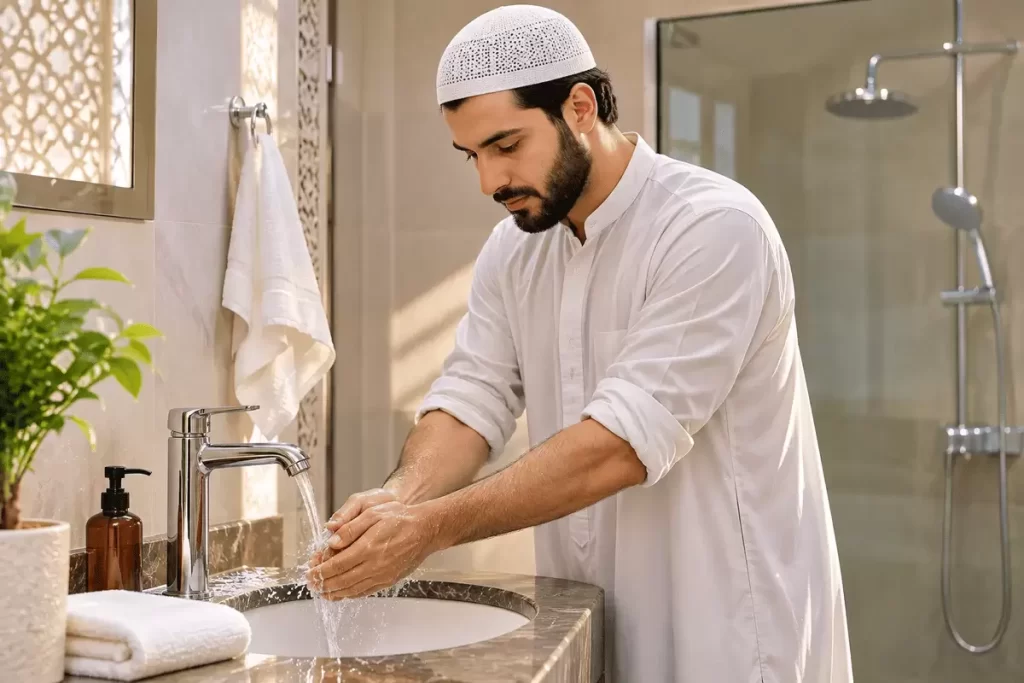
Ghusl is the full ritual bath that restores purity after major impurity, and every Muslim needs to know how to perform ghusl correctly, because prayer, circling the Kaaba and entering the mosque depend on it. The method comes directly from the Sunnah, since Aisha and Maymunah described the Prophet’s practice in detail, and scholars have organised it into obligatory and recommended acts. This guide explains the steps in order, the acts that are required and those that are recommended, the situations that call for ghusl, the conditions that make it valid, and the points that often raise questions among worshippers.
How to Perform Ghusl: Step by Step Method
The sequence below follows the narrations of Aisha and Maymunah, and it gives the complete form of ghusl that combines every required and recommended act.
- Make the intention in the heart to purify yourself from major impurity, without speaking it aloud;
- Say Bismillah, then wash both hands up to the wrists three times;
- Pour water from the right hand over the left, then wash the private parts and remove any impurity from the body;
- Perform wudu as for prayer, including rinsing the mouth and nose;
- Pour water over the head three times, running wet fingers through the roots of the hair so that the skin is reached;
- Wash the rest of the body, beginning with the right side and then the left, and rub the folds of the skin, such as the armpits, navel and behind the ears;
- Wash the feet last, moving aside from the place where the water has gathered if the floor is not clean.
How to Perform Ghusl After Menstruation
The method is the same as above, with a few additions that the Prophet ﷺ taught when Asma asked him about purification after menstruation.
- Use water with a cleansing agent, such as the lotus leaves mentioned in the narration or soap today, and clean the body thoroughly;
- Rub the head firmly so that water reaches the roots of the hair, then pour water over it;
- Apply a little fragrance to a piece of cotton or cloth and use it on the places where blood was present, which is recommended and not obligatory.
روت عائشة رضي الله عنها: «كَانَ رَسُولُ اللَّهِ ﷺ إِذَا اغْتَسَلَ مِنَ الْجَنَابَةِ غَسَلَ يَدَيْهِ، وَتَوَضَّأَ وُضُوءَهُ لِلصَّلَاةِ، ثُمَّ اغْتَسَلَ، ثُمَّ يُخَلِّلُ بِيَدِهِ شَعَرَهُ، حَتَّى إِذَا ظَنَّ أَنَّهُ قَدْ أَرْوَى بَشَرَتَهُ أَفَاضَ عَلَيْهِ الْمَاءَ ثَلَاثَ مَرَّاتٍ، ثُمَّ غَسَلَ سَائِرَ جَسَدِهِ»
(صحيح البخاري، حديث 248)
Aisha رضي الله عنها narrated: “When the Messenger of Allah ﷺ performed Ghusl after Janabah, he washed his hands and performed Wudu as for prayer. He then worked his fingers through his hair until he was satisfied that the water had reached the skin, poured water over his head three times, and washed the rest of his body.”
(Sahih al-Bukhari 248)
Obligatory and Recommended Acts of Ghusl
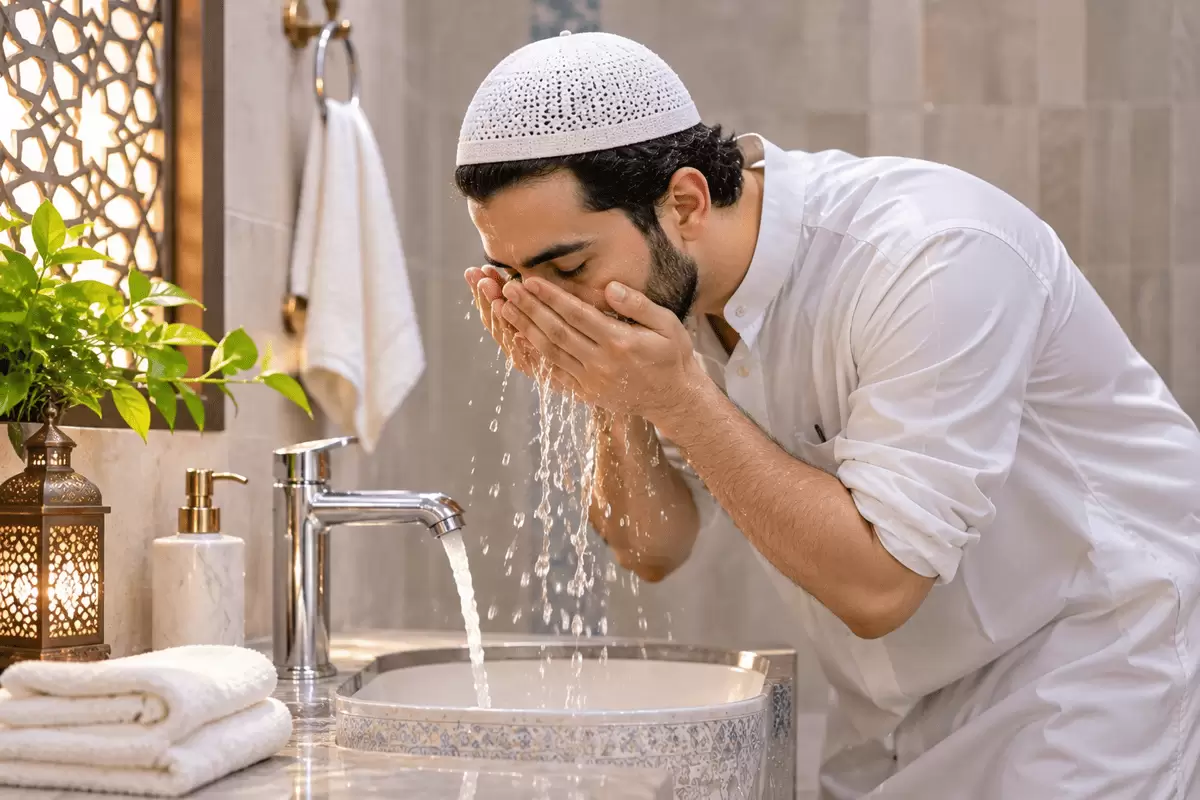
Scholars divide the acts of ghusl into those without which it is invalid and those that perfect it, and the table below compares the two groups.
| Category | Acts | Note |
| Obligatory | The intention, rinsing the mouth and nose, and washing the entire body so that water reaches the skin and the roots of the hair | Schools differ over whether the intention and rinsing are strictly required, so following a trusted scholar is advised |
| Recommended | Saying Bismillah, washing the hands first, performing wudu, pouring water over the head three times and starting with the right side | These acts follow the Prophet’s practice and add reward, but ghusl remains valid without them |
Because the schools differ on the intention and on rinsing, a person may follow the view of a trusted school, while the complete method above satisfies every opinion.
When Is Ghusl Required?
Ghusl becomes obligatory in specific situations that the Quran and the Sunnah define, and knowing when it applies matters as much as knowing how to perform ghusl, since it prevents both neglect and needless doubt.
- Sexual intercourse, whether or not discharge occurs (Muslim);
- The emission of semen, whether during sleep or while awake, accompanied by sensation;
- The end of menstruation, as the Quran instructs women to purify themselves after it (2:222);
- The end of postnatal bleeding.
Occasions When Ghusl Is Recommended
Scholars also recommend ghusl on certain occasions, although it is not obligatory on them.
- Before the Friday prayer, as the Prophet ﷺ emphasised (Bukhari and Muslim);
- Before the two Eid prayers;
- Before entering the state of ihram for Hajj or Umrah;
- After washing a deceased person, according to many scholars.
قال الله تعالى: ﴿وَلَا تَقْرَبُوهُنَّ حَتَّىٰ يَطْهُرْنَ ۖ فَإِذَا تَطَهَّرْنَ فَأْتُوهُنَّ مِنْ حَيْثُ أَمَرَكُمُ اللَّهُ﴾
(سورة البقرة 2:222)
Allah says: “Do not approach them until they become pure. When they have purified themselves, then approach them as Allah has commanded you.”
(Surah Al-Baqarah 2:222)
Conditions for a Valid Ghusl
Even a carefully performed ghusl is incomplete if its conditions are missed, and these conditions concern the water, the skin and the hair.
- The water must be pure and must not have changed in colour, taste or smell because of impurity;
- Nothing may block water from reaching the skin, such as wax, paint, glue or waterproof nail polish;
- Water must reach the roots of the hair and every part of the body, including areas easy to overlook;
- Privacy is maintained, so the private parts remain covered from others while bathing in shared facilities;
- Moderation is preferred, since the Prophet ﷺ used about one sa’ of water for ghusl, which is roughly a few litres.
How does the Arabian Tongue shape your journey of learning the Quran and Arabic?
At Arabian Tongue, we help you understand the Quran deeply and connect with its meanings through simple and effective teaching methods. Our courses are designed to make your learning journey clear, engaging, and spiritually enriching.
Guidance from the Quran and Hadith
قال النبي ﷺ: «غُسْلُ يَوْمِ الْجُمُعَةِ وَاجِبٌ عَلَى كُلِّ مُحْتَلِمٍ»
(صحيح البخاري، حديث 879)
The Prophet ﷺ said: “Taking a bath on Friday is obligatory for every person who has reached puberty.”
(Sahih al-Bukhari 879)
قال الله تعالى: ﴿وَإِن كُنتُمْ جُنُبًا فَاطَّهَّرُوا﴾
(سورة المائدة 5:6)
Allah says: “And if you are in a state of major ritual impurity, then purify yourselves.”
(Surah Al-Ma’idah 5:6)
FAQs
Must a woman undo her braids for ghusl?
For ghusl after intimacy, Umm Salamah asked the Prophet ﷺ about her tightly braided hair, and he told her that pouring three handfuls of water over her head is enough. After menstruation, some scholars advise loosening the hair, so a woman may follow the view of her trusted scholar.
Is a separate wudu needed after ghusl?
No, Aisha reported that the Prophet ﷺ did not perform wudu after ghusl, because the wudu performed within it is sufficient. A person may pray directly after completing ghusl, unless something that breaks wudu occurs afterwards, such as passing wind or using the toilet, which requires wudu again.
Can ghusl be performed in a shower?
Yes, a shower or bathtub is valid, provided the water is pure, reaches the whole body and the person follows the required acts. Privacy and modesty must be kept, and the person should avoid wasting water, since the Prophet ﷺ discouraged excess even when performing acts of worship.
Does madhi require ghusl?
No, madhi, the thin fluid released with desire, requires washing the private parts and the affected clothing, followed by wudu, as the Prophet ﷺ told Ali. Ghusl is required for semen, which is thicker and is released with a surge of desire.
What is not permitted before performing ghusl?
Before ghusl, a person may not pray, circle the Kaaba or touch the Quran according to most scholars, and may not stay in the mosque. Scholars also differ over reciting the Quran from memory, so delaying ghusl without need is not advised. Eating, sleeping and daily activities remain permitted.