

For centuries, the Quran has been recited with a precision and beauty that transcends time, and at the heart of that beauty lies Tajweed. Learn Quran with Tajweed online has made this sacred discipline more accessible than ever, allowing Muslims across the world to connect with the divine words of Allah in the way they were meant to be heard. Whether you are a complete beginner or looking to refine your recitation, the journey of Tajweed is one that deepens your relationship with the Quran, enriches your prayer, and elevates your spiritual experience. The question is no longer whether you can learn; it is where to begin.
What is Tajweed?
Tajweed, derived from the Arabic root meaning “to improve” or “to make better,” refers to the set of rules governing the proper pronunciation, articulation, and recitation of the Quran. It ensures that every letter is pronounced correctly, every vowel is elongated or shortened as prescribed, and every rule of articulation is followed, preserving the integrity of the Quranic text and allowing listeners to fully grasp its meaning and emotional depth.
At its core, Tajweed combines linguistics, phonetics, and spiritual practice, teaching Muslims to recite the Quran in alignment with the traditions of the Prophet Muhammad ﷺ and the early generations of Muslims. Without it, recitation may lack clarity, rhythm, and the intended emotional impact that makes the Quranic experience truly transformative.
The rules of Tajweed are categorized into several branches:
- Makharij (points of articulation): Where sounds are produced in the mouth, throat, or nasal cavity.
- Sifat (characteristics): How sounds are pronounced, such as whether they are voiced or voiceless.
- Idgham (assimilation): When two similar letters merge into one sound.
- Ikhfa (concealment): When a letter is pronounced softly without fully articulating it.
- Iqlab (change): When a letter changes its sound when followed by another specific letter.
Mastering these rules transforms recitation from a mechanical act into an art form, reflecting the beauty and wisdom embedded in the Quran’s words.
Learn Quran with Tajweed Online
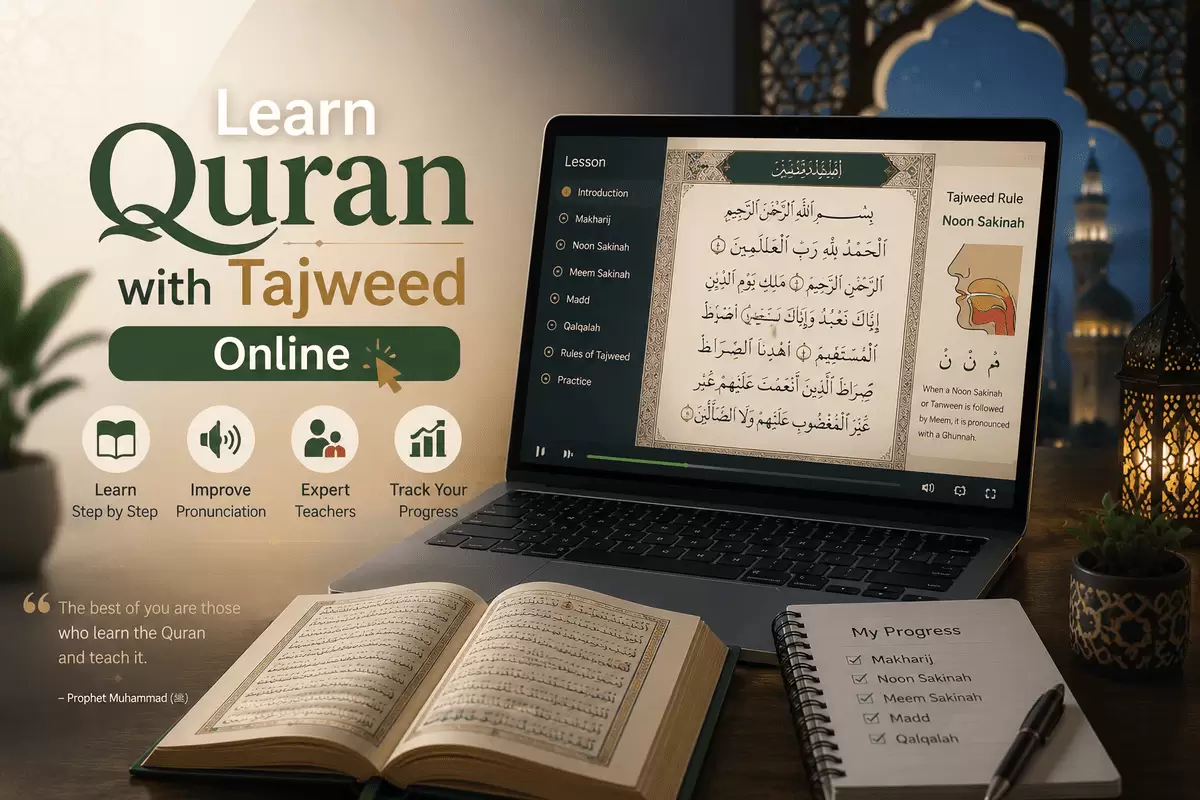
Tajweed, derived from the Arabic root meaning “to improve,” refers to the set of rules governing the proper pronunciation and recitation of the Quran. Combining linguistics, phonetics, and spiritual practice, it ensures that every letter is pronounced from its correct point of articulation and every vowel is precisely measured — preserving both the integrity of the sacred text and the emotional depth it carries. Rooted in the tradition of the Prophet Muhammad ﷺ and the early generations of Muslims, Tajweed transforms recitation from a mechanical act into a refined art form.
- Tajweed refers to the set of rules governing the proper pronunciation and recitation of the Quran.
- The word is derived from the Arabic root meaning “to improve” or “to make better.”
- It combines linguistics, phonetics, and spiritual practice into a unified discipline.
- It ensures every letter is pronounced from its correct point of articulation and every vowel is precisely measured.
- Rooted in the tradition of the Prophet Muhammad ﷺ and the early generations of Muslims.
- Its rules are divided into five branches: Makharij, Sifat, Idgham, Ikhfa, and Iqlab.
- Mastering Tajweed transforms recitation from a mechanical act into a refined art form.
- It allows listeners to fully grasp the meaning and emotional depth of the Quranic text.
Key Tajweed Rules Every Learner Should Know
To learn Tajweed, it is essential to familiarize yourself with the foundational rules that govern proper recitation. These rules ensure that every word of the Quran is pronounced with clarity and adherence to the linguistic traditions of the Arabic language. Below are the most critical rules that every learner should master:
- Makharij al-Huruf (Points of Articulation): Understanding where each letter is articulated in the mouth, throat, or nasal cavity. For example, “ق” (Qaf) is articulated at the back of the throat, while “ب” (Ba) is pronounced with the lips. Mispronouncing these points can alter the meaning of words.
- Sifat al-Huruf (Characteristics of Letters): Letters are categorized based on their pronunciation, such as whether they are voiced (e.g., “ب”, “ج”) or voiceless (e.g., “ت”, “ث”), which helps maintain the correct rhythm and flow of recitation.
- Idgham (Assimilation): When two similar letters merge into one sound. For instance, “ن” (Nun) followed by “م” (Meem) is pronounced as “م” (Meem) only, maintaining the melodic flow without disrupting the meaning.
- Ikhfa (Concealment): Pronouncing a letter softly without fully articulating it, particularly when followed by specific letters. This rule adds depth to the recitation.
- Iqlab (Change): When a letter changes its sound before a specific letter, such as “ن” (Nun) changing to “م” (Meem) when followed by “ب” (Ba), keeping the recitation smooth.
- Qalqalah (Vibration): Certain letters, such as “ق”, “ط”, and “ب”, produce a vibrating echo when pronounced at the end of a word or in a paused state, adding a rhythmic quality to recitation.
How Online Tajweed Classes Work?
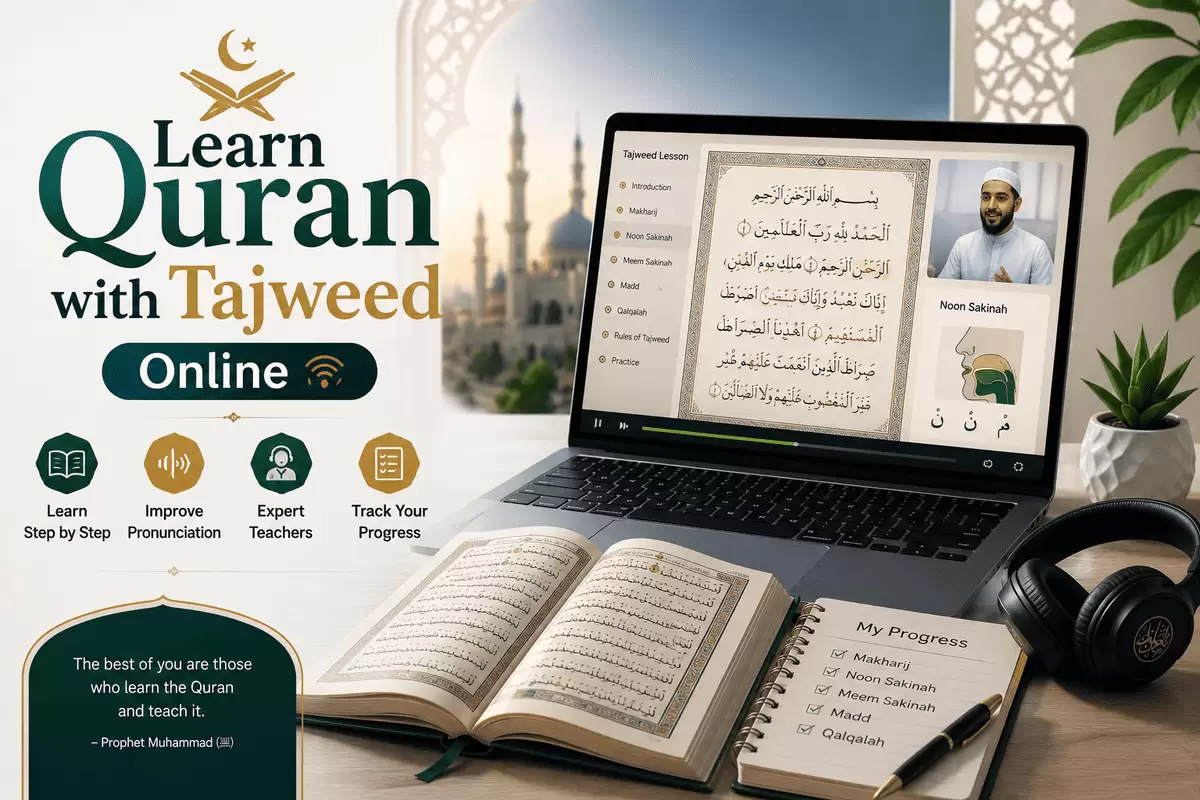
Enrolling in online Quran Tajweed classes typically begins with an assessment to determine your current level of Arabic and Tajweed knowledge, ensuring you are placed in a class that matches your proficiency. Once enrolled, learners gain access to a structured curriculum that progresses from basic rules to advanced techniques, allowing for steady improvement over time. Online Tajweed classes incorporate a variety of teaching methods to cater to different learning styles:
- Interactive Live Sessions: Real-time classes with certified Tajweed teachers via video conferencing, allowing for immediate feedback, personalized corrections, and direct interaction with the instructor.
- Pre-Recorded Lessons: Video and audio lessons that learners can access at any time, particularly useful for revisiting difficult concepts or practicing at a self-determined pace.
- Assignments and Practice Exercises: Learners are given specific verses or chapters to practice, often with accompanying audio recordings for comparison, helping reinforce what has been taught and track progress over time.
- Progress Tracking and Feedback: Teachers provide detailed feedback on recitations, highlighting areas for improvement, while quizzes and assessments evaluate understanding of Tajweed rules.
- Community and Support: Online learning communities offer a space for learners to connect, share experiences, and seek advice from peers and instructors, fostering a sense of camaraderie and motivation.
For effective learning, consistency is key. Dedicating even 15–30 minutes daily to practice will, over time, make the rules second nature and bring greater beauty and precision to your recitation.
How does the Arabian Tongue shape your journey of learning the Quran and Arabic?
At Arabian Tongue, we help you understand the Quran deeply and connect with its meanings through simple and effective teaching methods. Our courses are designed to make your learning journey clear, engaging, and spiritually enriching.
Guidance from the Quran and Hadith
قال الله تعالى: “وَرَتِّلِ الْقُرْآنَ تَرْتِيلًا”
Allah says: “And recite the Quran with measured recitation.”
(سورة المزمل: 4 — Al-Muzzammil: 4)
قال رسول الله ﷺ: “خَيْرُكُمْ مَنْ تَعَلَّمَ الْقُرْآنَ وَعَلَّمَهُ”
The Prophet ﷺ said: “The best among you are those who learn the Quran and teach it.”
(رواه البخاري — Narrated by Al-Bukhari)
FAQs
What are the basic Tajweed rules for beginners?
Beginners should start with Makharij al-Huruf (points of articulation) and Sifat al-Huruf (characteristics of letters), as these form the foundation of correct pronunciation. From there, rules like Idgham, Ikhfa, Iqlab, and Qalqalah can be gradually introduced.
Is it better to learn Tajweed online or offline?
Both methods are effective, and the choice depends on your schedule and learning style. Online learning offers flexibility and access to qualified teachers regardless of location, while offline classes provide a more traditional, immersive environment.
How long does it take to learn the Quran with Tajweed?
The duration varies depending on the learner's dedication, prior Arabic knowledge, and consistency of practice. On average, mastering the foundational rules can take anywhere from several months to a few years.
Are online Quran classes suitable for beginners?
Yes, online Quran classes are well-suited for beginners, as most platforms offer structured curricula that start from the very basics. Features like one-on-one sessions, recorded lessons, and personalized feedback make the learning experience accessible and effective for all levels.