
Surah Quraish is only four verses long, yet it speaks to the two things almost every person worries about: food on the table and safety at home. That is why the benefits of Surah Quraish are among the most searched topics by Muslims seeking barakah in their provision. This guide walks through what the surah actually says, what its verses promise, which popular narrations about it are authentic and which are not, and how to build a simple recitation habit around it that carries real spiritual weight rather than superstition.
Surah Quraish Benefits Every Believer Should Know
The clearest benefits of this surah come from its own wording, not from folklore:
- It ties provision directly to Allah: The surah names Allah as the One who fed a people against hunger, reframing rizq as a gift rather than an achievement.
- It ties safety directly to Allah: The same verse names Him as the One who secured them against fear, linking material and emotional security to one source.
- It teaches gratitude as a response to blessing: The surah’s command is to worship, not to celebrate the blessing itself.
- It is short enough to memorise in one sitting: Four verses make it accessible to children, new Muslims and busy adults alike.
- It carries the general reward of reciting the Quran; Every letter recited brings reward, as authentically reported from the Prophet ﷺ.
- It reframes anxiety about the future: A people once dependent on dangerous trade routes were told their security came from Allah, not from their caravans.
قال الله تعالى:﴿لِإِيلَافِ قُرَيْشٍ إِيلَافِهِمْ رِحْلَةَ الشِّتَاءِ وَالصَّيْفِ فَلْيَعْبُدُوا رَبَّ هَٰذَا الْبَيْتِ الَّذِي أَطْعَمَهُم مِّن جُوعٍ وَآمَنَهُم مِّنْ خَوْفٍ﴾
(سورة قريش 106:1–4)Allah says: “For the accustomed security of Quraish, their accustomed security in the caravan of winter and summer, let them worship the Lord of this House, who fed them against hunger and secured them from fear.”
(Surah Quraish 106:1–4)
What Surah Quraish Is About
Surah Quraish is the 106th chapter of the Quran, revealed in Makkah, and it sits immediately after Surah Al-Fil. Its four verses read, in plain rendering:
- For the security and familiarity granted to Quraish,
- their familiarity with the caravan journey of winter and summer,
- let them worship the Lord of this House,
- the One who fed them against hunger and secured them against fear.
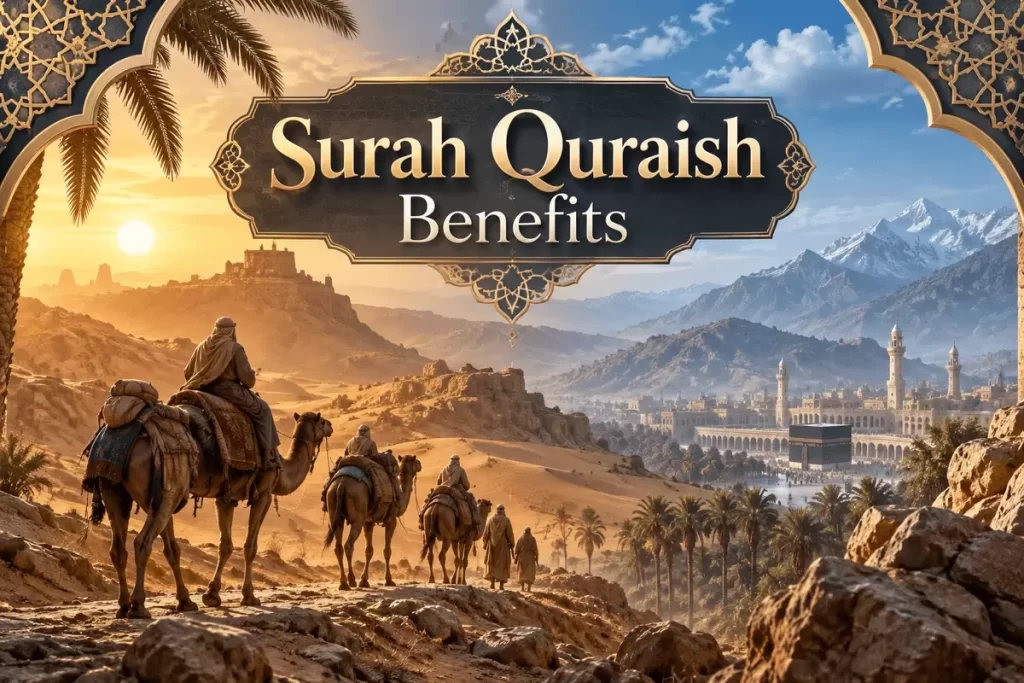
Quraish were the custodians of the Kaaba in Makkah. Two annual trade caravans sustained their entire economy: one south to Yemen in winter, one north to Sham in summer. These routes crossed tribal territories where caravans were routinely raided, yet Quraish travelled unharmed because of the respect the Kaaba commanded.
Many scholars read Surah Quraish as a continuation of Surah Al-Fil. After Allah destroyed Abraha’s army, the standing of Quraish rose across Arabia; their caravans were left untouched, and Makkah became a trading hub. The surah’s argument is simple and direct: your food and your safety came from the Lord of this House, so worship Him alone.
قال الله تعالى:﴿أَوَلَمْ يَرَوْا أَنَّا جَعَلْنَا حَرَمًا آمِنًا وَيُتَخَطَّفُ النَّاسُ مِنْ حَوْلِهِمْ﴾
(سورة العنكبوت 29:67)Allah says: “Have they not seen that We made a secure sanctuary, while people are being taken away all around them?”
(Surah Al-‘Ankabut 29:67)
Surah Quraish Benefits for Rizq
Interest in Surah Quraish benefits for rizq comes from verse four, where Allah describes Himself as the One who fed a people who had no farmland and no river. Makkah is a barren valley. Quraish did not eat because of good soil; they ate because Allah opened trade routes and kept them safe.
That is the lesson the surah offers anyone worried about income. Rizq does not come from a job title, a client list, or a market cycle. Those are channels. The source is Allah, and He can open a channel where nothing appears to exist, exactly as He did in a valley with no crops.
Reciting the surah with this understanding does three practical things:
- It corrects your mental picture of provision: Panic about income usually comes from over-trusting one channel. This surah moves your reliance upstream to the One who controls all channels.
- It pairs recitation with gratitude: The surah’s own instruction after mentioning food is worship, which strengthens the reasons Allah gives elsewhere in the Quran for increasing a grateful servant.
- It keeps you working while trusting: Quraish still loaded their camels and made the journey. Tawakkul in Islam includes taking the means, not abandoning them.
There is no authentic narration promising a fixed amount of wealth to whoever recites this surah a certain number of times. What is authentic is that Allah responds to sincere du’a, that gratitude invites increase, and that the Quran is a source of guidance and mercy. Recite it as worship, ask Allah for halal provision in your own words, and treat any specific numerical formula you find online with caution.
قال الله تعالى:﴿وَمَا بِكُم مِّن نِّعْمَةٍ فَمِنَ اللَّهِ﴾
(سورة النحل 16:53)Allah says: “And whatever you have of favor, it is from Allah.”
(Surah An-Nahl 16:53)
Surah Quraish Benefits for Food and Provision
The phrase “fed them against hunger” is worth pausing on. Allah does not simply say He fed them; He describes the hunger He removed. The blessing is defined by the hardship it replaced.
This is why many readers connect Surah Quraish benefits for food and provision with everyday gratitude at mealtimes. Nothing in the Sunnah designates this surah as a specific du’a before eating, and the established practice is to say Bismillah before a meal and Alhamdulillah after it. But reciting Surah Quraish while reflecting on a full plate is a legitimate act of worship, because the surah’s entire purpose is to link food to the One who provided it.
Households that read it together often notice a shift at the table: less complaining about what is missing, more awareness of what is present.
The surah also carries a quiet warning. Quraish were given food and security, and the response Allah asked for was worship. Blessings that do not lead to gratitude become a test rather than a gift.
قال الله تعالى:﴿فَكُلُوا مِمَّا رَزَقَكُمُ اللَّهُ حَلَالًا طَيِّبًا وَاشْكُرُوا نِعْمَتَ اللَّهِ إِن كُنتُمْ إِيَّاهُ تَعْبُدُونَ﴾
(سورة النحل 16:114)Allah says: “So eat of what Allah has provided for you, lawful and good, and be grateful for the favor of Allah, if it is Him that you worship.”
(Surah An-Nahl 16:114)
Surah Quraish Recitation Benefits
The most reliable Surah Quraish recitation benefits are the ones shared by all Quranic recitation, and they are substantial:
- Reward per letter: The Prophet ﷺ taught that each letter of the Quran recited brings a good deed, multiplied tenfold.
- Intercession on the Day of Judgement: Authentic narrations describe the Quran interceding for those who recited and acted upon it.
- Ease of memorisation: At four short verses, it is one of the first surahs children and new Muslims learn, and it is commonly recited in the third and fourth units of prayer.
- Reported use in prayer: It is reported that Umar ibn al-Khattab recited Surah Al-Fil and Surah Quraish together in a single unit of Maghrib prayer, and many scholars consider pairing them in prayer a good practice.
- Reflection over repetition: Because the surah is short, it is easy to recite slowly and think about each phrase, which is the manner of recitation the Quran itself commends.
Are the Popular Narrations About Surah Quraish Authentic?
You will find claims online promising enormous, precisely quantified rewards for reciting this surah, often traced to a long chain listing a reward for every chapter of the Quran and attributed to Ubayy ibn Ka’b. Hadith scholars, including Ibn al-Jawzi and Ibn Hajar al-Asqalani, classified that entire chain as fabricated. It should not be spread as prophetic speech.
Some people also recite the surah a set number of times for wealth, before travel, or over food or water. These are cultural practices rather than established sunnah. They are not sinful in themselves if done as general du’a and remembrance, but they should never be presented as something the Prophet ﷺ prescribed.
Being precise here protects your worship. The authentic virtues of this surah are more than enough.
قال النبي ﷺ:«مَنْ قَرَأَ حَرْفًا مِنْ كِتَابِ اللَّهِ فَلَهُ بِهِ حَسَنَةٌ، وَالْحَسَنَةُ بِعَشْرِ أَمْثَالِهَا»
(جامع الترمذي)The Prophet ﷺ said: “Whoever recites a letter from the Book of Allah will receive one good deed, and the good deed is multiplied by ten.”
(Jami` at-Tirmidhi)
How to Include Surah Quraish in Your Daily Routine
- Memorise it this week: Four verses, ten minutes a day, and you have it for life.
- Recite it in prayer: Use it in the third or fourth unit, or pair it with Surah Al-Fil in a single unit.
- Learn the meaning alongside the words: Read a reliable translation and a short tafsir so each phrase carries weight.
- Fix your tajweed: Correct pronunciation of إِيلَافِ and أَطْعَمَهُم changes the recitation, and a qualified teacher can correct it in one session.
- Use it as a gratitude anchor: Recite it when income arrives, when a meal is served, or when a worry about the future surfaces.
How does the Arabian Tongue shape your journey of learning the Quran and Arabic?
At Arabian Tongue, we help you understand the Quran deeply and connect with its meanings through simple and effective teaching methods. Our courses are designed to make your learning journey clear, engaging, and spiritually enriching.
Guidance from the Quran and Hadith
قال النبي ﷺ:«اقْرَؤُوا الْقُرْآنَ، فَإِنَّهُ يَأْتِي يَوْمَ الْقِيَامَةِ شَفِيعًا لِأَصْحَابِهِ»
(صحيح مسلم)The Prophet ﷺ said: Recite the Quran, for it will come on the Day of Resurrection as an intercessor for its companions.”
(Sahih Muslim)قال الله تعالى:﴿أَفَلَا يَتَدَبَّرُونَ الْقُرْآنَ أَمْ عَلَىٰ قُلُوبٍ أَقْفَالُهَا﴾
(سورة محمد 47:24)Allah says: “Then do they not reflect upon the Quran, or are there locks upon their hearts?”
(Surah Muhammad 47:24)
FAQs
What is the main benefit of reciting Surah Quraish?
Its main benefit is the reward and guidance of Quranic recitation, combined with its specific meaning: it trains you to attribute your food and your safety to Allah alone rather than to your own effort or circumstances.
Can Surah Quraish be recited specifically to increase rizq?
You may recite it and then ask Allah for halal provision in your own words, as with any part of the Quran. What has no authentic basis is a fixed number of repetitions guaranteeing a specific financial result.
How many verses does Surah Quraish have, and where is it in the Quran?
It has four verses and is the 106th chapter, revealed in Makkah, placed directly after Surah Al-Fil
Why are Surah Al-Fil and Surah Quraish often recited together?
They are closely linked in meaning: Al-Fil describes the destruction of the army that attacked the Kaaba, and Quraish describes the security and prosperity that followed for its custodians. Some scholars even discussed whether they form a single surah
Is there an authentic hadith about the specific reward of Surah Quraish?
No authentic narration specifies a unique reward for this surah. The widely circulated narration listing rewards for each chapter has been classified as fabricated by hadith specialists, so rely on the established general virtues of Quranic recitation instead.