
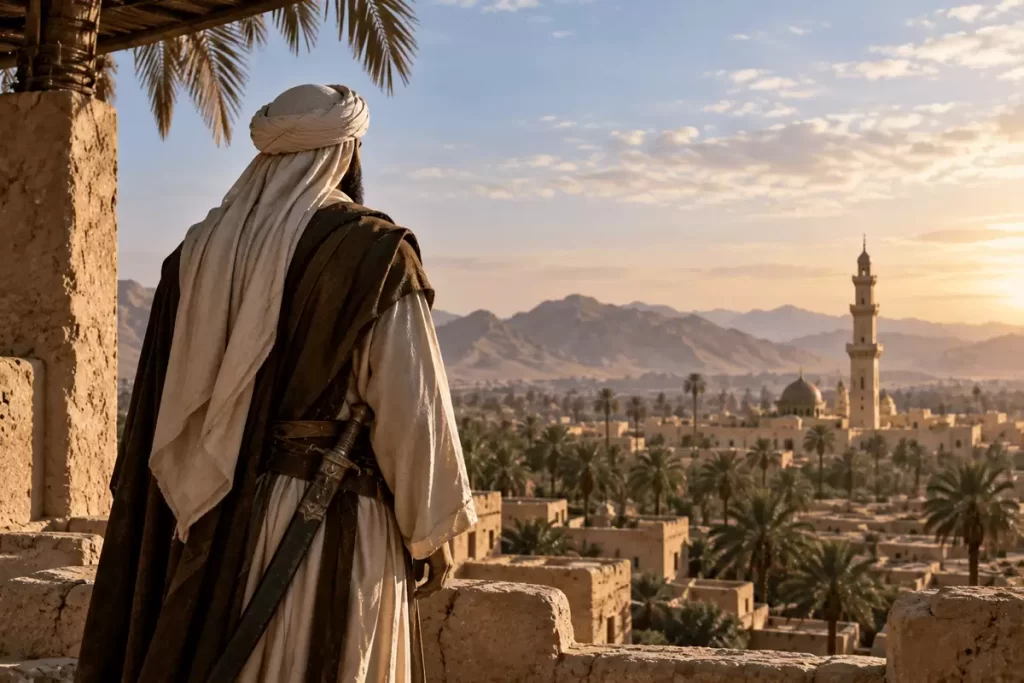
Talhah ibn Ubaydillah was one of the earliest believers in Mecca and among the closest companions of Prophet Muhammad ﷺ. He belonged to the Ten Promised Paradise, stood as a living shield for the Prophet ﷺ at the Battle of Uhud, and became famous for a generosity that earned him the title Talhah al-Khayr. The Prophet ﷺ described him as a martyr walking on the earth, a rare honor for anyone still alive. His biography covers his acceptance of Islam, his courage, his kindness to the poor, and the circumstances of his death, along with lessons that remain relevant today.
Who Was Talhah ibn Ubaydillah?
Talhah ibn Ubaydillah came from the clan of Banu Taym of Quraysh, the same clan as Abu Bakr al-Siddiq. He was a successful merchant before Islam and became one of its most devoted servants afterward. Key facts about him include:
- Full name: Talhah ibn Ubaydillah ibn Uthman al-Taymi al-Qurashi.
- Kunya: Abu Muhammad.
- Rank: one of the Ten Promised Paradise and among the first eight Muslims.
- Profession: a merchant who traded in the markets of Syria.
قال الله تعالى: ﴿وَالسَّابِقُونَ الْأَوَّلُونَ مِنَ الْمُهَاجِرِينَ وَالْأَنصَارِ وَالَّذِينَ اتَّبَعُوهُم بِإِحْسَانٍ رَّضِيَ اللَّهُ عَنْهُمْ وَرَضُوا عَنْهُ﴾
(سورة التوبة 9:100)
:Allah says: “The first forerunners among the Muhajirun and the Ansar, and those who followed them with excellence—Allah is pleased with them, and they are pleased with Him.”
(Surah At-Tawbah 9:100)
Talha’s Acceptance of Islam
Talhah embraced Islam in its earliest days, and his story began far from Mecca, in the markets of Syria. His journey to faith combined a remarkable sign with the guidance of a close friend.
The Monk of Busra
While trading in Busra, Talhah met a monk who asked whether a man named Ahmad had appeared among the people of the Haram. The monk explained that a final prophet would emerge in Mecca and later migrate to a land of palm trees.
Embracing Islam and Facing Persecution
After returning to Mecca, Talhah’s path to faith unfolded quickly:
- He asked about recent events and learned that Muhammad ﷺ had declared his prophethood.
- He went to Abu Bakr, who confirmed the news and took him to the Prophet ﷺ.
- He accepted Islam, becoming one of the first eight Muslims.
- Nawfal ibn Khuwaylid tied him to Abu Bakr with a single rope to punish them, so the two became known as Al-Qarinan, “the two joined together.”
Talha Protecting the Prophet at Uhud
The Battle of Uhud in 3 AH revealed Talhah’s courage most clearly. When the archers left their positions and the Muslim lines broke, only a small group remained around the Prophet ﷺ. Talhah’s actions that day unfolded as follows:
- He fought off attackers who were trying to reach the Prophet ﷺ.
- He blocked an arrow with his hand, which remained paralyzed for the rest of his life.
- He reportedly suffered more than seventy wounds while defending the Prophet ﷺ.
- He bent down so the injured Prophet ﷺ could climb onto a rock, after which the Prophet ﷺ declared that Talhah had earned Paradise.
Whenever Uhud was mentioned, Abu Bakr would say that the entire day belonged to Talhah.
قال قيس بن أبي حازم رحمه الله: «رَأَيْتُ يَدَ طَلْحَةَ شَلَّاءَ، وَقَى بِهَا النَّبِيَّ ﷺ يَوْمَ أُحُدٍ»
(صحيح البخاري، حديث 4063)
Qays ibn Abi Hazim reported: “I saw Talhah’s paralyzed hand, with which he had protected the Prophet ﷺ on the day of Uhud.”
(Sahih al-Bukhari 4063)
Talha the Living Martyr (Shahid Yamshi ala Al-Ard)
Because of his sacrifice, Talhah received a description that remains closely tied to his name. The Prophet ﷺ said that whoever wished to see a martyr walking on the face of the earth should look at Talhah ibn Ubaydillah. This statement, recorded by al-Tirmidhi and Ibn Majah, carried several meanings:
- It confirmed that Talhah had fulfilled his pledge to Allah.
- It honored him with the rank of martyrdom while he was still alive.
- It indicated, in the view of many scholars, that he would die as a martyr.
Talha ibn Ubaydullah Generosity: Talha Al-Khayr
Talhah was one of the wealthiest companions, yet he treated money as a means of doing good. The Prophet ﷺ honored his generosity with several titles:
- Talhah al-Khayr: “Talhah of goodness.”
- Talhah al-Fayyad: “Talhah the overflowing,” for his abundant giving.
- Talhah al-Jud: “Talhah of generosity.”
It is reported that he once received 700,000 dirhams and could not sleep until he had distributed the entire sum among the poor of Medina that same night. He also paid the debts of needy members of his clan and supported widows and orphans.
قال الله تعالى: ﴿لَن تَنَالُوا الْبِرَّ حَتَّىٰ تُنفِقُوا مِمَّا تُحِبُّونَ ۚ وَمَا تُنفِقُوا مِن شَيْءٍ فَإِنَّ اللَّهَ بِهِ عَلِيمٌ﴾
(سورة آل عمران 3:92)
Allah says: “You will never attain righteousness until you spend from what you love. And whatever you spend, Allah knows it.”
(Surah Aal-Imran 3:92)
How Did Talha ibn Ubaydullah Die?
Talhah’s life ended during the painful civil strife that followed the assassination of Uthman ibn Affan. The key events were:
- In 36 AH, he traveled to Basra seeking justice against Uthman’s killers.
- At the Battle of the Camel, he was struck by an arrow in the leg and bled heavily.
- He died from the wound in his sixties and was buried in Basra.
When Ali ibn Abi Talib saw his body, he grieved deeply and expressed hope that Allah would unite them in Paradise, free of any resentment.
Lessons from the Life of Talhah ibn Ubaydillah
The biography of Talhah ibn Ubaydillah offers clear guidance for anyone seeking to live with faith and integrity:
- Seek the truth sincerely, as Talhah did when he first heard of the Prophet ﷺ.
- Stand firm in hardship, even when protecting what you love comes at a high cost.
- Use wealth to serve others rather than to accumulate it.
- Remember that differences among righteous people do not cancel their virtues.
Final Thoughts on Talhah ibn Ubaydillah
Talhah ibn Ubaydillah lived as a believer who gave everything he had: his body at Uhud and his wealth in Medina. His story remains a model of loyalty, courage, and generosity for every generation of Muslims.
How does the Arabian Tongue shape your journey of learning the Quran and Arabic?
At Arabian Tongue, we help you understand the Quran deeply and connect with its meanings through simple and effective teaching methods. Our courses are designed to make your learning journey clear, engaging, and spiritually enriching.
Guidance from the Quran and Hadith
قال النبي ﷺ: «الْيَدُ الْعُلْيَا خَيْرٌ مِنَ الْيَدِ السُّفْلَى، وَابْدَأْ بِمَنْ تَعُولُ»
(صحيح البخاري، حديث 1427)
The Prophet ﷺ said: “The upper hand is better than the lower hand, and begin with those for whom you are responsible.”
(Sahih al-Bukhari 1427)
قال الله تعالى: ﴿وَإِن طَائِفَتَانِ مِنَ الْمُؤْمِنِينَ اقْتَتَلُوا فَأَصْلِحُوا بَيْنَهُمَا﴾
(سورة الحجرات 49:9)
Allah says: “And if two groups of believers fight, make peace between them.”
(Surah Al-Hujurat 49:9)
FAQs
The following answers address common questions readers ask about this great companion.
Why did Talhah miss the Battle of Badr?
The Prophet ﷺ sent Talhah, along with Sa'id ibn Zayd, to gather information about the Qurayshi caravan. They returned after the battle ended, yet the Prophet ﷺ granted him a share of the spoils and assured him of the reward.
Was Talhah part of the shura council?
Yes. Before his death, Umar ibn al-Khattab appointed six companions to choose the next caliph, and Talhah was among them. He was away from Medina when the council met, and Uthman ibn Affan was ultimately chosen as the third caliph.
Where is Talhah buried?
Talhah was buried in Basra, in present-day Iraq, near the site of the Battle of the Camel. A mosque bearing his name stands in the city, and many Muslims visit it to remember this honored companion of the Prophet ﷺ.
What does the name Talhah mean in Arabic?
Talhah comes from the Arabic word talh, a type of acacia tree that commonly grows in the desert. The tree is known for its strength and shade, and it is mentioned in Surat al-Waqi'ah among the delights described in Paradise.
Is it Ubaydillah or Ubaydullah?
Both forms are correct. In Arabic grammar, the name changes with its position in the sentence. After the word ibn, it takes the genitive case, producing Ubaydillah, while Ubaydullah reflects the nominative form, which is more common in English writing.