
What if a single letter could shape the rhythm, meaning, and even the miraculous structure of an entire holy text? The Arabic letter Alif ا is exactly that: the very first letter of the alphabet and one of the most frequently occurring characters in the Quran. Far from being a simple symbol, Alif carries unique grammatical roles, multiple pronunciation forms, and deep linguistic significance that shapes how words are read and understood. Let’s break down everything this powerful letter represents.
What is the Arabic Letter Alif ا and its Significance?
The Arabic letter Alif (ا) is the first letter of the Arabic alphabet, serving as a fundamental building block for pronunciation, grammar, and word structure. It possesses a dual nature, functioning both as a vowel extender and a consonant carrier.
Key Aspects and Functions
- Vowel Extension: It functions to lengthen the fatha vowel sound, creating a long ‘aa’.
- Hamza Carrier: It often acts as a seat for the hamza (ء), which then dictates the actual pronunciation.
- Grammatical Marker: It is used to indicate dual forms, feminine plurals, and other grammatical nuances.
- Word Structure: It is integral to the construction of countless Arabic words, directly influencing their meaning and form.
- Quranic Recitation: It is essential for correct Tajweed, ensuring proper pronunciation and meaning in Quranic text.
يقول الله تعالى: “إِنَّا أَنزَلْنَاهُ قُرْآنًا عَرَبِيًّا لَّعَلَّكُمْ تَعْقِلُونَ” (سورة يوسف: 2).
Allah says: “Indeed, We have sent it down as an Arabic Quran that you might understand.” (Surah Yusuf 12:2).
Pronunciation and Sound Variations of Alif
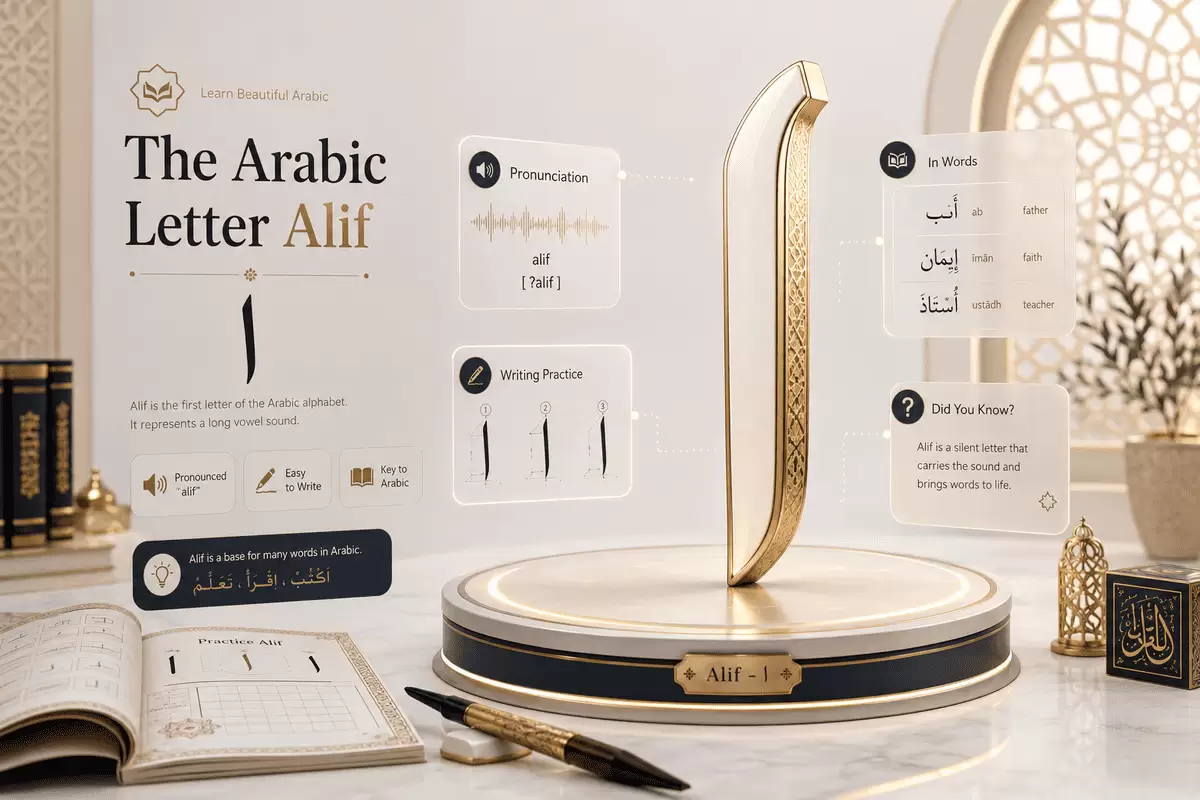
Understanding the pronunciation of Alif is key to accurate speech, as its sound varies depending on its context and whether it carries a hamza.
1. Alif as a Long Vowel Extender
When Alif appears without a hamza and is preceded by a letter with a fatha ( َ ), it acts as a long vowel, extending the ‘a’ sound (like the ‘aa’ in ‘father’).
- Example: بَا (baa) – extends the ‘a’ sound.
- Note: Even Alif Maqsura (ى), though visually different, functions identically as a long ‘a’ sound at the end of words.
2. Alif as a Hamza Carrier
When Alif carries a hamza, the hamza dictates the actual pronunciation, and the Alif merely serves as its base. The sound changes based on the vowel markings:
- With Fatha (أَ): Pronounced as ‘a’.
Example: أَسَد (asad – lion)
- With Damma (أُ): Pronounced as ‘u’.
Example: أُذُن (udhun – ear)
- With Kasra (إِ): Pronounced as ‘i’.
Example: إِبْرَة (ibrah – needle)
يقول الله تعالى: “وَرَتِّلِ الْقُرْآنَ تَرْتِيلًا” (سورة المزمل: 4).
Allah says: “And recite the Quran with measured recitation.” (Surah Al-Muzzammil 73:4).
Different Forms of the Arabic Letter Alif ا in Writing
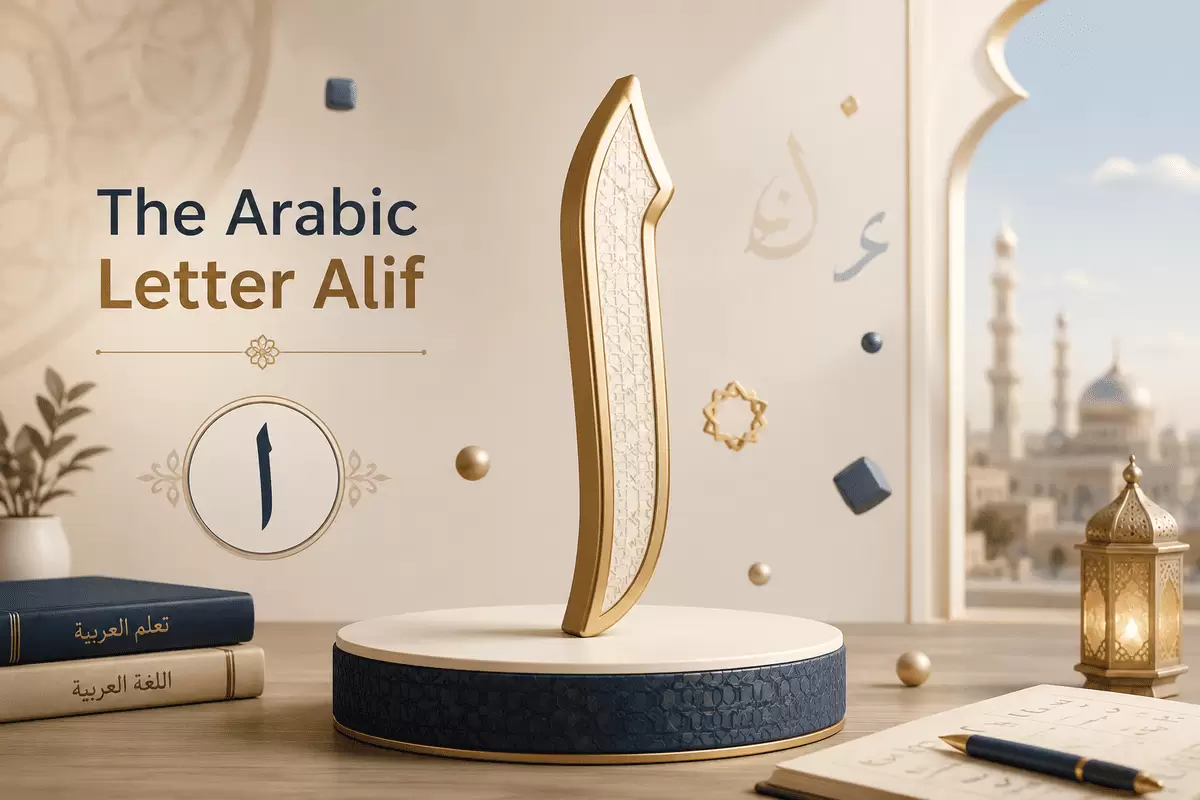
The Arabic letter Alif (ا) is unique because it is a non-connector from the left, meaning it never connects to the letter that follows it. While its basic form is a straight vertical line, its precise appearance changes slightly depending on its position within a word.
| Position / Form (الموضع أو الشكل) | Connection Rule (قاعدة الاتصال) | Description & Function (الوصف والوظيفة) | Examples (أمثلة) |
| Alif in Initial Position
(الألف في أول الكلمة) |
Does not connect to the letter that follows it. |
|
Not provided in text |
| Alif in Medial Position
(الألف في وسط الكلمة) |
Connects to the preceding letter but does not connect to the letter after it. |
|
Not provided in text |
| Alif in Final Position
(الألف في آخر الكلمة) |
Connects to the preceding letter (with no letter to connect to afterwards). |
|
Not provided in text |
| Alif Maqsura (ى)
(الألف المقصورة) |
Exclusively found at the end of words. |
|
مُسْتَشْفَى (mustashfa)
عَلَى (ala) إِلَى (ila) |
يقول النبي ﷺ: “خَيْرُكُمْ مَنْ تَعَلَّمَ الْقُرْآنَ وَعَلَّمَهُ” (صحيح البخاري، 5027).The Prophet ﷺ said: “The best among you are those who learn the Quran and teach it.” (Sahih al-Bukhari, 5027).
Practical Examples of Alif in Arabic Words and Sentences
Observing the letter Alif (ا) within words and sentences helps reinforce the rules of writing and pronunciation. The following practical examples demonstrate its roles as a long vowel, a carrier for hamza, and in its unique Alif Maqsura form.
1. Initial Alif with Hamza
- أَب (ab – father): Alif carries a hamza with fatha.
- إِسْم (ism – name): Alif carries a hamza with kasra.
- أُذُن (udhun – ear): Alif carries a hamza with damma.
- Sentence: أَنَا أُحِبُّ أُمِّي. (Ana uhibbu ummi. – I love my mother.)
2. Medial Alif as a Long Vowel
- كِتَاب (kitāb – book): Alif lengthens the ‘a’ sound.
- بَاب (bāb – door): Alif lengthens the ‘a’ sound.
- Sentence: هَذَا كِتَابٌ جَمِيلٌ. (Hādhā kitābun jamīlun. – This is a beautiful book.)
3. Final Alif as a Long Vowel
- عَصَا (aṣā – stick): Alif lengthens the ‘a’ sound.
- دُنْيَا (dunyā – world): Alif lengthens the ‘a’ sound.
- Sentence: رَأَيْتُ دُنْيَا وَاسِعَةً. (Ra’aytu dunyā wāsi’atan. – I saw a vast world.)
4. Alif Maqsura (ى)
- مُسْتَشْفَى (mustashfa – hospital): Alif Maqsura provides a long ‘a’ sound.
- عَلَى (ala – on): Alif Maqsura provides a long ‘a’ sound.
- Sentence: ذَهَبْتُ إِلَى الْمُسْتَشْفَى. (Dhahabtu ilā al-mustashfā. – I went to the hospital.)
يقول الله تعالى: “الَّذِينَ آتَيْنَاهُمُ الْكِتَابَ يَتْلُونَهُ حَقَّ تِلاوَتِهِ” (سورة البقرة: 121).
Allah says: “Those to whom We have given the Book recite it with its true recitation.” (Surah Al-Baqarah 2:121).
Alif’s Role in Tajweed Rules
Understanding the functions of Alif within Tajweed is essential for accurate Quranic recitation and preserving the meaning of the text.
Key Tajweed Rules and Functions
- Alif Waslah (وصلة): This is a connecting hamza that appears at the beginning of words. It is only pronounced if recitation starts with that word. If connected to a preceding word, the Alif Waslah becomes silent.
- Example: In وَالْقَمَرِ (wal-qamari – and the moon), the Alif in الْقَمَرِ is silent because it is preceded by “وَ”.
- Alif Qat’ (قطع): This is a cutting hamza that is always pronounced regardless of its position in recitation. It always has a hamza written above or below it (أ, إ).
- Example: أَكَلَ (akala – he ate) and إِنَّ (inna – indeed).
- Madd Alif (مد ألف): This refers to the lengthening of the ‘a’ sound when Alif follows a letter with a fatha. It is one of the three letters of Madd (long vowels), and the duration of this lengthening is typically two counts (harakat).
- Example: In قَالَ (qāla – he said), the Alif extends the ‘a’ sound of the letter qaf.
- Alif as a Substitute for Tanween: In some cases, Alif is written to carry the fatha tanween (ً) at the end of words. While written, it is not pronounced as a long vowel but indicates the ‘an’ sound.
- Example: كِتَابًا (kitāban – a book).
Importance of Accuracy
Understanding these rules ensures that the meaning of Quranic verses is not distorted, as incorrect lengthening or omission of sounds can alter a word’s significance.
How does the Arabian Tongue shape your journey of learning the Quran and Arabic?
At Arabian Tongue, we help you understand the Quran deeply and connect with its meanings through simple and effective teaching methods. Our courses are designed to make your learning journey clear, engaging, and spiritually enriching.
Guidance from the Quran and Hadith
يقول الله تعالى: “فَإِذَا قَرَأْتَ الْقُرْآنَ فَاسْتَعِذْ بِاللَّهِ مِنَ الشَّيْطَانِ الرَّجِيمِ” (سورة النحل: 98).
Allah says: “So when you recite the Quran, seek refuge in Allah from Satan, the expelled.” (Surah An-Nahl 16:98).
يقول النبي ﷺ: “لَا أَقُولُ الم حَرْفٌ، وَلَكِنْ أَلِفٌ حَرْفٌ وَلَامٌ حَرْفٌ وَمِيمٌ حَرْفٌ” (جامع الترمذي).
The Prophet ﷺ said that Alif is a letter, Lam is a letter, and Mim is a letter. (Jami` at-Tirmidhi).
FAQs:
How do you pronounce the Arabic Letter Alif ا correctly?
It is pronounced as a long 'a' sound (like 'aa' in 'father') when acting as a vowel extender. When it carries a hamza, it serves as its base and takes on the hamza's specific vowel sound.
Does the Arabic Letter Alif ا connect to other letters in all positions?
No, it only connects to the letter preceding it and never connects to the letter following it. This makes it a non-connector from the left, which creates a break in the script's cursive flow.
Why is Alif Maqsura (ى) considered a form of Alif?
Despite looking like a dotless yaa, its phonetic function is identical to a regular Alif. It is exclusively found at the end of words to provide a long 'a' sound (aa).
What are some common examples of Alif (أ) at the beginning of Arabic words?
Common examples include أَب (father), أُخْت (sister), إِسْم (name), and أَنَا (I). These examples show Alif carrying a hamza with different short vowels at the start of a word.
How can I practice writing the Arabic Letter Alif ا effectively?
Focus on drawing a straight vertical stroke that sits correctly on the baseline. Use tracing exercises, write it in isolation, and then practice integrating it into simple words.