

The Arabic letter Fa (ف) is a fundamental component of the Arabic alphabet, offering a straightforward pronunciation that makes it one of the easier letters for English speakers to master. This letter, integral to both written and spoken Arabic, plays a significant role beyond its basic sound, influencing grammar, morphology, and the overall meaning of words. Understanding its nuances is crucial for anyone embarking on their journey to learn Arabic, providing a solid foundation for more complex linguistic structures. This guide aims to thoroughly explore the various facets of this essential letter, from its phonetic value to its grammatical functions.
What is The Arabic Letter Fa (ف) and Its Phonetic Value?
The Arabic letter Fa (ف) is the twentieth letter of the Arabic alphabet, representing the voiceless labiodental fricative sound—exactly like the English “f” in “fan” or “fish.”
Key Characteristics:
- Articulation Point: Formed by lightly touching your lower lip to the edge of your upper front teeth.
- Sound Type: Voiceless labiodental fricative (produced without vocal cord vibration).
- Visual Form: Features a rounded head with a single dot placed directly above it.
- English Equivalent: Directly corresponds to the English letter “f”.
قال تعالى: {وَرَتِّلِ الْقُرْآنَ تَرْتِيلًا} [سورة المزمل: 4].
Allah says: “And recite the Quran with measured recitation.” (Surah Al-Muzzammil 73:4).
The Role of The Arabic Letter Fa (ف) in Arabic Grammar and Morphology
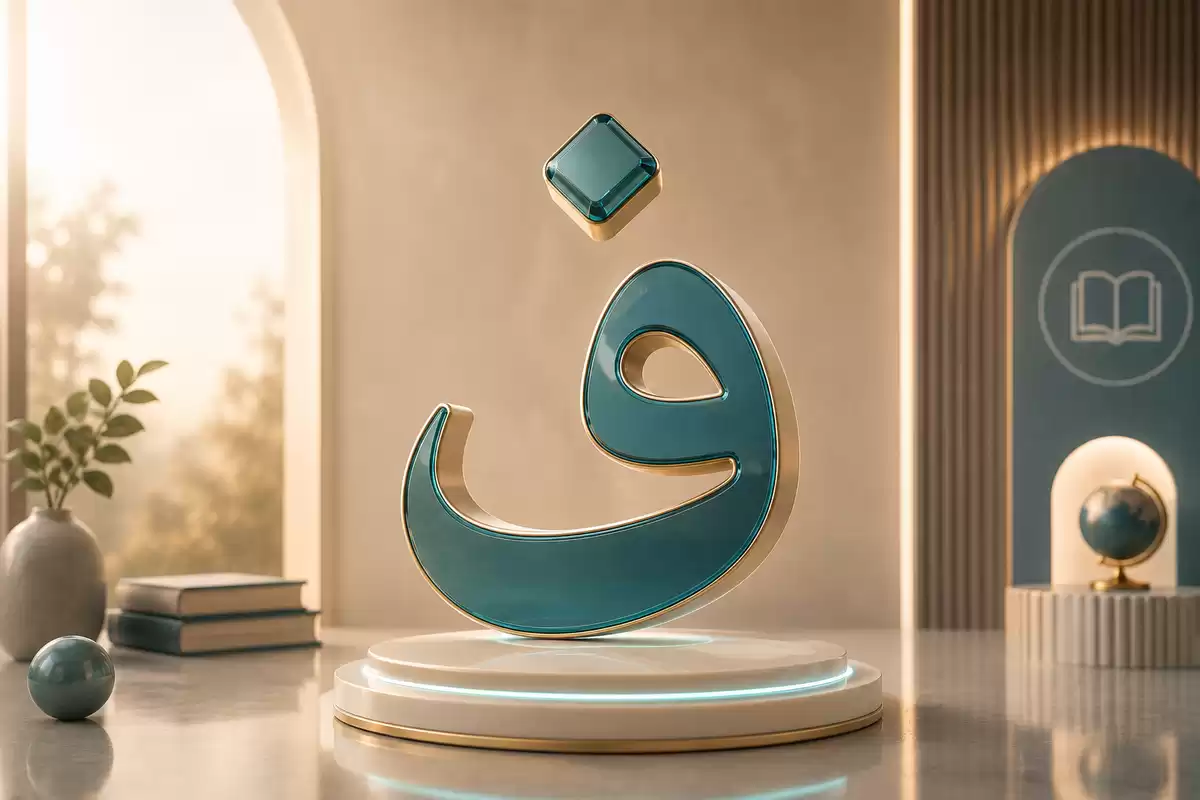
Beyond its pronunciation, the letter Fa (ف) serves critical functions in Arabic grammar and word structure, acting as a connector and a base for word derivation.
Fa as a Conjunction
The prefix Fa (فـ) functions as a conjunction meaning “so” or “then,” linking ideas in specific ways:
- Immediate Sequence: “جاء فجلس” (He came, then sat down).
- Consequence: “درس فنجح” (He studied, so he succeeded).
- Cause: “تأخرت فالطريق مزدحم” (I was late because the road was crowded).
- Conditional Result: “إن تدرس فستنجح” (If you study, then you will succeed).
Morphological Patterns Involving Fa
In morphology, Fa (ف) is the standard placeholder for the first letter of any Arabic root, using the scale ف-ع-ل (F-A-L) as the baseline template:
- Form I (فَعَلَ): The basic root verb form, like “فَعَلَ” (he did).
- Form II (فَعَّلَ): Expresses intensive or causative action, like “فَعَّلَ” (he activated).
- Form III (فَاعَلَ): Indicates mutual action or participation, like “فَاعَلَ” (he interacted).
- Form IV (أَفْعَلَ): Denotes causation, like “أَفْعَلَ” (he caused to do).
- Noun of Place/Time (مَفْعَل): Specifies the location or timing of an action.
قال تعالى: {فَمَن يَعْمَلْ مِثْقَالَ ذَرَّةٍ خَيْرًا يَرَهُ} [سورة الزلزلة: 7].
Allah says: “So whoever does an atom’s weight of good will see it.” (Surah Az-Zalzalah 99:7).
Comparing The Arabic Letter Fa (ف) with Qaaf (ق): Key Differences
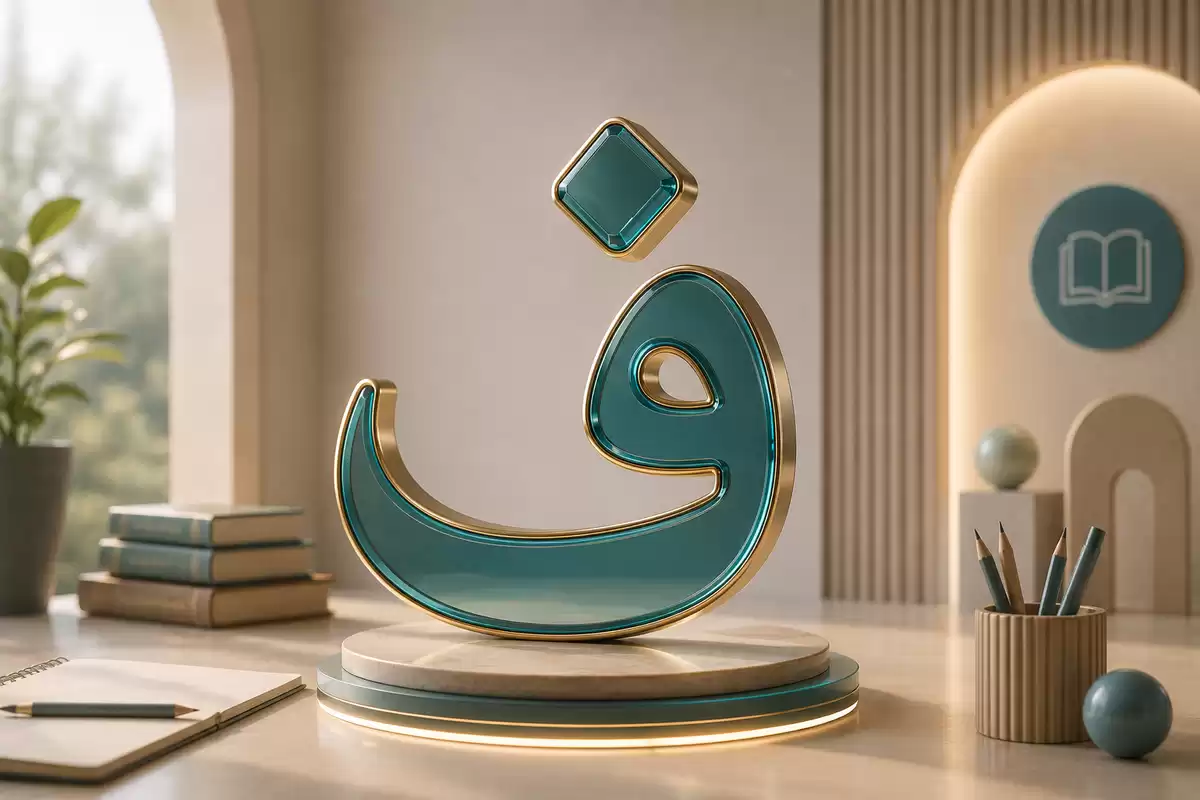
While visually similar, Fa (ف) and Qaaf (ق) are phonetically opposite. Confusing them changes meanings completely (e.g., قَلْب means “heart,” while فَلْب is meaningless).
Articulation Points and Sound Production
- Fa (ف) — Labiodental (Front):
How: Lower lip touches the upper teeth, letting air flow freely and continuously.
Sound: Light (muraqqaq), identical to the English “f”.
- Qaaf (ق) — Uvular (Back):
How: The back of the tongue presses the soft palate, blocking and then releasing the air.
Sound: Heavy (mufakhkham), with a bouncing echo (qalqalah) on sukoon. No English equivalent.
Visual Distinctions in Writing
| Feature | Fa (ف) | Qaaf (ق) |
| Dots | One dot | Two dots |
| Final Shape | Flat, shallow tail resting on baseline | Deep bowl dipping below baseline |
| Initial / Medial | فـ / ـفـ | قـ / ـقـ |
| Final | ـف | ـق |
How does the Arabian Tongue shape your journey of learning the Quran and Arabic?
At Arabian Tongue, we help you understand the Quran deeply and connect with its meanings through simple and effective teaching methods. Our courses are designed to make your learning journey clear, engaging, and spiritually enriching.
Guidance from the Quran and Hadith
قال تعالى: {وَقُل رَّبِّ زِدْنِي عِلْمًا} [سورة طه: 114].
Allah says: “And say, ‘My Lord, increase me in knowledge.’” (Surah Taha 20:114).
قال رسول الله ﷺ: «خَيْرُكُمْ مَنْ تَعَلَّمَ الْقُرْآنَ وَعَلَّمَهُ» [صحيح البخاري: 5027].
Prophet ﷺ said: “The best among you are those who learn the Quran and teach it.” (Sahih al-Bukhari, 5027).
FAQs:
What is the Arabic letter Faa (ف) and how is it pronounced?
Faa is the twentieth letter of the Arabic alphabet, representing a voiceless labiodental fricative — the same sound as the English f in face. It is produced by resting the inner edge of the lower lip against the tips of the upper front teeth and pushing air through the narrow gap without vibrating the vocal cords.
What are the four written forms of the Arabic letter Faa?
Like most Arabic letters, Faa changes shape depending on its position in the word: isolated (ف), initial (فـ), medial (ـفـ), and final (ـف). All four keep the single dot above the letter, while the tail appears only in the isolated and final forms.
What is the difference between the Arabic letters Faa (ف) and Qaaf (ق)?
Visually, Faa carries one dot above, and Qaaf carries tw; and in the final position, Faa has a shallow tail on the baseline while Qaaf dips into a deep bowl below it. Phonetically, they are far apart: Faa is a light lip-and-teeth sound, whereas Qaaf is a heavy, plosive sound made deep at the back of the tongue — the difference between فَلْب (meaningless) and قَلْب (heart).
What are some common examples of Arabic words using the letter Faa?
Faa appears at the start of words like فَتَحَ (he opened), فِيل (elephant), and فَجْر (dawn); in the middle of words like سَفَر (travel) and نَفْس (soul); and at the end of words like خَوْف (fear) and حَرْف (letter). It is also central to everyday vocabulary such as فُنْدُق (hotel) and فِنْجان (cup).
Why is the Arabic letter Faa easy for English speakers to learn?
Faa has a direct equivalent in English, so learners do not need to train a new articulation point or master heaviness (tafkheem) as they do with letters like ق, ص, or ط. The only real adjustment is memorizing its four written shapes and keeping its single dot distinct from the two dots of Qaaf.