
Two months after the defeat at Badr, Quraysh attempted a response that collapsed before it began. The battle of Al-Saweeq is one of the shorter episodes in the Prophet’s biography, yet it carries a name that has kept it memorable for fourteen centuries, drawn from the sacks of provisions a fleeing raiding party abandoned on the road. The expedition reveals how quickly the balance of power had shifted after Badr, how Madinah responded to threats on its edges, and how a vow made in anger produced nothing more than a scattered trail of supplies.
What Was the Battle of Al-Saweeq?
The episode is classified among the campaigns the Prophet led in person, though no fighting took place between the two forces. The defining details are set out below.
- A pursuit rather than an engagement, since the raiders withdrew before contact.
- Launched in response to a night raid on the outskirts of Madinah.
- Involved around two hundred riders from Quraysh under Abu Sufyan ibn Harb.
- Met by a Muslim force that pursued the raiders as far as Qarqarat Al-Kudr.
- Ended with the raiders escaping and their provisions left behind on the route.
When Did the Battle of Al-Saweeq Take Place?
The timing places it directly in the aftermath of Badr, which explains the motive behind it. The table below summarises the key coordinates of the expedition.
| Detail | Description |
| Date | Dhul Hijjah, 2 AH, corresponding to late 624 CE |
| Gap after Badr | Roughly two months |
| Raided area | Al-Urayd, a district on the outskirts of Madinah |
| Pursuit route | Towards Qarqarat Al-Kudr, south of Madinah |
| Quraysh commander | Abu Sufyan ibn Harb |
| Duration | Around five days from the raid to the return |
Abu Sufyan’s Vow After Badr
The raid grew out of a personal oath taken in the weeks following the loss at Badr. Abu Sufyan swore that no water would touch his head for washing until he had struck at Muhammad (peace be upon him), a formal vow of the kind Arab leaders made to bind themselves publicly to an act of revenge. He had escaped Badr with the caravan intact while the senior men of Quraysh were killed, and the pressure on him to act was considerable. To release himself from the oath he needed a visible strike rather than a full campaign, which shaped the limited and hurried nature of what followed.
How the Expedition Unfolded
The sequence of events runs over a few days and moves quickly from raid to retreat. The order was as follows.
- Abu Sufyan left Mecca with around two hundred riders, travelling by a route that avoided detection.
- He stopped with Sallam ibn Mishkam, a chief of Banu Nadir, who gave him information about conditions in Madinah.
- That night the raiders struck Al-Urayd on the edge of the city, burning palm trees and setting fire to two dwellings.
- Two men were killed in the raid, a man of the Ansar and an ally working in the fields.
- The party withdrew immediately towards Mecca rather than pressing further.
- The Prophet gathered a force and pursued them, leaving Abu Lubabah in charge of Madinah.
- The raiders, realising they were being followed, lightened their loads to move faster and escaped.
- The Muslim force reached Qarqarat Al-Kudr, found no enemy, and returned.
Why Is It Called Ghazwat Al-Sawiq?
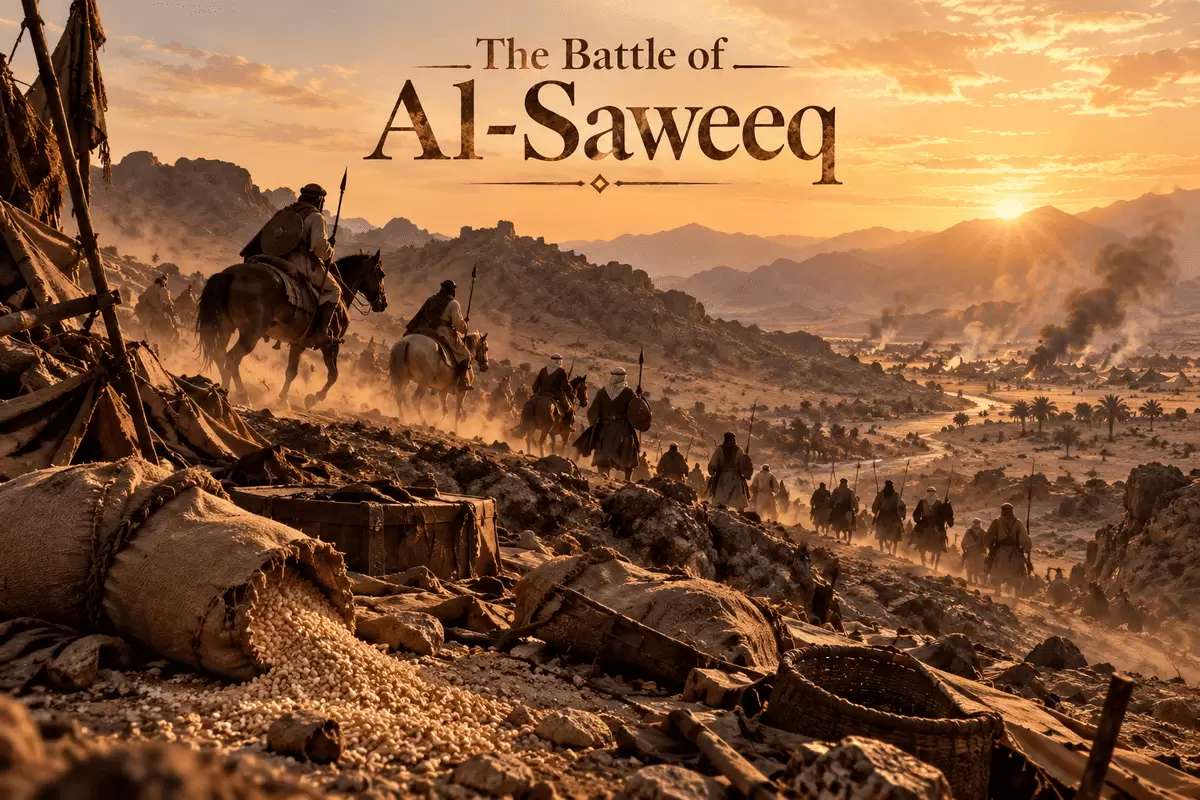
The name comes from what the raiders left behind rather than from anything that happened in combat. Sawiq is a provision of parched barley or wheat, ground and carried in leather sacks, used as travel food because it needed no cooking. As the Quraysh party fled they threw down these sacks to reduce weight and increase speed, scattering them along the route. The pursuing force collected the abandoned supplies, and the expedition took its name from them. The naming itself carried a message, since an army identified by the food it dropped while running had little claim to have avenged anything.
Outcome of the Battle of Al-Saweeq
The results of the expedition were limited in material terms but clear in what they signalled to both sides. The main outcomes are listed here.
- No engagement: the two forces never met, and neither side took losses in the pursuit.
- Two Muslim casualties: both killed during the initial night raid, not in the chase.
- Provisions captured: the sacks of sawiq were gathered by the pursuing force.
- Vow technically fulfilled: Abu Sufyan could claim his oath discharged, though the strike was minor.
- Reputation damaged: the retreat confirmed the impression left by Badr rather than correcting it.
- Madinah secured: the speed of the response discouraged similar raids on the city’s outskirts.
Lessons from the Sawiq Expedition
The episode is short, but it is taught for several principles that recur throughout the biography. The most frequently drawn are these.
- A response made only to satisfy pride tends to be small in effect and costly in reputation.
- Speed of reaction matters: the pursuit began quickly enough to make the city’s edges unattractive as a target.
- Vigilance on the periphery is part of defending a centre, since the raid struck farmland rather than the city itself.
- Internal arrangements matter, shown by the appointment of a deputy over Madinah before the force moved out.
- How an episode is remembered can outweigh its scale, which is why the name attached to the abandoned provisions has lasted.
The Place of Al-Saweeq Among the Early Campaigns
Placing the expedition beside the engagements around it clarifies its weight within the second and third years. The table below gives the comparison.
| Expedition | Date | Nature | Result |
| Badr | Ramadan, 2 AH | Full battle | Decisive Muslim victory |
| Al-Saweeq | Dhul Hijjah, 2 AH | Raid and pursuit | Quraysh withdrawal without contact |
| Uhud | Shawwal, 3 AH | Full battle | Severe Muslim setback |
| Hamra Al-Asad | Shawwal, 3 AH | Pursuit march | Quraysh advance deterred |
Seen in this sequence, Al-Saweeq sits between two major battles as evidence that Quraysh were not yet prepared for a second confrontation. The serious response came a year later at Uhud, after far longer preparation.
Guidance from the Quran and Hadith
قال النبي ﷺ: «كُلُّكُمْ رَاعٍ، وَكُلُّكُمْ مَسْئُولٌ عَنْ رَعِيَّتِهِ» (صحيح البخاري وصحيح مسلم)
The Prophet ﷺ said: “Every one of you is a shepherd, and every one of you is responsible for those under his care.” (Sahih al-Bukhari and Sahih Muslim)
قال الله تعالى: ﴿وَتِلْكَ الْأَيَّامُ نُدَاوِلُهَا بَيْنَ النَّاسِ﴾ (سورة آل عمران 3:140)
Allah says: “And these days We alternate among people.” (Surah Aal-Imran 3:140)
FAQs
Who was left in charge of Madinah during the pursuit?
Abu Lubabah ibn Abd Al-Mundhir was appointed over the city while the force was absent. Appointing a deputy before departure was standard practice in the campaigns the Prophet led personally.
What exactly is sawiq as a food?
It is grain, usually barley or wheat, roasted and ground into a coarse flour that could be mixed with water, dates, or clarified butter. It kept well and required no preparation, which made it standard provision for desert travel.
Did Banu Nadir face consequences for hosting Abu Sufyan?
The visit to Sallam ibn Mishkam is recorded among the grievances that accumulated against Banu Nadir. Their expulsion from Madinah came later, in the fourth year, after a separate and more direct incident.
Was the raid considered a breach of an agreement?
Quraysh had no treaty with Madinah at that stage, so the raid broke no formal pact. The agreements that governed relations with Quraysh came later, most notably at Hudaybiyyah in the sixth year.
How far did the pursuing force travel?
They reached Qarqarat Al-Kudr, a watering place roughly a day's travel south of Madinah on the route towards Mecca. Finding the area empty, the Prophet turned the force back rather than continuing towards Quraysh territory.