
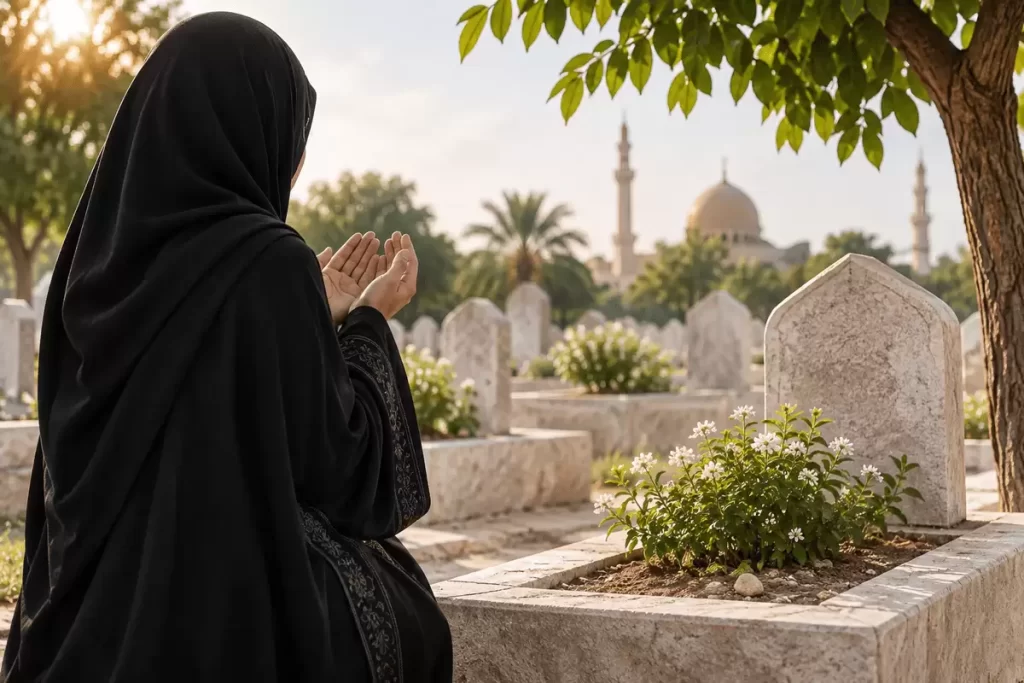
Few questions draw as much discussion as whether women visit graveyards in Islam, because the authentic texts include both a permission and a warning, and scholars have weighed them differently. The Prophet ﷺ first discouraged grave visits, then allowed them, and he taught his wife Aisha what to say when standing among the graves. At the same time, a report about women who visit graves frequently led to different rulings across the schools of jurisprudence. This guide sets out the evidence, the scholarly positions and the etiquette that apply, so the ruling on how women visit graveyards in Islam becomes clear.
Can Women Visit Graveyards in Islam: The Ruling Explained
The ruling depends on how scholars reconcile two groups of texts, one that permits grave visits in general and one that warns women in particular.
Evidence for Permission
- The Prophet ﷺ said he had once forbidden visiting graves and then allowed it, because graves remind a person of the Hereafter, and the permission is general;
- Aisha asked the Prophet ﷺ what she should say when visiting the graves, and he taught her a greeting and a supplication instead of forbidding her;
- The Prophet ﷺ met a woman weeping beside a grave and advised her to fear Allah and be patient, without telling her to leave the cemetery;
- Aisha herself is reported to have visited the grave of her brother, which scholars cite as a sign that the Companions understood the permission to include women.
Evidence for Restriction
The restriction rests on one main report, and scholars have understood it in different ways, as the points below show:
- A report states that the Prophet ﷺ cursed women who visit graves frequently, and this is the main text cited by those who restrict the practice;
- Some scholars, among them Al-Qurtubi, understood the curse as aimed at frequent visits because of what they may lead to, such as neglecting family duties, wailing and displaying beauty;
- Others took it as a general warning against women visiting at all;
- The wording of the report also uses an intensive form, which supports the view that the warning targets repeated visits and not an occasional visit made for remembrance and prayer.
قال النبي ﷺ: «نَهَيْتُكُمْ عَنْ زِيَارَةِ الْقُبُورِ فَزُورُوهَا»
(صحيح مسلم، حديث 977a)
The Prophet ﷺ said: “I had forbidden you from visiting graves, but now visit them.”
(Sahih Muslim 977a)
Scholarly Positions on Women Visiting Graves
Because the texts point in two directions, jurists reached three positions, and the table below compares each one with its reasoning.
| Position | Reasoning | Held by |
| Permissible with conditions | The general permission covers men and women, and the curse applies to excess or forbidden conduct | Many scholars, including numerous Hanafi jurists |
| Disliked but not forbidden | The curse signals reproach, yet the permission and the Prophet’s treatment of women at graves prevent a full prohibition | Many classical jurists in the Shafi’i and Hanbali schools |
| Prohibited | The curse is taken as proof of prohibition | Some scholars, and some official fatwa bodies today |
This is a recognised scholarly disagreement, so a woman may follow a trusted scholar or the fatwa authority of her country.
Men and Women at the Graveyard
The rulings overlap in most respects, and the table below shows where the guidance is shared and where it differs.
| Aspect | Men | Women |
| Permission to visit | Established by the general hadith | Established by the same hadith, with scholarly disagreement over the curse |
| Greeting and supplication | The same words and the same purpose | The same words, as taught to Aisha |
| Wailing and striking the cheeks | Forbidden | Forbidden, with stronger warnings against it |
| Frequency | No specific caution | Caution against frequent visits, based on the report of the curse |
Conditions and Etiquette for Women at the Graveyard
Even scholars who permit the visit attach clear conditions whenever women visit graveyards in Islam, all aimed at protecting its purpose, which is remembrance and prayer.
- Wear modest clothing, avoid perfume and avoid displaying adornment;
- Refrain from wailing, striking the cheeks and tearing clothes, all of which the Prophet ﷺ prohibited;
- Do not ask the dead for help or treat graves as sources of blessing, since supplication belongs to Allah alone;
- Avoid sitting on or walking over graves, and keep the voice low;
- Choose a safe and suitable time, and go with a companion where possible;
- Keep visits balanced, so they never interfere with family duties or become excessive.
The greeting taught to Aisha means: peace be upon you, people of these abodes among the believers and Muslims; we will join you, Allah willing; we ask Allah for well-being for us and for you.
قال النبي ﷺ: «لَيْسَ مِنَّا مَنْ لَطَمَ الْخُدُودَ، وَشَقَّ الْجُيُوبَ، وَدَعَا بِدَعْوَى الْجَاهِلِيَّةِ»
(صحيح البخاري، حديث 1294)
The Prophet ﷺ said: “The one who strikes the cheeks, tears the clothes, and calls with the calls of the pre-Islamic period is not following our way.”
(Sahih al-Bukhari 1294)
Benefits of Visiting Graves
Visiting graves is encouraged because it serves clear spiritual purposes, which is why many scholars permit women to share in it under the conditions above.
- It reminds the visitor of death and the Hereafter;
- It softens the heart and reduces attachment to worldly gain;
- It allows the visitor to pray for the deceased and ask Allah to forgive them.
How does the Arabian Tongue shape your journey of learning the Quran and Arabic?
At Arabian Tongue, we help you understand the Quran deeply and connect with its meanings through simple and effective teaching methods. Our courses are designed to make your learning journey clear, engaging, and spiritually enriching.
Guidance from the Quran and Hadith
قال النبي ﷺ: «السَّلَامُ عَلَى أَهْلِ الدِّيَارِ مِنَ الْمُؤْمِنِينَ وَالْمُسْلِمِينَ»
(صحيح مسلم، حديث 974b)
The Prophet ﷺ said: “Peace be upon the inhabitants of these dwellings among the believers and Muslims.”
(Sahih Muslim 974b)
قال الله تعالى: ﴿لَا يُكَلِّفُ اللَّهُ نَفْسًا إِلَّا وُسْعَهَا﴾ (سورة البقرة 2:286)
Allah says: “Allah does not burden any soul beyond its capacity.” (Surah Al-Baqarah 2:286)
FAQs
Can women attend a funeral procession or burial?
Umm Atiyyah reported that women were discouraged from following funeral processions, but it was not made binding upon them. Scholars therefore regard it as disliked for women to walk with the procession to the grave, while praying for the deceased, offering condolences and attending the funeral prayer where it is arranged remain permitted.
Does menstruation prevent a woman from entering a cemetery?
No, scholars state that menstruation does not prevent a woman from entering a cemetery, because a graveyard is not a mosque and has no prayer area that requires ritual purity. She may stand, make supplication and greet the deceased, provided she follows the etiquette of modesty and respect.
Is there a special day or time for visiting graves?
No authentic text assigns a particular day, date or fixed gathering for grave visits, so a woman may visit whenever it is convenient and safe. The Prophet ﷺ visited the cemetery of Al-Baqi’ himself, and scholars advise against inventing customary rituals, such as fixed days of mourning, that have no basis in the Sunnah.
Can a woman visit the grave of a non-Muslim relative?
Yes, the Prophet ﷺ visited his mother’s grave and wept, which shows that visiting a non-Muslim relative is permitted for reflection and remembrance. However, he was not permitted to seek forgiveness for her, so a visitor must not pray for the forgiveness of those who died without faith.
Does the deceased still benefit if a woman cannot visit the grave?
Yes, a visit is not required for the deceased to benefit. Supplication, continuing charity given on their behalf and a righteous child who prays for them all reach them wherever the believer is, as the Prophet ﷺ taught that these deeds continue to benefit a person after death.