
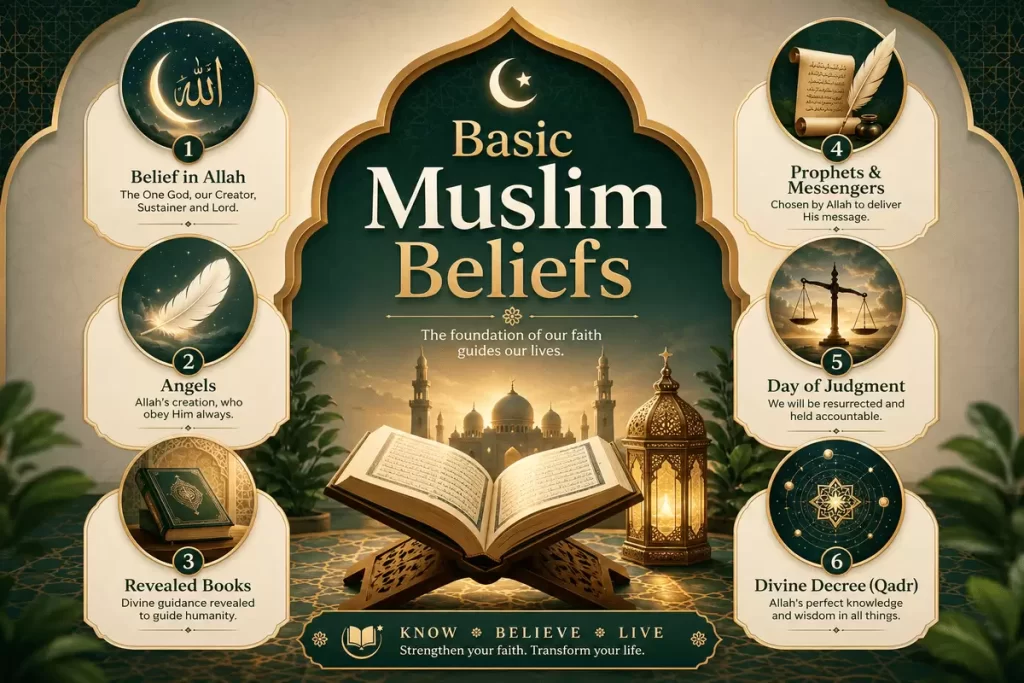
What defines the soul of a believer and provides an unwavering compass in a changing world? Beyond the surface of rituals lies a profound spiritual architecture that has guided millions for centuries. These basic muslim beliefs are not just ancient doctrines; they are the vibrant heartbeat of a faith built on clarity, purpose, and divine connection. From the mysteries of the unseen to the ultimate destiny of mankind, each principle unveils a new layer of truth. Step inside to explore the pillars that hold a global civilization together.
What are the basic Muslim beliefs?
The Islamic faith is built on profound basic Muslim beliefs known as Aqeedah. These core principles serve as a spiritual compass, shaping a believer’s worldview, moral values, and relationship with the Divine. Understanding these fundamentals is essential to grasping the essence of Islam.
The Practical Impact of Belief
These basic Muslim beliefs are lived experiences that influence daily actions and decisions:
- Belief in Allah: Recognizing God as the sole Creator and Sustainer, which fosters gratitude, humility, and trust in divine wisdom.
- Belief in the Day of Judgment: Serving as a reminder of accountability and encouraging a life of righteousness.
A Cohesive Framework
The beauty of Islam lies in the simplicity and clarity of its basic Muslim beliefs. They form an interconnected framework that addresses both the spiritual and practical dimensions of life, offering answers to humanity’s most profound questions. For those seeking depth, structured study through an Aqeedah Course—whether you learn Aqeedah online or join a specialized program—is the first step toward building a strong spiritual foundation.
The Meaning of Faith in Islam
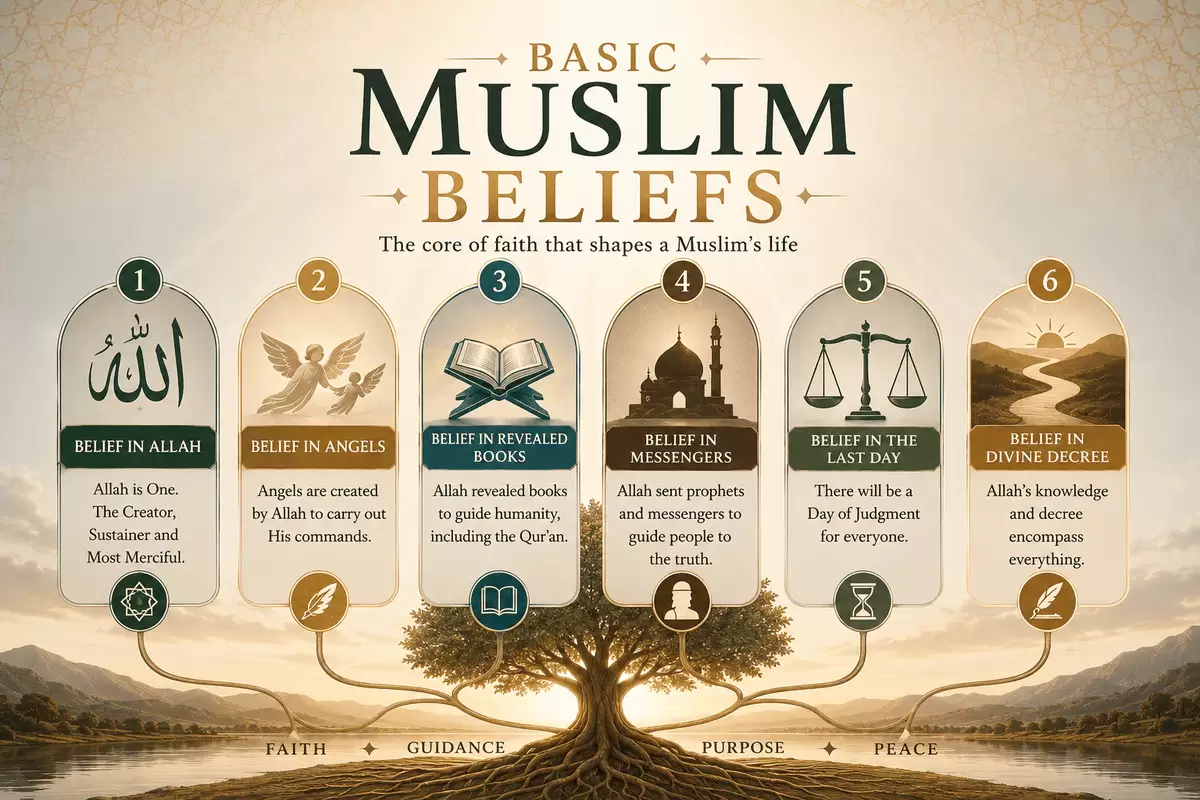
Faith (Iman) in Islam is a dynamic experience encompassing conviction, submission, and devotion. It is an active state of being that grows with knowledge and reflection. Faith consists of six key articles, which are not just intellectual acknowledgments but are lived through actions and intentions.
1. Belief in Allah (God)
This is the fundamental cornerstone of faith, known as Tawheed (Oneness of God). It encompasses three principles:
- Oneness in Lordship: Allah is the sole creator and sustainer of the universe.
- Oneness in Worship: Muslims direct all acts of devotion solely to Allah.
- Oneness in Names and Attributes: Allah has perfect names, such as Al-Rahman (The Merciful), describing His essence.
2. Belief in Angels
Angels are pure beings created from nur (light) who carry out Allah’s commands without disobedience. Their roles include:
- Recording Deeds: Tracking every word and action for accountability.
- Delivering Revelations: Such as Angel Jibril delivering the Quran.
- Protection: Guarding believers and managing natural phenomena like rain and wind.
3. Belief in the Holy Books
This reflects Allah’s continuous guidance through history via revealed scriptures:
- The Quran: The final, unaltered word of Allah to Prophet Muhammad.
- The Torah (Tawrat): Revealed to Prophet Moses.
- The Psalms (Zabur): Given to Prophet David.
- The Gospel (Injeel): Revealed to Prophet Jesus.
- The Scrolls of Abraham: Guidance for Prophet Abraham.
4. Belief in the Prophets and Messengers
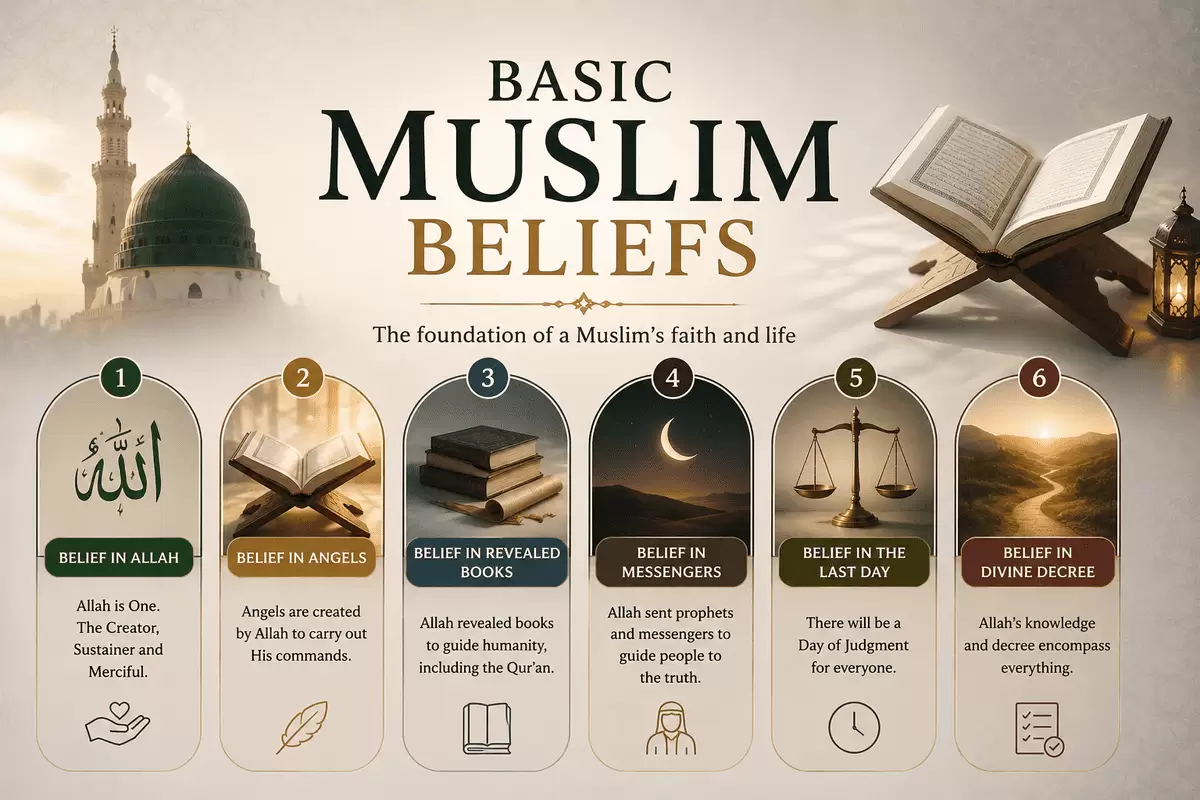
Muslims recognize a lineage of prophets (Anbiya) and messengers (Rusul) sent to guide humanity to monotheism.
- Prophets & Messengers: Prophets reinforce ethical living, while Messengers bring new scriptures and miracles (Mu’jizat).
- Key Figures: Including Adam (the first human), Noah, Abraham, Moses, Jesus, and Muhammad (the final messenger).
- Core Message: All prophets called for worshipping Allah alone, following divine laws, and seeking justice.
5. Belief in the Day of Judgment
Known as Yawm al-Qiyamah, this belief serves as a reminder of accountability. Key events include:
- The Trumpet Blast: Signalling the end of the world and the resurrection of all humanity.
- The Weighing of Deeds: Every individual’s actions will be judged with absolute justice.
- The Siraat: A bridge over Hellfire that only the righteous will cross to reach Paradise.
- Signs: The Day is preceded by signs, such as the emergence of the Dajjal and the descent of Prophet Jesus.
How does the Arabian Tongue shape your journey of learning the Quran and Arabic?
At Arabian Tongue, we help you understand the Quran deeply and connect with its meanings through simple and effective teaching methods. Our courses are designed to make your learning journey clear, engaging, and spiritually enriching.
Guidance from the Quran and Hadith
قال الله تعالى: {آمَنَ الرَّسُولُ بِمَا أُنزِلَ إِلَيْهِ مِن رَّبِّهِ وَالْمُؤْمِنُونَ ۚ كُلٌّ آمَنَ بِاللَّهِ وَمَلَائِكَتِهِ وَكُتُبِهِ وَرُسُلِهِ لَا نُفَرِّقُ بَيْنَ أَحَدٍ مِّن رُّسُلِهِ} [سورة البقرة: 285]
Allah the Almighty said: “The Messenger has believed in what was revealed to him from his Lord, and [so have] the believers. All of them have believed in Allah and His angels and His books and His messengers, [saying], ‘We make no distinction between any of His messengers.'” [Surah Al-Baqarah: 285]
قال رسول الله صلى الله عليه وسلم حين سُئل عن الإيمان: “أَنْ تُؤْمِنَ بِاللَّهِ، وَمَلَائِكَتِهِ، وَكُتُبِهِ، وَرُسُلِهِ، وَالْيَوْمِ الْآخِرِ، وَتُؤْمِنَ بِالْقَدَرِ خَيْرِهِ وَشَرِّهِ” [رواه مسلم]
The Prophet (peace be upon him) said when asked about faith (Iman): “It is to believe in Allah, His angels, His books, His messengers, the Last Day, and to believe in the divine decree (Qadar), both its good and its evil.” [Narrated by Muslim]
FAQs
What do Muslims believe about Allah?
Muslims believe in Tawheed, the absolute oneness of Allah as the sole Creator and Sustainer of the universe. He is described through perfect attributes, such as being All-Merciful and All-Powerful, with no partners or equals.
Who are the prophets in Islam?
Prophets are divinely chosen men, starting from Adam to Muhammad (peace be upon them), sent to guide humanity to monotheism. Key figures include Noah, Abraham, Moses, and Jesus, all of whom delivered the same core message of devotion to one God.
What are the Five Pillars of Islam?
The Five Pillars are the mandatory acts of worship: the testimony of faith (Shahada), daily prayers (Salah), almsgiving (Zakat), fasting during Ramadan (Sawm), and the pilgrimage to Mecca (Hajj). They form the practical foundation of a Muslim's life and devotion.
Why is the Quran important to Muslims?
The Quran is revered as the literal, unaltered word of Allah revealed to the Prophet Muhammad as the final guidance for mankind. It serves as a comprehensive manual for life, providing spiritual, moral, and legal directions for all believers.