
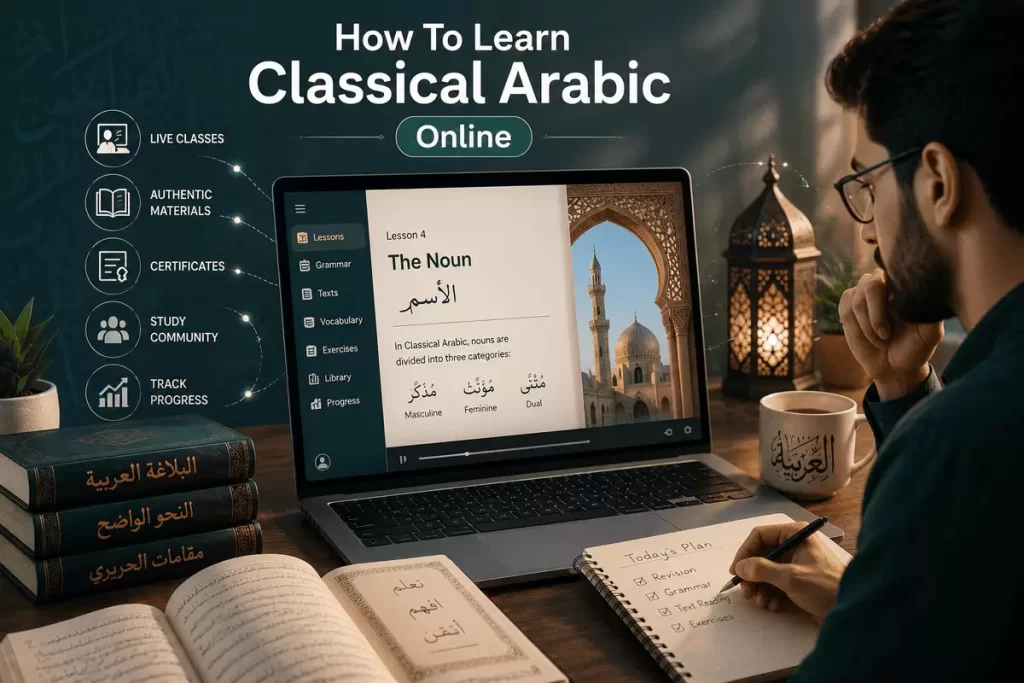
Classical Arabic is not a dead language. It is the language in which Allah chose to reveal His final message, the language in which the greatest scholars of human history wrote their most profound works, and the language that connects over a billion Muslims to their faith across fourteen centuries. Learning how to learn Classical Arabic online today means stepping into that living tradition, gaining direct access to its texts, its wisdom, and its timeless beauty from anywhere in the world.
How to Learn Classical Arabic Online?
Embarking on the journey of learning Classical Arabic online is a rewarding decision that opens doors to understanding one of the world’s most influential languages. Classical Arabic, the language of the Quran and ancient Islamic texts, remains the foundation of modern Arabic dialects, and with the rise of digital learning platforms, mastering it has never been more accessible.
Whether you are a complete beginner or someone looking to deepen existing knowledge, online resources provide flexibility, structured learning, and expert guidance. The key to success lies in choosing the right tools, setting clear goals, and maintaining consistency throughout the journey.
Why Learn Classical Arabic Online
The decision to learn Classical Arabic online is driven by a combination of cultural, religious, academic, and professional motivations:
- Religious significance: For Muslims, Classical Arabic is the language of the Quran, Hadith, and Islamic scholarship, and understanding it allows for deeper engagement with sacred texts and a stronger spiritual connection.
- Literary and cultural heritage: Classical Arabic serves as a bridge to the rich literary tradition of the Arab world, including poetry, philosophy, and historical documents that span centuries.
- Academic necessity: Students of Middle Eastern studies, Islamic history, and linguistics often require Classical Arabic proficiency for advanced university programs and research institutions.
- Professional opportunities: Fluency opens doors in translation, diplomacy, and international business, particularly in regions where Arabic is widely spoken and valued.
- Foundation for modern dialects: Learning Classical Arabic improves understanding of contemporary spoken forms, as many modern dialects retain grammatical and lexical roots from the classical language.
- Accessibility of online learning: Digital platforms provide structured courses, interactive lessons, and access to native speakers with the flexibility to study at your own pace from anywhere in the world.
Differences Between Classical and Modern Standard Arabic
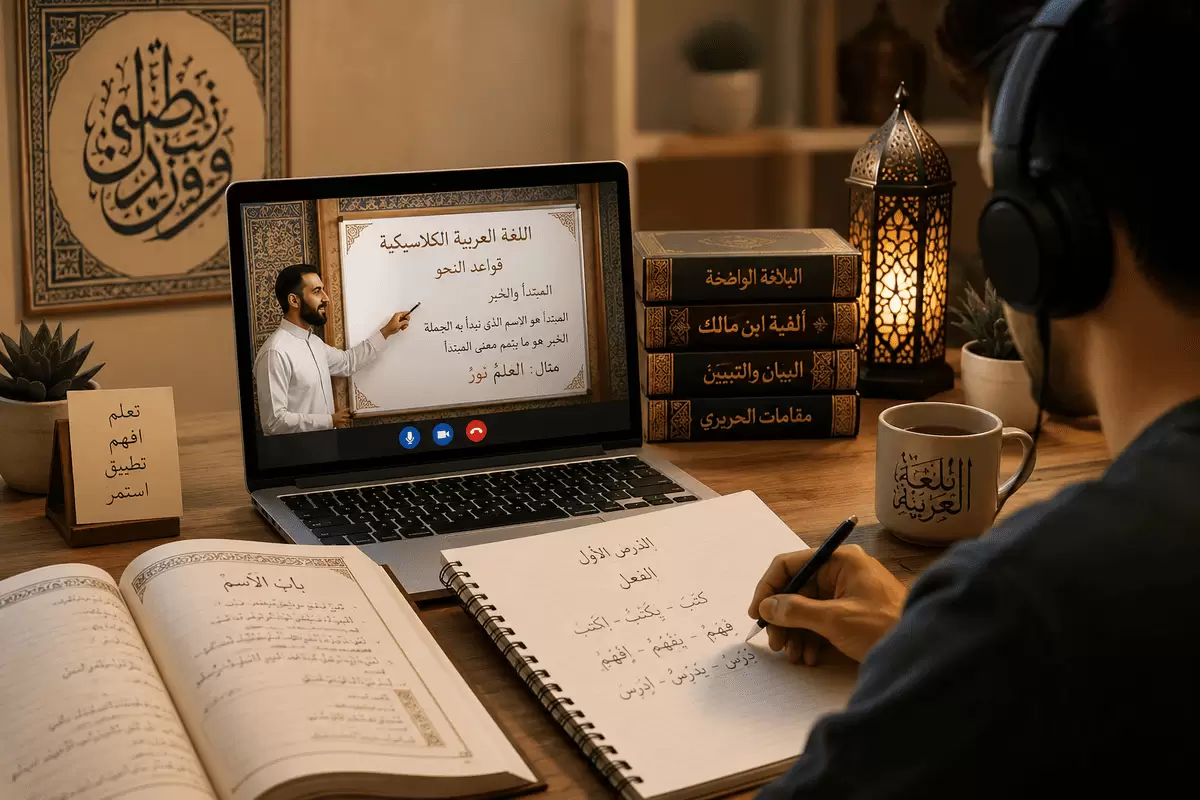
While Classical Arabic and Modern Standard Arabic (MSA) share a common linguistic foundation, they differ significantly in usage, vocabulary, and grammatical nuances. Understanding these differences is crucial for learners, as studying both simultaneously can enhance overall proficiency since the two forms complement each other.
| Feature | Classical Arabic | Modern Standard Arabic (MSA) |
| Primary Use | Quran, ancient texts, and pre-Islamic poetry | News, formal writing, and official documents |
| Vocabulary | Archaic words and poetic expressions | Modernized vocabulary and simplified terms |
| Grammar | Complex and rigid structures with wider verb conjugations | Simplified and more accessible grammar |
| Pronunciation | Retains older phonetic rules | Some phonetic changes adapted for modern speech |
| Learning Curve | Steeper due to archaic grammatical elements | Easier for beginners with a modern context |
| Example | “Qāla Allāhu” (قال الله) — formal Quranic usage | “Qāla Allāh” (قال الله) — same meaning, different contextual application |
Benefits of Online Learning for Arabic
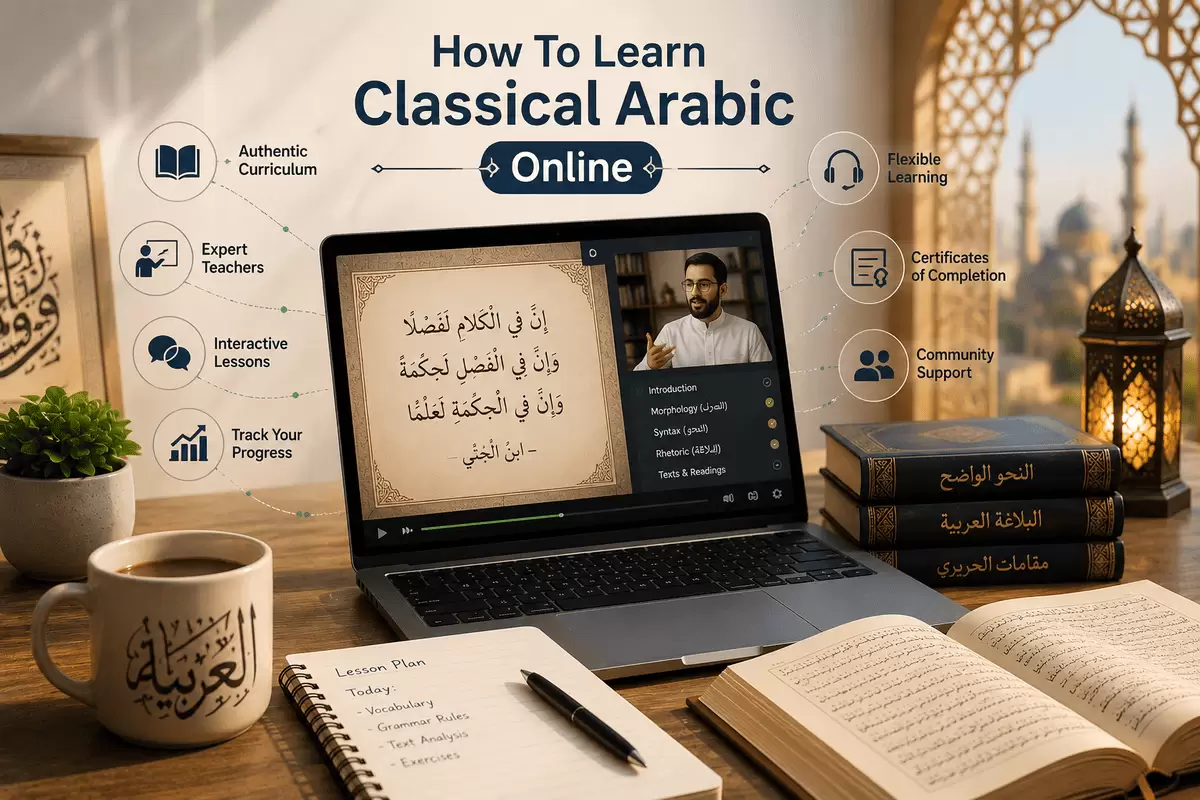
Learning Classical Arabic online offers numerous advantages over traditional in-person methods, making it the preferred choice for learners worldwide seeking flexibility, quality, and accessibility.
Advantages of online learning for Classical Arabic:
- Flexibility in scheduling: Study at any time from anywhere, pausing and revisiting lessons as needed while balancing other life commitments.
- Access to diverse resources: Structured courses, video lessons, audio recordings of native speakers, and written classical texts are all available in one place.
- Personalized learning experience: Adaptive learning paths tailored to individual strengths, with progress tracking and performance analytics.
- Global community and support: Connect with learners and instructors worldwide through discussion forums and language exchange groups.
- Cost-effectiveness: More affordable than in-person courses with no travel costs and access to free beginner resources.
- Multimedia and interactive tools: Engaging video lessons, interactive quizzes, and gamified learning experiences that make practice enjoyable.
Essential Steps for Beginners Learning Classical Arabic Online
- Master the Arabic script: Learn all 28 letters in their isolated, initial, medial, and final forms, focusing on challenging letters like “ع” (ayn), “غ” (ghayn), and “ض” (dad).
- Understand basic pronunciation rules: Learn vowel sounds (fatha, kasra, damma), practice distinguishing similar sounds, and listen to native speakers to train your ear.
- Build a foundation in grammar: Start with noun cases, verb conjugations, dual and plural forms, and basic sentence structure before advancing to complex grammatical concepts.
- Expand vocabulary with thematic lists: Begin with high-frequency words organized by themes, using flashcards and root-letter patterns to understand how words are derived from a single base.
Common Challenges for Beginners and How to Overcome Them
- Memorizing the Arabic script: Practice writing letters daily and use typing apps to reinforce recognition.
- Understanding verb conjugations: Start with the present and past tense for first and third person, using conjugation tables and verb drills.
- Noun cases: Learn case endings and use color-coding in textbooks to visualize differences between nominative, accusative, and genitive.
- Guttural letter pronunciation: Listen to native speakers repeatedly and practice tongue placement through minimal pair exercises.
- Motivation and consistency: Set small daily goals, track progress, and join online communities for accountability.
Intermediate Strategies for Learning Classical Arabic Online
Once a foundation is established, intermediate learners should focus on deepening understanding through:
- Immersion in classical texts: Begin with simplified Quran commentaries (Tafsir) and gradually transition to unvocalized text, incorporating Tajweed rules for accurate pronunciation.
- Grammar mastery: Study derived verb forms (Form I–X), particles and conjunctions, idiomatic expressions, and syntax in complex sentences with relative pronouns and conditional structures.
- Advanced reading resources: Progress through Tafsir Ibn Kathir, Sahih al-Bukhari with Arabic text, and classical literature such as simplified versions of One Thousand and One Nights.
- Listening and pronunciation practice: Watch recitations by renowned Qaris such as Abdul Rahman Al-Sudais and listen to classical Arabic podcasts and audiobooks to train the ear for natural speech patterns.
How does the Arabian Tongue shape your journey of learning the Quran and Arabic?
At Arabian Tongue, we help you understand the Quran deeply and connect with its meanings through simple and effective teaching methods. Our courses are designed to make your learning journey clear, engaging, and spiritually enriching.
Guidance from the Quran and Hadith
قال الله تعالى: “وَكَذَٰلِكَ أَنزَلْنَاهُه حُكْمًا عَرَبِيًّا” — سورة الرعد: ٣٧
Allah said: “And thus We have revealed it as an Arabic legislation.” — Ar-Ra’d: 37
قال رسول الله ﷺ: “تَعَلَّمُوا الْعَرَبِيَّةَ وَعَلِّمُوهَا النَّاسَ” — رواه الطبراني، عن عمر بن الخطاب رضي الله عنه
The Prophet ﷺ said: “Learn Arabic and teach it to the people.” — Narrated by At-Tabarani, on the authority of Umar ibn Al-Khattab (may Allah be pleased with him)
FAQs
What are the main differences between Classical Arabic and Modern Standard Arabic?
Classical Arabic preserves the archaic grammar, vocabulary, and poetic expressions of 7th-century Arabia, serving as the language of the Quran, Hadith, and pre-Islamic literature. Modern Standard Arabic evolved as a simplified and modernized form for contemporary communication, incorporating modern vocabulary while retaining the core grammatical structure of Classical Arabic.
How long does it take to become proficient in Classical Arabic?
Most dedicated learners can develop a functional reading ability in Classical Arabic within one to two years of consistent, structured study. Reaching advanced proficiency that allows independent engagement with classical texts such as the Quran and Hadith, however, typically requires three to five years of disciplined daily study combined with regular practice with authentic classical materials.
Which online platforms are best for learning Classical Arabic?
The best platforms combine structured curricula, qualified native-speaking instructors, interactive exercises, and multimedia resources that progress systematically from alphabet recognition to advanced grammar and classical text analysis. Look for platforms offering dedicated Classical Arabic programs rather than general modern Arabic courses, as the linguistic focus and teaching methodology differ significantly between the two.
Do I need to learn grammar first when studying Classical Arabic?
A basic understanding of grammar is essential from the very beginning, as Classical Arabic's complex noun cases, verb conjugations, and sentence structures are fundamental to reading and understanding any text accurately. However, grammar should be learned alongside vocabulary and reading practice rather than in complete isolation, as applying grammatical concepts to real classical texts from early on accelerates both comprehension and retention significantly.