
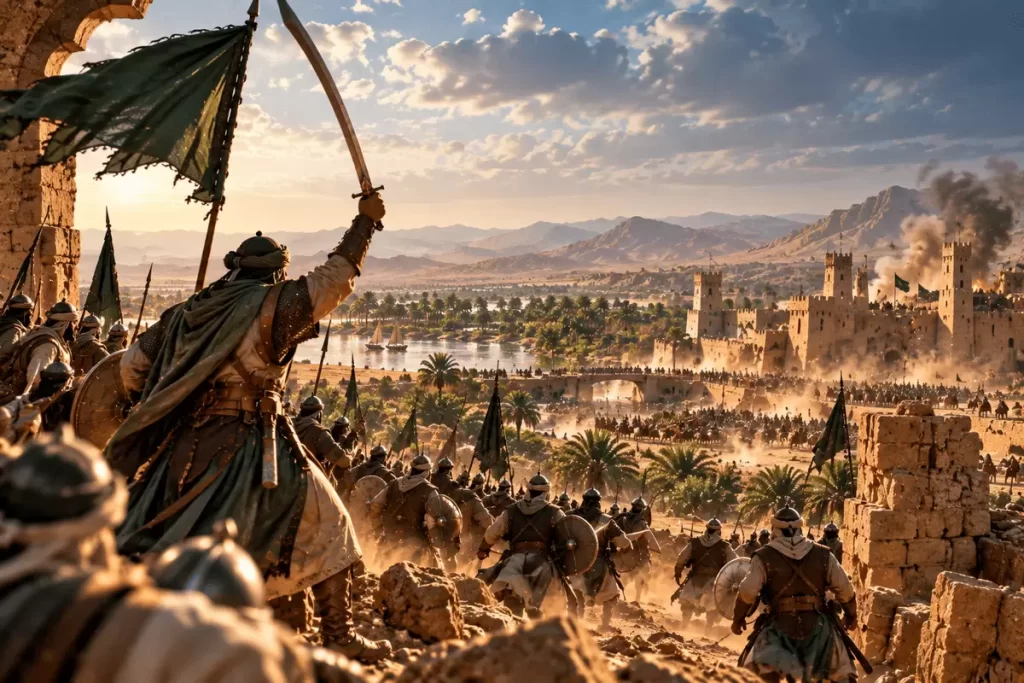
The Battle of Al-Asherah, known in Arabic as Ghazwat Al-Ushayrah, was one of the earliest military expeditions led by Prophet Muhammad ﷺ after the migration to Medina. No fighting took place, but the campaign shaped the strategic balance between the Muslims and Quraysh in the months before Badr. It also preserved a memorable moment of warmth in Islamic tradition, when the Prophet gave Ali ibn Abi Talib the nickname “Abu Turab.” Understanding this expedition shows how the early Muslim community secured alliances, protected its interests, and prepared for the decisive events of the second year of the Hijrah.
What Was the Battle of Al-Asherah?
The Battle of Al-Asherah was an expedition rather than a battle in the full sense, since the Muslims returned without combat. Historians count it among the ghazawat, the campaigns the Prophet ﷺ led in person. A brief Ghazwat Al-Ushayrah summary includes these points:
- Type: a personal expedition (ghazwah) led by the Prophet ﷺ.
- Aim: intercepting a Quraysh trade caravan bound for Syria.
- Participants: around 150 to 200 of the Muhajirun.
- Result: no fighting, but new treaties with local tribes.
قال الله تعالى:﴿وَأَعِدُّوا لَهُم مَّا اسْتَطَعْتُم مِّن قُوَّةٍ﴾(سورة الأنفال 8:60)
Allah says: “And prepare against them whatever you are able of power.” (Surah Al-Anfal 8:60)
Battle of Al-Ushayra Date and Location
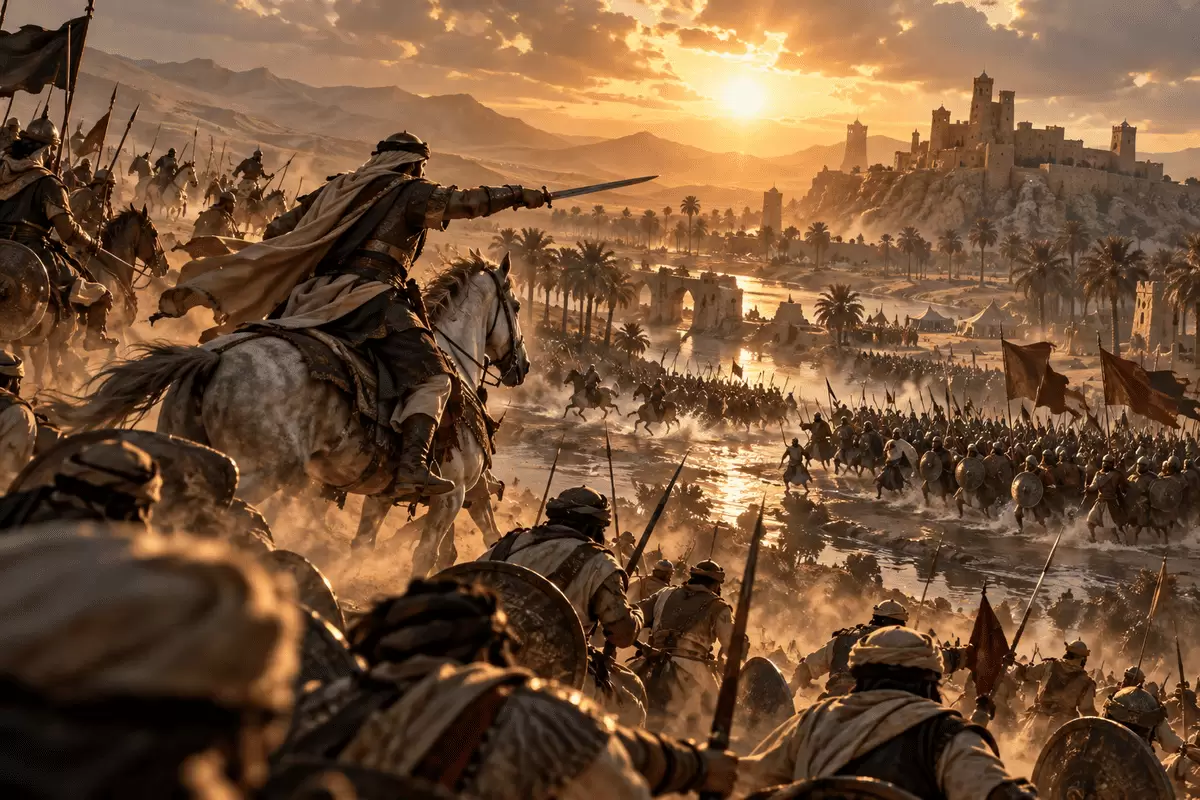
Placing the expedition in time and space clarifies its purpose. The route, the season, and the tribes living along the coast all influenced the decisions the Prophet ﷺ made during the campaign.
When Did It Take Place?
Most biographers place the expedition in Jumada al-Ula of 2 AH, corresponding to late 623 CE. The Muslims remained in the area for the rest of that month and a few nights of Jumada al-Akhirah before returning to Medina.
Where Is Al-Ushayrah?
Al-Ushayrah lies in the valley of Yanbu, between Mecca and Medina, near the Red Sea coast. Its geography mattered for several reasons:
- It sat directly on the trade road linking Mecca to Syria.
- It belonged to the lands of Banu Mudlij, a tribe with strong local influence.
- Its water sources made it a natural stop for passing caravans.
The Quraysh Caravan at Al-Ushayrah
Trade was the lifeline of Quraysh, and its caravans to Syria carried wealth that partly came from property the Muslims had been forced to leave behind in Mecca. The events of the expedition unfolded in a clear sequence:
- News reached Medina that a large Qurayshi caravan led by Abu Sufyan was heading north.
- The Prophet ﷺ set out with his companions to intercept it near Al-Ushayrah.
- On arrival, the Muslims learned that the caravan had passed a few days earlier.
- The same caravan’s return journey, months later, led to the Battle of Badr.
قال الله تعالى: ﴿وَإِذْ يَعِدُكُمُ اللَّهُ إِحْدَى الطَّائِفَتَيْنِ أَنَّهَا لَكُمْ وَتَوَدُّونَ أَنَّ غَيْرَ ذَاتِ الشَّوْكَةِ تَكُونُ لَكُمْ﴾
(سورة الأنفال 8:7)
Allah says: “And remember when Allah promised you that one of the two groups would be yours, and you wished that the unarmed one would be yours.”
(Surah Al-Anfal 8:7)
The Army and Leadership of the Expedition
Although small, the force was organized with care. Its composition reflects the limited resources of the young Muslim state in its second year and the discipline that held it together.
- Abu Salamah ibn Abd al-Asad was appointed to govern Medina in the Prophet’s absence.
- Hamzah ibn Abd al-Muttalib carried the white banner of the expedition.
- The companions shared about thirty camels, riding in turns throughout the journey.
The Prophet Naming Ali “Abu Turab”
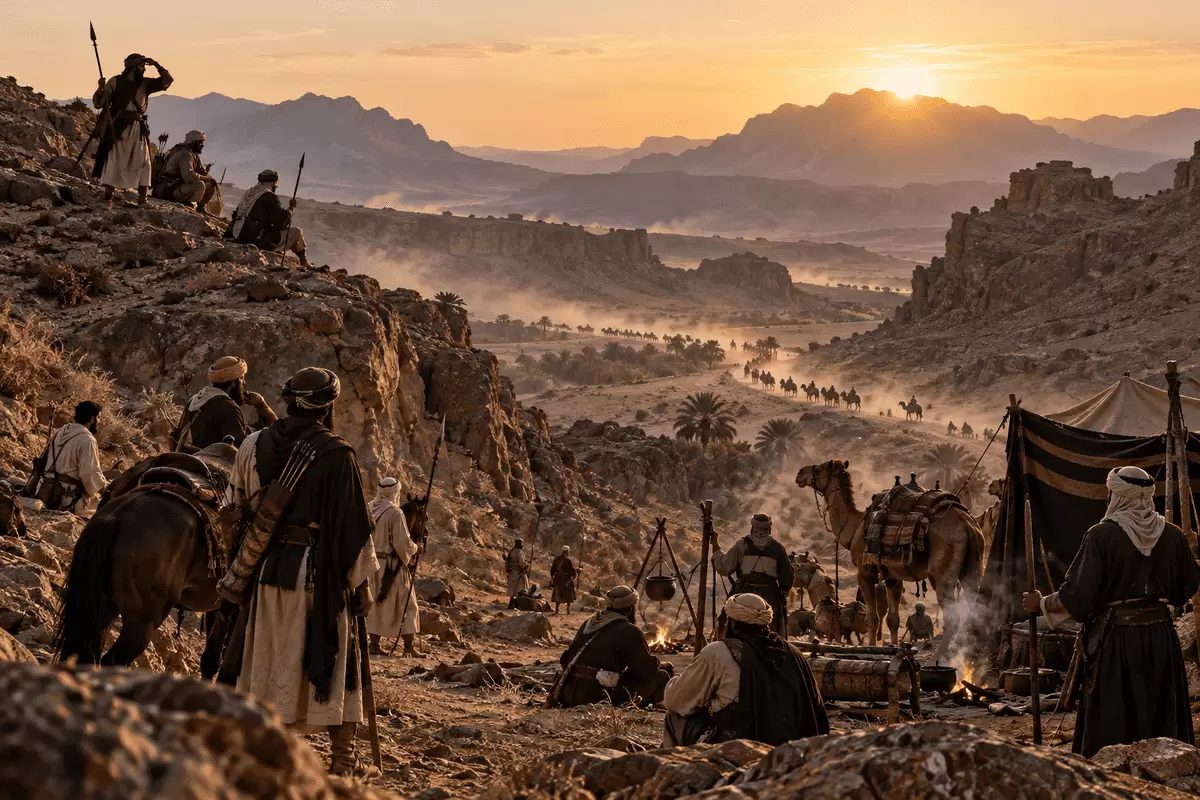
One of the most cherished episodes connected to the Battle of Al-Asherah involves Ali ibn Abi Talib. Ammar ibn Yasir narrated that he and Ali rested under palm trees during the expedition and fell asleep on the dusty ground. The Prophet ﷺ came to wake them and, seeing Ali covered in earth, called him “Abu Turab,” meaning “father of dust.” The nickname carried several meanings:
- It expressed the Prophet’s affection and gentle humor toward his cousin.
- It became the name Ali loved more than any other.
- It reflected a life of simplicity and humility.
Another well-known report in Sahih al-Bukhari links the same nickname to a different occasion in the mosque of Medina. Scholars have reconciled the two accounts by suggesting that the Prophet ﷺ used the name on more than one occasion.
قال عمار بن ياسر رضي الله عنه: «كُنْتُ أَنَا وَعَلِيٌّ رَفِيقَيْنِ فِي غَزْوَةِ ذَاتِ الْعُشَيْرَةِ»
ثم قال في روايته:
«فِيَوْمَئِذٍ قَالَ رَسُولُ اللَّهِ ﷺ لِعَلِيٍّ: يَا أَبَا تُرَابٍ، لِمَا يَرَى عَلَيْهِ مِنَ التُّرَابِ»
(مسند أحمد؛ والسنن الكبرى للنسائي، حديث 8538)
Ammar ibn Yasir رضي الله عنه narrated: “Ali and I were companions during the expedition of Dhat Al-Ushayrah.”
He continued:
“On that day, the Messenger of Allah ﷺ said to Ali, ‘O Abu Turab,’ because of the dust he saw covering him.”
(Musnad Ahmad; Al-Sunan Al-Kubra by Al-Nasa’i 8538)
Outcome of Ghazwat Al-Ushayrah
The Muslims returned without capturing the caravan, yet the expedition was far from a failure. Its results appeared on political, strategic, and practical levels:
- A non-aggression treaty with Banu Mudlij and their allies from Banu Damrah.
- A stronger Muslim presence along the vital western trade route.
- Valuable information on the movements of Qurayshi caravans.
- Direct preparation for Badr, which followed when the same caravan returned from Syria.
Lessons from the Battle of Al-Asherah
Students of the Seerah find practical guidance in the Battle of Al-Asherah, even though no swords were drawn. Several lessons stand out:
- Diplomacy can achieve what force cannot, as the tribal treaties showed.
- Effective leadership includes delegation, seen in the appointment of Abu Salamah.
- Shared hardship, such as riding camels in turns, builds unity and equality.
- Kindness from leaders strengthens bonds, as the “Abu Turab” moment demonstrates.
Final Thoughts on the Battle of Al-Asherah
The Battle of Al-Asherah reminds readers that the early Islamic campaigns were not only about confrontation. Through careful planning, wise alliances, and genuine compassion, the Prophet ﷺ laid the groundwork for the major turning points that soon followed.
How does the Arabian Tongue shape your journey of learning the Quran and Arabic?
At Arabian Tongue, we help you understand the Quran deeply and connect with its meanings through simple and effective teaching methods. Our courses are designed to make your learning journey clear, engaging, and spiritually enriching.
Guidance from the Quran and Hadith
قال سهل بن سعد رضي الله عنه: «فَوَاللَّهِ مَا سَمَّاهُ إِلَّا النَّبِيُّ ﷺ، وَمَا كَانَ لَهُ اسْمٌ أَحَبَّ إِلَيْهِ مِنْهُ»
(صحيح البخاري، حديث 3703)
Sahl ibn Sa’d رضي الله عنه said: “By Allah, none but the Prophet ﷺ gave him this name, and no name was dearer to Ali than it.”
(Sahih al-Bukhari 3703)
قال الله تعالى:﴿وَإِن جَنَحُوا لِلسَّلْمِ فَاجْنَحْ لَهَا وَتَوَكَّلْ عَلَى اللَّهِ ۚ إِنَّهُ هُوَ السَّمِيعُ الْعَلِيمُ﴾
(سورة الأنفال 8:61)
Allah says:“And if they incline toward peace, then incline toward it and rely upon Allah. Indeed, He is the All-Hearing, the All-Knowing.”
(Surah Al-Anfal 8:61)
FAQs
Is Al-Ushayrah the same as Dhul-Ushayrah?
Yes. Classical historians use both names for the same place and expedition. Some books also write it as Al-Ushayr or Al-Usayrah. Differences in English spelling, such as Al-Asherah or Al-Ushayra, come from the varied transliteration of the original Arabic name.
What was the order of Al-Ushayrah among the Prophet's expeditions?
It was the third expedition the Prophet ﷺ led in person, following the campaigns of Waddan and Buwat. All three took place in the second year after the Hijrah and aimed to monitor Quraysh and build alliances with nearby tribes.
Did the Ansar take part in the expedition?
Most reports indicate that the participants were from the Muhajirun, the emigrants from Mecca. The Ansar of Medina joined military campaigns later, most notably at Badr, which marked the first large expedition in which both groups marched side by side.
Which classical books describe the Battle of Al-Asherah?
The expedition is recorded in the Seerah of Ibn Ishaq as transmitted by Ibn Hisham, the Maghazi of al-Waqidi, and the Tabaqat of Ibn Sa'd. Sahih al-Bukhari also mentions it, listing Al-Ushayrah among the earliest campaigns led by the Prophet.
Why do Arabic learners study expeditions like this one?
Seerah narratives introduce learners to classical vocabulary, place names, and expressions found in hadith and history books. Reading about events such as Al-Ushayrah in Arabic builds comprehension while connecting students with the life of the Prophet ﷺ and his companions.