
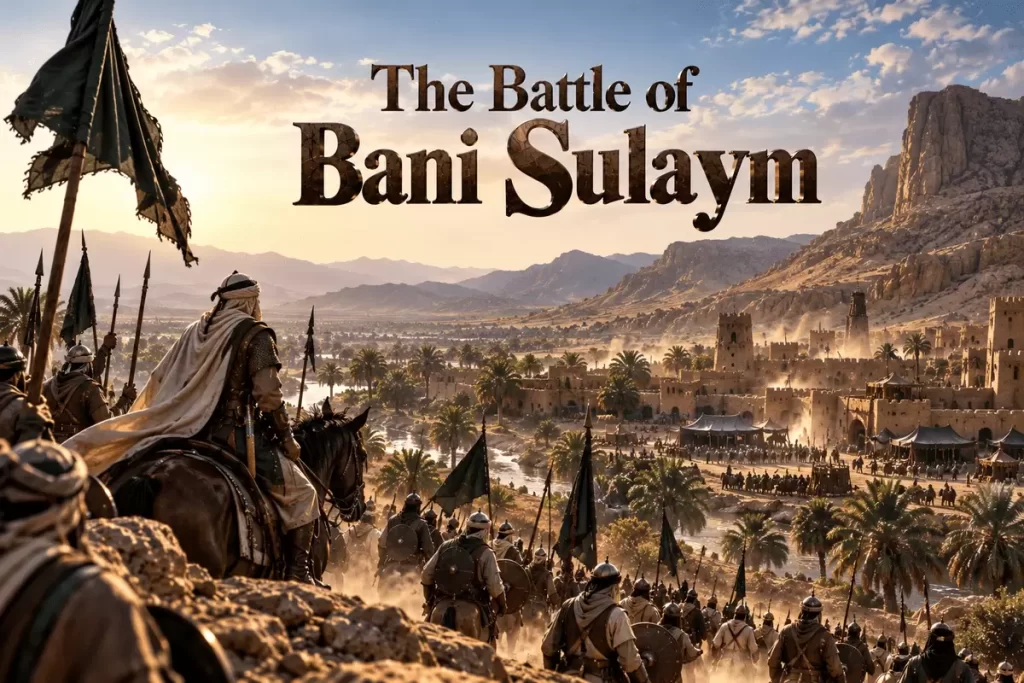
Within days of returning from Badr, the Prophet Muhammad (peace be upon him) was on the move again. The battle of Bani Sulaym, recorded in the sources as Ghazwat Al-Kudr, answered reports that a large tribe east of Madinah was assembling to raid the city while attention was fixed on Quraysh. The expedition ended without fighting, yet it returned with substantial spoils and settled an immediate threat on a second front. It stands as the first campaign launched after the victory at Badr, and it shows how quickly the new state acted on intelligence.
What Was the Battle of Bani Sulaym?
The campaign is counted among the expeditions the Prophet led in person, and it belongs to the preventive category rather than the combative one. Its defining features are set out below.
- A rapid march to a watering place in the grazing lands of a major tribe.
- Launched roughly one week after the return from Badr.
- Directed at Bani Sulaym and the allied branch of Ghatafan gathered with them.
- Concluded without an engagement, as the tribesmen withdrew before contact.
- Returned with a large number of camels taken as spoils from the abandoned grazing grounds.
قال ابن إسحاق رحمه الله: «فَبَلَغَ مَاءً مِنْ مِيَاهِهِمْ يُقَالُ لَهُ الْكُدْرُ، فَأَقَامَ عَلَيْهِ ثَلَاثَ لَيَالٍ»
(البداية والنهاية لابن كثير، غزوة بني سليم، نقلًا عن ابن إسحاق)
Ibn Ishaq reported: “He reached one of their watering places called Al-Kudr and remained there for three nights.”
(Ibn Kathir, Al-Bidayah wa Al-Nihayah, Expedition of Bani Sulaym)
Date and Location of the Al-Kudr Expedition
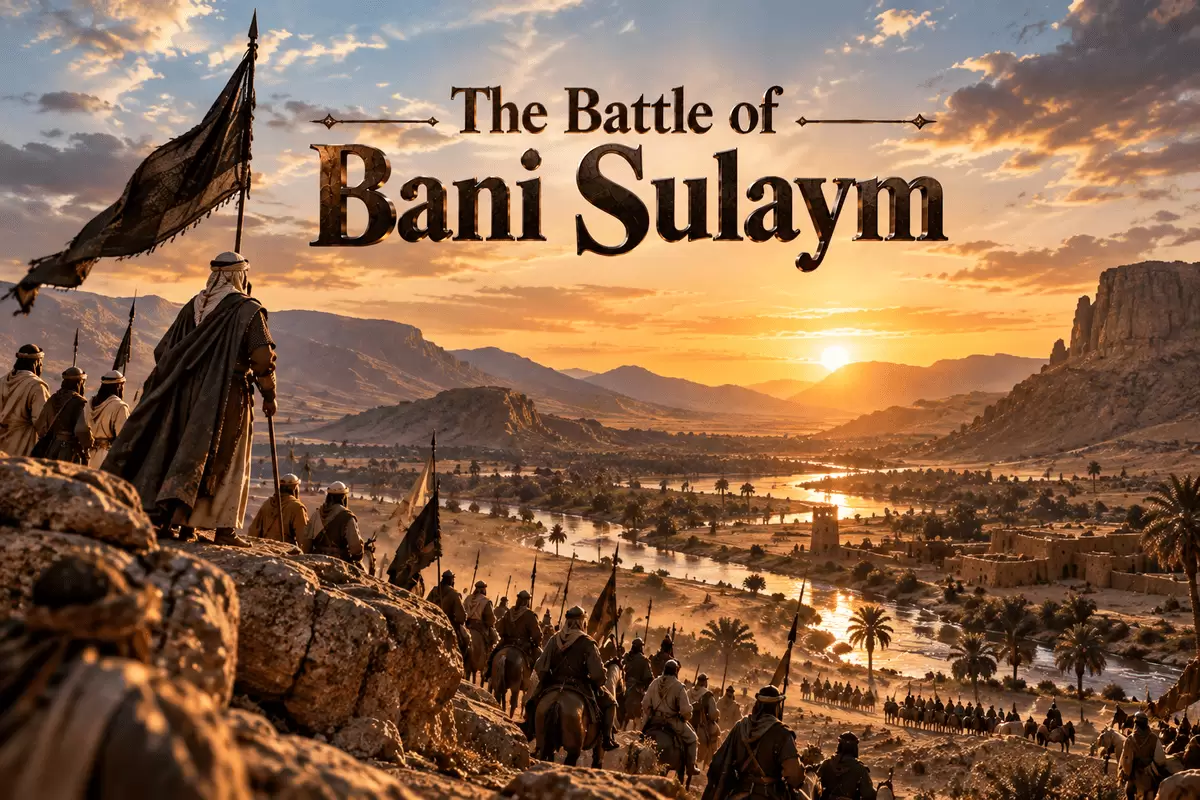
The timing and the geography explain why the campaign could be completed quickly and why the threat was treated seriously. The table below gives the key details.
| Detail | Description |
| Date | Shawwal, 2 AH, corresponding to April 624 CE |
| Gap after Badr | Approximately seven days |
| Destination | Al-Kudr, a watering place in the territory of Bani Sulaym |
| Direction from Madinah | Towards Najd, on the route past Qarqarat Al-Kudr |
| Force size | Around 200 fighters, all mounted |
| Deputy over Madinah | Siba ibn Urfutah or Ibn Umm Maktum, according to differing reports |
| Duration | Fifteen nights in total, including travel |
Where Was Al-Kudr Situated?
Al-Kudr was a watering point lying within the grazing range of the tribe, positioned to the east of Madinah on the approaches to Najd. Watering places of this kind determined where herds could be kept and where a tribal force could assemble, which is why they served as both gathering points and targets. The site is sometimes recorded as Qarqarat Al-Kudr in the sources, the same location later associated with the pursuit after the raid of Al-Saweeq. Its distance allowed a mounted force from Madinah to reach it and return within roughly two weeks.
Why the Expedition Against Bani Sulaym Was Launched
The march was a response to intelligence rather than to an attack already carried out. Several considerations made the report serious enough to act on immediately.
- Bani Sulaym was among the larger tribes of the region, capable of assembling a substantial force.
- Reports reached Madinah that men of the tribe were gathering with the intention of raiding the city.
- The timing suggested an attempt to exploit the period directly after a major battle.
- Leaving a hostile concentration unanswered on the eastern approaches would have invited other tribes to follow.
- Acting quickly would demonstrate that the force returning from Badr was still capable of marching again.
قال الله تعالى:﴿يَا أَيُّهَا الَّذِينَ آمَنُوا خُذُوا حِذْرَكُمْ﴾
(سورة النساء 4:71)
Allah says: “O you who have believed, take your precautions.”
(Surah An-Nisa 4:71)
How the Campaign Unfolded
The expedition achieved its objective through speed and presence rather than through combat. Events ran in this order.
- The Prophet appointed a deputy over Madinah and set out with two hundred mounted men.
- The force travelled by a route chosen to reach the watering place without giving early warning.
- On arrival, the Muslims found the gathering already dispersed into the surrounding high ground.
- The tribe had abandoned their grazing herds in the haste of their withdrawal.
- A herdsman named Yasar was found with the animals and was taken, later being freed.
- The force remained in the area for three nights, confirming that no assembly remained.
- The Prophet ordered the return to Madinah with the captured herds.
The War Booty From Ghazwat Al-Kudr
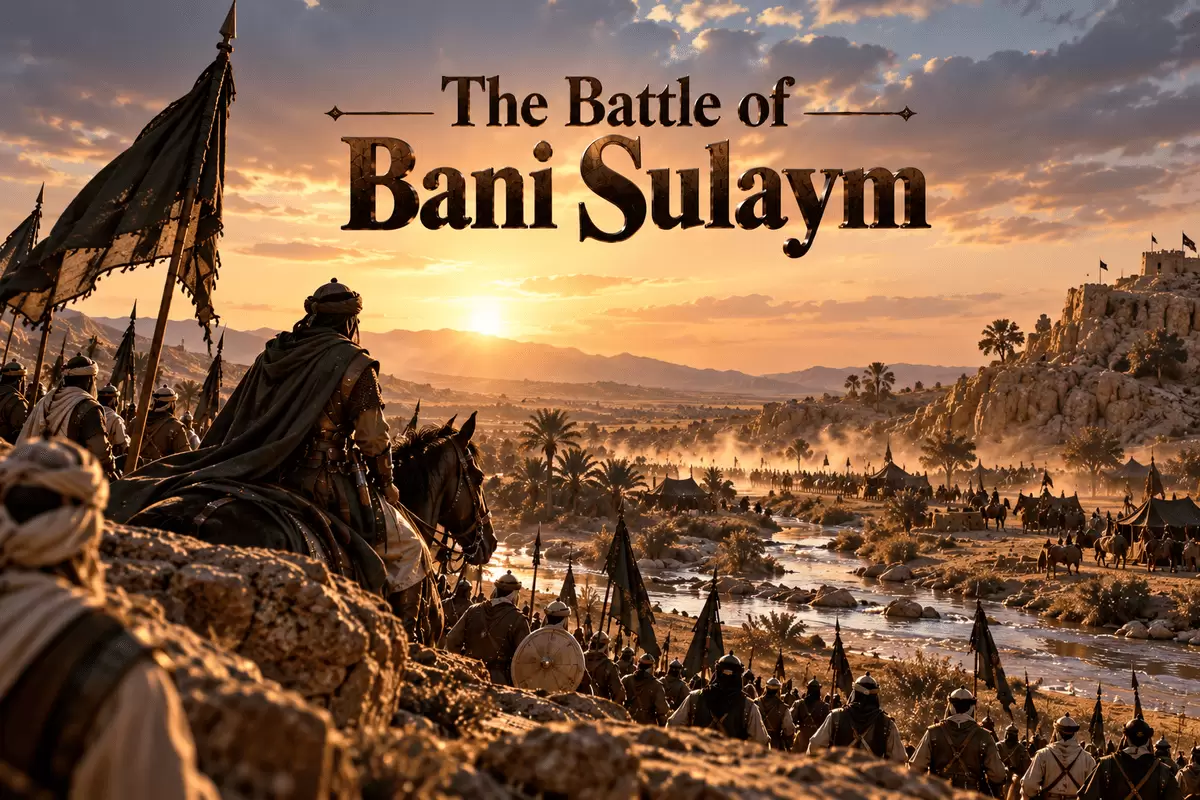
The campaign produced no casualties but returned significant material gain, and its distribution followed the rules established after Badr. The details are as follows.
- Five hundred camels were taken from the grazing grounds left behind by the tribe.
- A fifth of the total was set aside as the share designated for the state and its specified recipients.
- The remainder was divided among the participants, giving each man two camels.
- The captured herdsman was released without ransom.
- No prisoners from the tribe itself were taken, since no contact occurred.
قال الله تعالى:﴿وَاعْلَمُوا أَنَّمَا غَنِمْتُم مِّن شَيْءٍ فَأَنَّ لِلَّهِ خُمُسَهُ وَلِلرَّسُولِ وَلِذِي الْقُرْبَىٰ وَالْيَتَامَىٰ وَالْمَسَاكِينِ وَابْنِ السَّبِيلِ﴾
(سورة الأنفال 8:41)
Allah says: “And know that whatever you obtain of war booty, then indeed, one-fifth of it is for Allah and the Messenger, close relatives, orphans, the needy, and the traveler.”
(Surah Al-Anfal 8:41)
Outcome of the Bani Sulaym Expedition
The results were strategic as much as material, and they held through the months that followed. The main outcomes are listed here.
- Raid prevented: the planned attack on Madinah was abandoned before it could be launched.
- No losses: neither side suffered a casualty during the entire campaign.
- Eastern approaches secured: the route towards Najd became less attractive as a staging area.
- Spoils distributed: the camels strengthened the mobility of a force that had fought at Badr with only two horses.
- Deterrence confirmed: the speed of the response showed that a week was enough to mount another campaign.
The Place of This Campaign Among the Early Expeditions
Setting the expedition beside those around it clarifies both its scale and its purpose. The table below compares them.
| Expedition | Date | Nature | Result |
| Badr | Ramadan, 2 AH | Full battle | Decisive victory |
| Al-Kudr | Shawwal, 2 AH | Preventive march | Gathering dispersed, 500 camels taken |
| Al-Saweeq | Dhul Hijjah, 2 AH | Raid and pursuit | Raiders withdrew without contact |
| Dhi Amr | Rabi Al-Awwal, 3 AH | Preventive march | Tribal gathering dispersed |
| Bahran | Rabi Al-Thani, 3 AH | Preventive march | Tribal gathering dispersed |
Viewed in this sequence, the campaign opened a pattern of short preventive movements that secured the frontiers of Madinah while the larger confrontation with Quraysh was still building towards Uhud.
Lessons From the Expedition
The campaign is studied for its principles rather than for dramatic events, and these are the conclusions drawn from it most consistently.
- Intelligence acted on promptly removes a threat at a fraction of the cost of answering an attack.
- Rest after a victory is not a condition for responding to a new danger.
- Mobility determines reach, which is why a fully mounted force could cover the distance in time.
- An objective can be met without an engagement when presence alone changes the opponent’s calculation.
- Clear rules for distributing gains prevent disputes, following the framework settled after the previous battle.
How does the Arabian Tongue shape your journey of learning the Quran and Arabic?
At Arabian Tongue, we help you understand the Quran deeply and connect with its meanings through simple and effective teaching methods. Our courses are designed to make your learning journey clear, engaging, and spiritually enriching.
Guidance from the Quran and Hadith
قال الله تعالى:﴿وَأَحْسِنُوا ۛ إِنَّ اللَّهَ يُحِبُّ الْمُحْسِنِينَ﴾(سورة البقرة 2:195)
Allah says: “And do good; indeed, Allah loves those who do good.” (Surah Al-Baqarah 2:195)
قال النبي ﷺ: «لَا تَتَمَنَّوْا لِقَاءَ الْعَدُوِّ، وَسَلُوا اللَّهَ الْعَافِيَةَ»
(صحيح البخاري، حديث 7237)
The Prophet ﷺ said: “Do not wish to meet the enemy, and ask Allah for safety.”
(Sahih al-Bukhari 7237)
FAQs
Is this campaign known by more than one name?
It appears as Ghazwat Al-Kudr, Ghazwat Bani Sulaym, and occasionally as Ghazwat Qarqarat Al-Kudr. The variation reflects whether early biographers named it after the location or after the tribe involved.
Who was Yasar and what became of him?
He was a herdsman found with the abandoned camels and taken during the expedition. He was set free rather than kept, and some accounts record that he accepted Islam afterwards.
How long did the force remain at the watering place?
They stayed three nights at the site after arriving, remaining visible in the area to confirm that no assembly was reforming. The full expedition, including travel in both directions, lasted around fifteen nights.
Was there a later campaign against the same tribe?
Yes, the march to Bahran in the third year targeted another gathering of the same tribe. That expedition also ended without fighting, as the assembled men dispersed before the force arrived.
How were the spoils counted and divided?
The total was assessed, a fifth set aside under the established rule, and the balance shared among those present. With five hundred camels and two hundred participants, each fighter received two animals.