
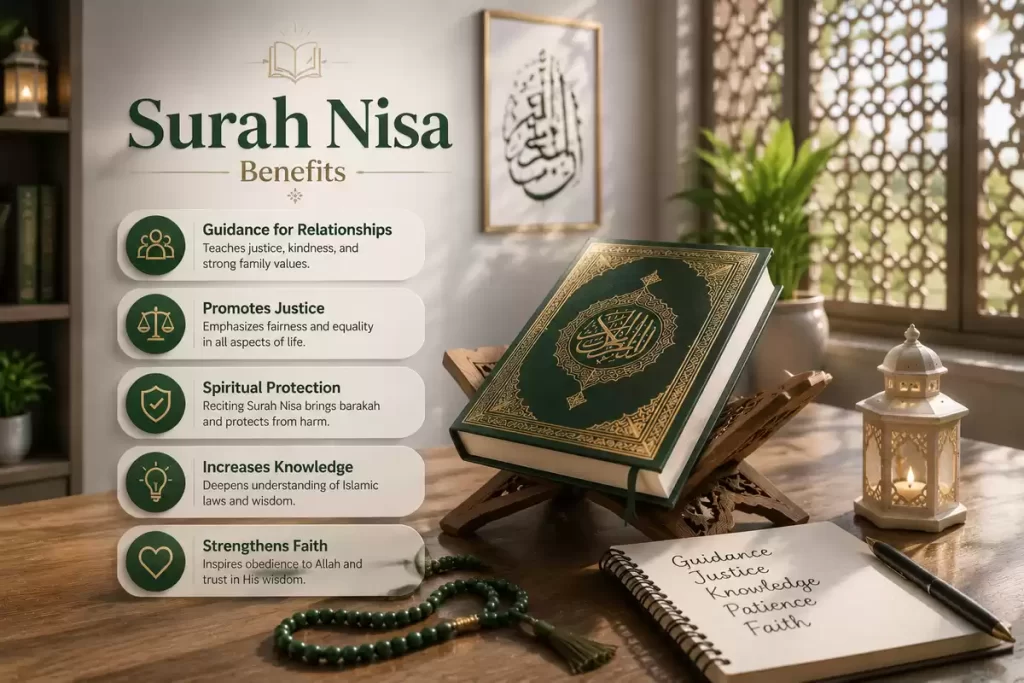
Surah An-Nisa, the fourth chapter of the Holy Quran, offers profound guidance and numerous Surah An-Nisa benefits that extend far beyond its literal verses, shaping individual lives and societal structures. This Medinan Surah, revealed during a critical period of early Islamic community building, addresses crucial aspects of social justice, family law, and the rights of women and vulnerable individuals. Understanding the depth of its teachings provides a foundational framework for a balanced and equitable society, offering practical wisdom for contemporary challenges. Exploring the Surah An-Nisa benefits allows believers to unlock its transformative potential for personal and communal well-being.
What is Surah An-Nisa and Its Historical Context?
Surah An-Nisa, meaning “The Women,” is the 4th chapter of the Quran, primarily addressing women’s rights, family law, and social justice. Revealed in Medina, this Surah emerged during a crucial period when the nascent Muslim community was actively establishing its social and legal framework while facing various internal and external challenges. Its divine verses provided comprehensive guidance on issues often neglected or unfairly treated in pre-Islamic society, particularly concerning women, orphans, and inheritance.
The historical context of its revelation emphasizes the urgent need for clear divine directives to build a just, balanced, and stable society. One of the most significant Surah Nisa benefits is its foundational role in establishing equitable laws that protect individual dignity and community well-being.
Key Focus Areas:
Revealed after the Hijra (migration) to Medina, this chapter addresses the fundamental rights and responsibilities of women, orphans, and the vulnerable. It lays down detailed laws regarding marriage, divorce, and inheritance, emphasizing justice, fairness, and mutual respect within the community during a time of major social reform in early Islam.
قال الله تعالى: «وَآتُواْ الْيَتَامَى أَمْوَالَهُمْ وَلاَ تَتَبَدَّلُواْ الْخَبِيثَ بِالطَّيِّبِ» (سورة النساء 4:2).
Allah says: “And give to the orphans their properties and do not substitute the defective for the good.” (Surah An-Nisa 4:2).
How to Incorporate Surah An-Nisa’s Teachings into Daily Life
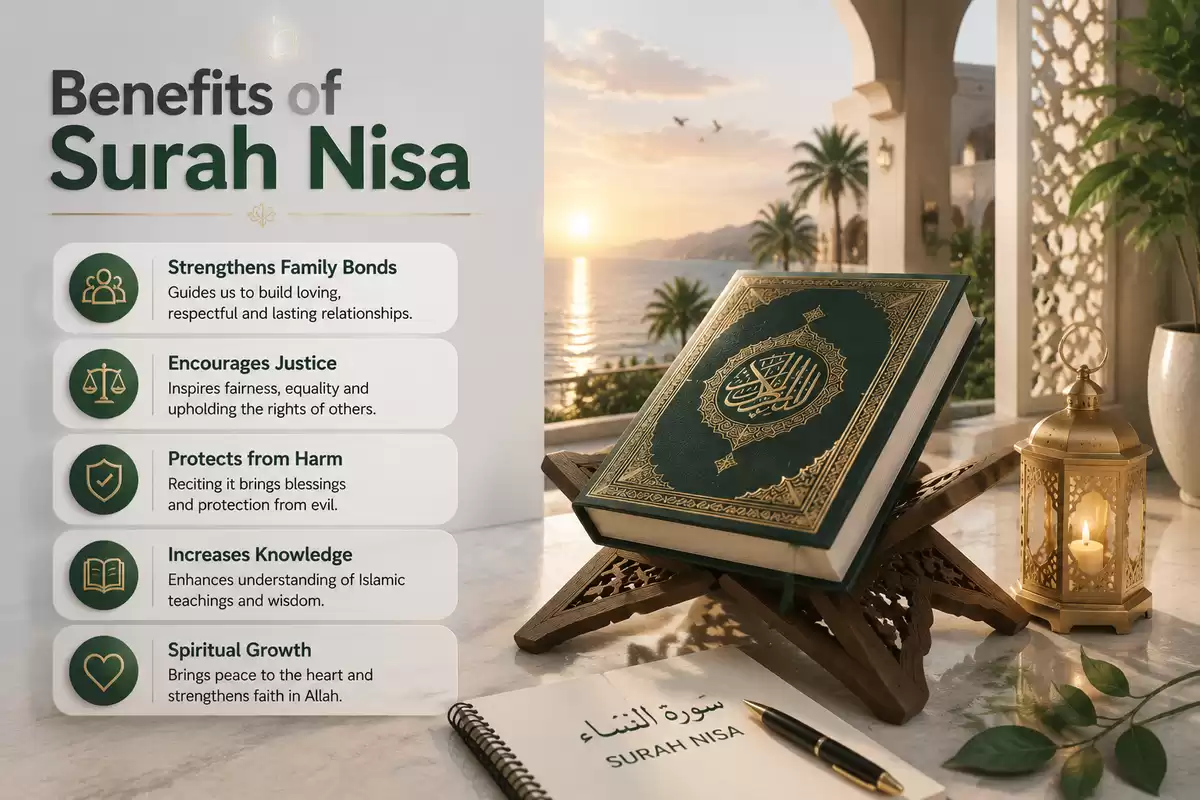
To truly benefit from the wisdom of this chapter, you must move beyond mere recitation and actively integrate its teachings into daily practices and interactions. The advantages of this Surah are maximized when its principles are applied to personal conduct, family dynamics, and social responsibilities.
This involves a conscious effort to reflect on its verses, understand their implications, and translate them into actionable steps that foster justice, compassion, and harmony in your life. Applying these lessons can lead to profound personal growth and stronger communal bonds.
1. Practical Application of Its Moral Lessons
Applying the moral lessons from this chapter involves translating its ethical principles into tangible actions that shape your character and daily interactions:
- Patience and Forgiveness: When resolving conflicts with family members or colleagues, choose deep understanding over immediate retaliation.
- Upholding Integrity: Maintain absolute honesty in all transactions—whether in business or personal life—reflecting the Surah’s call for ethical standing.
- Social Responsibility: Extend kindness and active support to neighbors and those in need, regardless of their background, to help build a virtuous society.
Practical Example: When faced with a disagreement with a family member, instead of reacting impulsively, practice patience and seek a peaceful resolution by listening to their perspective and offering forgiveness.
2. Reflecting on Key Verses for Personal Growth
Reflecting on key verses from this chapter serves as a powerful engine for personal growth, prompting deep introspection and self-improvement:
- Cultivating Gratitude: Contemplating verses that speak about divine blessings encourages individuals to appreciate things often taken for granted, fostering a positive outlook.
- Self-Accountability: Verses emphasizing self-awareness lead to a critical examination of one’s actions and intentions, motivating sincere repentance and reform.
Engaging with these verses through thoughtful contemplation helps internalize their meanings, transforming abstract concepts into guiding principles for daily conduct. Experiencing this personal transformation is one of the most profound Surah Nisa benefits.
Weekly Action Step: Choose one verse each week, read its authentic tafsir (exegesis), and consciously apply its core message in your daily interactions or personal reflections.
3. Seeking Scholarly Interpretation for Deeper Understanding
Seeking scholarly interpretation is crucial for an accurate understanding of this chapter, as its detailed legal rulings and social guidelines often require contextual and linguistic expertise:
- Avoiding Misinterpretation: Consulting qualified Islamic scholars and authentic sources helps clarify complex laws, historical background, and nuanced meanings.
- Preserving Authentic Knowledge: This structured approach safeguards against personal biases, ensuring your understanding aligns with sound Islamic scholarship.
When encountering a verse that seems difficult to grasp, consult a recognized tafsir by a respected scholar to gain clarity on its historical context and linguistic nuances. Reputable educational resources like Arabian Tongue often provide access to such structured scholarly insights.
قال الله تعالى: «وَاعْبُدُواْ اللَّهَ وَلاَ تُشْرِكُواْ بِهِ شَيْئًا وَبِالْوَالِدَيْنِ إِحْسَانًا وَبِذِي الْقُرْبَى وَالْيَتَامَى وَالْمَسَاكِينِ وَالْجَارِ ذِي الْقُرْبَى وَالْجَارِ الْجُنُبِ» (سورة النساء 4:36).
Allah says: “Worship Allah and associate nothing with Him, and to parents do good, and to relatives, orphans, the needy, the near neighbor, the neighbor farther away…” (Surah An-Nisa 4:36).
Social and Familial Advantages of Surah An-Nisa
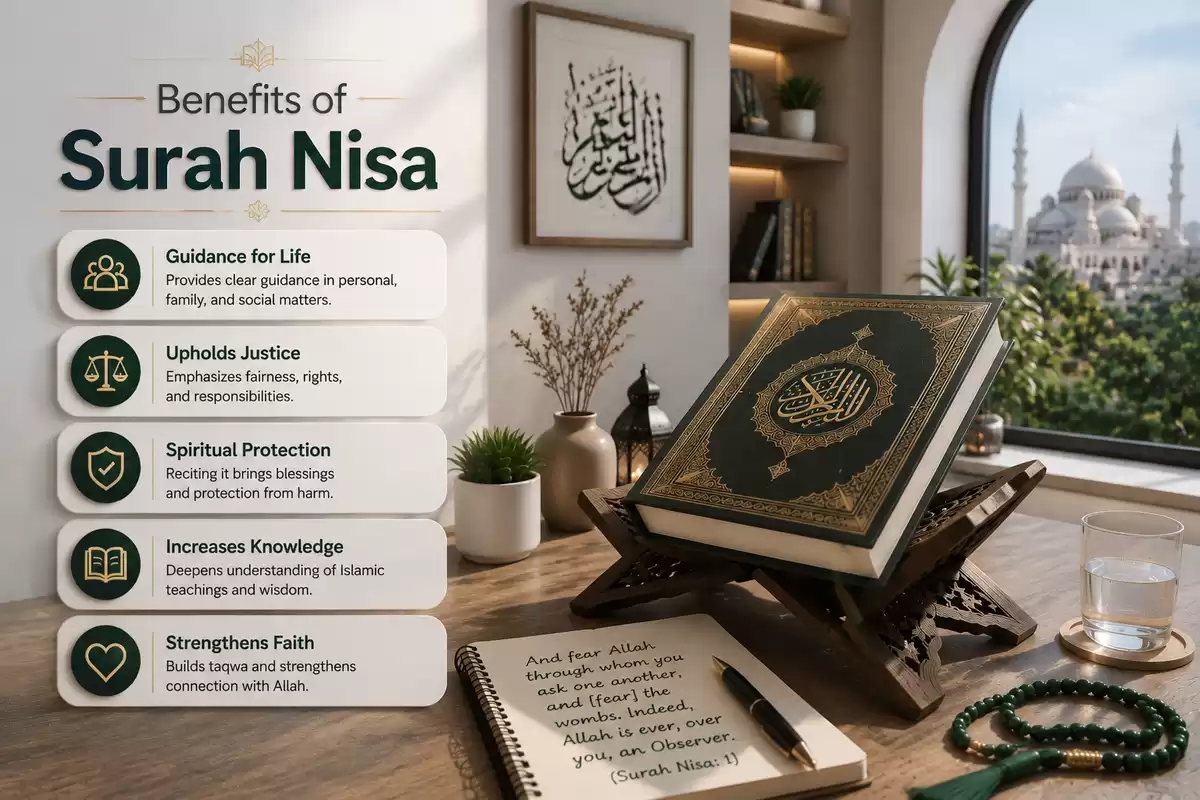
The social and familial advantages of this chapter are extensive, providing a comprehensive framework for building strong, just, and harmonious communities and households. The Surah addresses a wide array of issues, from marital rights and responsibilities to the protection of orphans and the equitable distribution of inheritance.
By establishing clear guidelines for interactions within families and society at large, this chapter fosters an environment of mutual respect, fairness, and compassion. These divine directives are fundamental for maintaining social order and ensuring the well-being of all community members, particularly the vulnerable.
1. Guidance on Marriage and Family Dynamics
This chapter offers extensive guidance on marriage and family dynamics, establishing timeless principles for healthy, stable, and fulfilling relationships:
- Spousal Relationships: It emphasizes mutual respect, love, and compassion between spouses, while clearly outlining their reciprocal rights and duties.
- Dispute Resolution: The Surah provides structured directives for resolving marital disputes, strongly encouraging reconciliation, patience, and fairness.
- Child Rearing: It stresses the importance of providing a nurturing, safe, and just environment for children, forming the bedrock of a virtuous society.
Practical Application: When a couple faces a disagreement, the Surah encourages seeking reconciliation through open dialogue or involving wise, impartial family members as arbitrators to reach a fair resolution.
2. Principles of Justice and Fairness in Relationships
The principles of justice and fairness are central to this chapter, extending to all human relationships beyond the immediate family unit:
| Principle | Core Teaching | Practical Impact |
| Unwavering Equity | Upholding justice even if it goes against oneself or close relatives. | Eliminates personal bias and favoritism in disputes. |
| Integrity & Impartiality | Protecting individual rights regardless of social status. | Builds trust and stability within the community. |
In daily life, this means striving to remain completely impartial in personal or professional conflicts, basing every decision on facts, truth, and genuine equity.
3. Protecting the Rights of Orphans and Vulnerable Individuals
This chapter strongly advocates for the protection of orphans and vulnerable individuals, demonstrating Islam’s profound commitment to social welfare and human dignity:
- Financial Management: The Surah contains explicit injunctions regarding the ethical care and protection of orphans’ property, strictly warning against exploitation.
- Collective Responsibility: It extends protection to marginalized groups, emphasizing society’s shared duty to prevent injustice and support those in need.
Promoting this compassionate framework is one of the most vital Surah Nisa benefits. To put this into practice, believers are encouraged to actively support charitable initiatives, orphanages, or local families in need to ensure their long-term well-being.
قال الله تعالى: «وَعَاشِرُوهُنَّ بِالْمَعْرُوفِ» (سورة النساء 4:19).
Allah says: “And live with them in kindness.” (Surah An-Nisa 4:19).
Common Misconceptions About Surah An-Nisa and Their Clarifications
This chapter, despite its profound wisdom, is often subject to various misconceptions—particularly concerning women’s rights and family laws. These misunderstandings frequently arise from taking verses out of context, relying on superficial interpretations, or failing to appreciate the historical and linguistic nuances of the Quran.
Addressing these misconceptions is crucial for a balanced understanding of the text and for dispelling stereotypes. Clarifying these points helps reveal the authentic Surah Nisa benefits, which are deeply rooted in justice, equity, and compassion.
1. Addressing Interpretive Challenges
Addressing interpretive challenges within this chapter requires a deep understanding of the classical Arabic language, the historical context of revelation, and the broader principles of Islamic jurisprudence:
- Contextual Nuance: Many verses, when read in isolation, can appear complex. However, when viewed through the lens of classical scholarship and the entire Quranic narrative, their wisdom becomes clear.
- Complementary Roles: A common challenge involves verses related to gender roles. Properly understanding them requires examining the Quran’s emphasis on mutual respect, equity, and complementary responsibilities rather than rigid hierarchy.
2. Contextualizing Specific Verses
Contextualizing specific verses is vital to avoid historical misinterpretations and controversies:
- Surah An-Nisa (Verse 3): Benefits from a thorough understanding of the societal conditions at the time, specifically the protection of orphaned women and the strict requirement for equitable treatment.
- Surah An-Nisa (Verse 45): Benefits from knowing the precise historical events and the specific audience it originally addressed.
Key Context Example: When studying verse 3, it is crucial to recognize that it was revealed following a period of warfare where male guardians managed orphaned girls’ property. The verse strictly restricted practices to prevent financial exploitation, permitting marriage only under the absolute condition of maintaining complete justice among wives.
3. Promoting a Balanced Understanding
Promoting a balanced understanding involves adopting a holistic approach that considers the Quran as a unified whole alongside the Sunnah (Prophet Muhammad’s authentic teachings):
| Approach | Pitfalls to Avoid | Recommended Practice |
| Holistic Study | Avoid selective readings that focus on isolated phrases. | Read verses in conjunction with complementary Quranic passages. |
| Scholarly Guidance | Avoid relying solely on literal translations without context. | Consult recognized tafsir works and linguistic explanations in classical Arabic. |
Recognizing how different verses complement and clarify one another leads to a comprehensive, just framework for daily life, allowing believers to truly appreciate the profound spiritual and practical advantages of this Surah.
How does the Arabian Tongue shape your journey of learning the Quran and Arabic?
At Arabian Tongue, we help you understand the Quran deeply and connect with its meanings through simple and effective teaching methods. Our courses are designed to make your learning journey clear, engaging, and spiritually enriching.
Guidance from the Quran and Hadith
قال الله تعالى: «إِنَّ الَّذِينَ يَأْكُلُونَ أَمْوَالَ الْيَتَامَى ظُلْمًا إِنَّمَا يَأْكُلُونَ فِي بُطُونِهِمْ نَارًا» (سورة النساء 4:10).
Allah says: “Indeed, those who devour the property of orphans unjustly are only consuming into their bellies fire.” (Surah An-Nisa 4:10).
قال النبي ﷺ: «مَنْ يُرِدِ اللَّهُ بِهِ خَيْرًا يُفَقِّهْهُ فِي الدِّينِ» (صحيح البخاري وصحيح مسلم).
The Prophet ﷺ said: “Whoever Allah intends good for, He gives him understanding of the religion.” (Sahih al-Bukhari and Sahih Muslim).
FAQs:
What are the main themes covered in Surah An-Nisa?
Surah An-Nisa focuses on women's rights, family law, inheritance, justice, and social ethics within the community. It also provides essential guidance on protecting orphans, community unity, warfare, and standing firm against hypocrisy.
How does Surah An-Nisa address women's rights?
It granted women revolutionary rights in marriage, divorce, property ownership, and direct financial independence. By securing their legal status and inheritance, it highlights the essential Surah An-Nisa benefits for establishing dignity and fairness.
What are the spiritual rewards of reciting Surah An-Nisa?
Reciting this Surah brings profound blessings, forgiveness of sins, and a deeper spiritual connection to Allah. It enhances a believer's understanding of divine laws while filling the heart with inner peace, guidance, and clarity.
Can Surah An-Nisa help in resolving family disputes?
Yes, it offers clear principles for resolving conflicts through patience, mutual respect, and fair arbitration. Its guidance encourages peaceful reconciliation and structured mediation to maintain long-term harmony within the home.
What is the significance of the inheritance laws in Surah An-Nisa?
It established a divine, equitable system that permanently protected the financial rights of women and orphans. By replacing unfair pre-Islamic customs, these detailed laws ensured social stability and fair distribution of wealth.