
Arabic is one of the most spoken, most studied, and most spiritually significant languages in the world, yet finding the right way to learn it has always been a real challenge. The best online Arabic course does not just teach you letters and grammar; it builds a bridge between you and an entire civilization, a sacred scripture, and over 400 million people. The question is not whether Arabic is worth learning. The question is where to start, and that decision changes everything.
Why choose an online Arabic course
In today’s interconnected world, the demand for learning Arabic has never been higher. Choosing the best online Arabic course is a transformative decision that opens doors to new opportunities in business, travel, and personal growth. Unlike traditional classroom settings, online courses offer unparalleled flexibility, allowing learners to study at their own pace while accessing high-quality resources, structured curricula, and real-time feedback from native speakers and language experts.
One of the greatest advantages of online Arabic courses is the ability to tailor the learning experience to individual needs. Whether a complete beginner or an advanced learner, customized pathways allow focus on specific areas such as Arabic reading online, conversational skills, or business Arabic, ensuring time and effort are invested where they matter most.
Features of the best online Arabic courses
When evaluating the best online Arabic course, several features distinguish exceptional programs:
- Quality of instructional materials: Top-tier courses blend video lectures, audio exercises, and written content to cater to different learning styles, incorporating real-life scenarios such as role-playing dialogues and cultural notes.
- Interactive elements: Live chat with instructors, discussion forums, peer collaboration, and gamification features such as quizzes and progress trackers create an immersive and motivating learning environment.
- Instructor expertise: The best courses are taught by native speakers or highly qualified educators who can explain complex concepts clearly and provide personalized guidance tailored to individual strengths and weaknesses.
- Supplementary resources: E-books, flashcards, mobile apps, and access to authentic materials such as news articles, podcasts, and films expose learners to real-world Arabic and develop cultural competence.
- Regular assessments: Consistent progress monitoring through quizzes and comprehensive exams ensures learners are continuously challenged and engaged throughout their learning journey.
Arabic courses for beginners vs advanced learners

The journey of learning Arabic can be broadly divided into two phases, each requiring a distinct approach tailored to the learner’s current proficiency and goals. Understanding the differences between beginner and advanced courses helps learners choose the right path and set realistic expectations for their progress.
| Beginner Courses | Advanced Courses | |
| Focus | Foundational skills, including the Arabic alphabet, pronunciation, and basic vocabulary | Refining fluency, expanding vocabulary, and mastering intricate grammar rules |
| Starting Point | Arabic script, right-to-left writing direction, and essential everyday phrases | Literary Arabic, dialects, and specialized terminology for business or academia |
| Grammar | Basic verb conjugations and sentence formation | Complex grammar structures and advanced linguistic rules |
| Materials | Simple dialogues, greetings, and introductions | Novels, academic papers, debates, and essay writing |
| Cultural Immersion | Basic cultural norms and etiquette | Historical and social contexts of Arabic-speaking regions |
| Goal | Communicating effectively in real-life situations | Achieving full fluency and engaging with native speakers at a high level |
| Religious Context | Introduction to Arabic as the language of the Quran | Deep exploration of the importance of learning Arabic in Islam and its diverse applications |
Importance of qualified Arabic teachers
The role of qualified Arabic teachers is indispensable in the language learning journey. A skilled instructor not only imparts knowledge but also inspires motivation, adapts to diverse learning styles, and creates an environment where learners feel confident to grow. Key benefits of learning from qualified teachers include:
- Personalized feedback: Instructors correct pronunciation errors, clarify grammar rules, and provide constructive criticism on writing and speaking skills, particularly valuable for learners tackling challenges like reading Arabic online for adults.
- Cultural competence: Knowledgeable teachers guide learners through Arabic dialects and regional variations, helping them navigate the distinctions between Modern Standard Arabic and dialectal Arabic.
- Adaptive teaching methods: Qualified instructors identify individual learning styles, using visual aids, auditory exercises, or hands-on activities to meet each learner’s unique needs.
- Real-world application: Teachers assign practical projects such as writing emails, conducting interviews, or translating documents, ensuring knowledge extends beyond the classroom.
Learning Arabic: Speaking, Reading, and Writing Skills
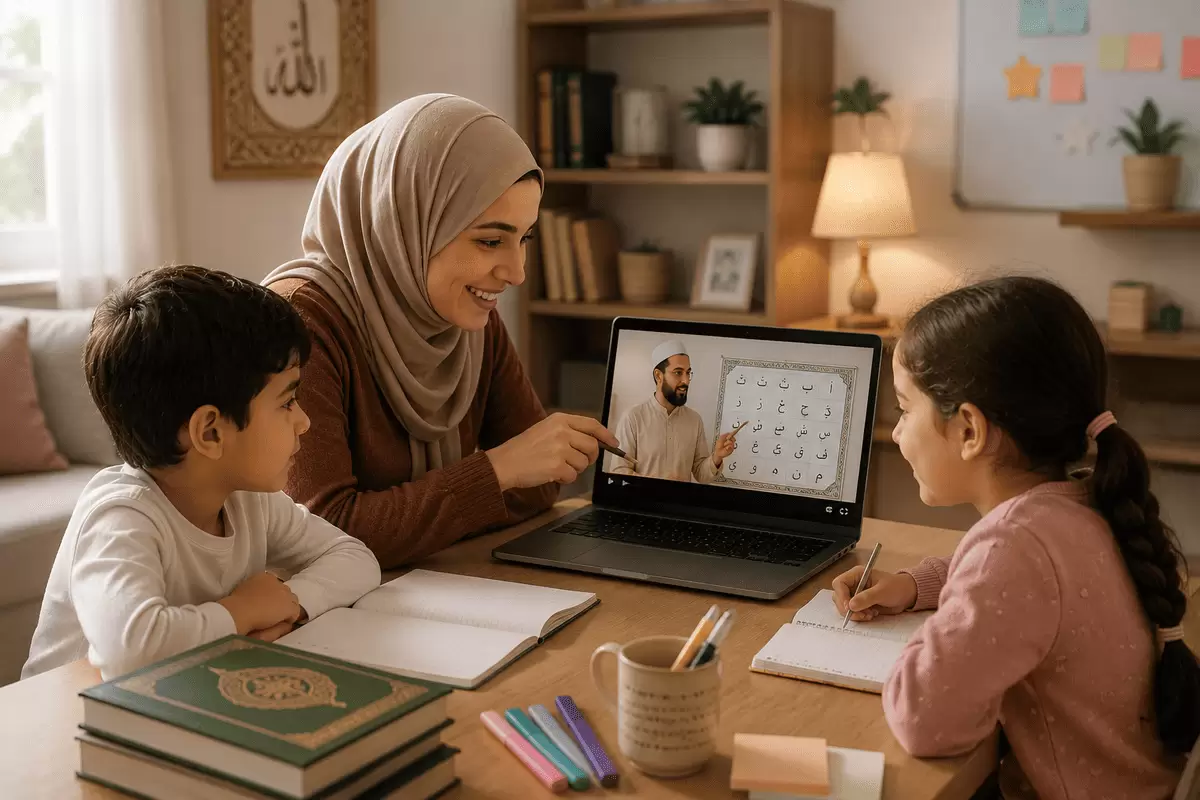
Learning Arabic—speaking, reading, and writing—is a gateway to a rich cultural heritage, providing the essential tools to unlock literary treasures and communicate effectively within a global civilization.
Mastering Arabic Speaking: Confidence Through Practice
Developing fluency in Arabic requires real-time interaction, which can be intimidating for beginners. The key lies in immersive practice through scenarios that mimic real-life interactions, starting with basic phrases and gradually building complexity:
- Greetings and introductions (“As-salamu alaykum,” “Ma ismak?”)
- Everyday questions (“Shu hadha?” — “What is this?”)
- Simple requests (“Aruidu ma’a” — “I want water”)
Listening comprehension is equally critical. Advanced courses incorporate podcasts and audiobooks in Modern Standard Arabic, shadowing techniques where learners repeat after native speakers, conversational role-plays with instructors, and language exchange programs with native speakers. Consistency is key; even 15–30 minutes of daily practice through apps, conversation clubs, or self-recorded sessions leads to significant improvement.
Arabic Reading Online: Navigating Script and Vocabulary
Reading Arabic presents unique challenges due to its right-to-left script, diacritical marks (tashkeel), and letter variations based on position in a word. The process begins with alphabet mastery through interactive drills, flashcards, tracing exercises, and graded reading materials. Once comfortable with individual letters, learners progress to word and sentence structure through common prefixes and suffixes, short texts with controlled vocabulary, bilingual texts, and reading comprehension exercises.
For reading Arabic online for adults, graded readers help build vocabulary in context, understand cultural references, improve reading speed, and gain exposure to different genres. Advanced learners explore classical Arabic texts such as excerpts from the Quran, requiring familiarity with tashkeel and complex grammatical structures.
Writing in Arabic: From Letters to Literary Expression
Writing in Arabic demands precision in both grammar and script. The journey begins with handwriting practice, tracing Arabic letters to develop muscle memory, writing words and simple sentences, using grid-based worksheets, and practicing joined writing (khat). As learners advance, exercises incorporate grammar-focused tasks, creative writing prompts, translation exercises, and essay writing on cultural or academic topics.
Digital tools play a crucial role for those seeking to improve Arabic writing online, including interactive writing boards, grammar checkers, peer review systems, and mobile apps for on-the-go practice. Advanced learners engage in literary writing such as poetry or prose, requiring a deep understanding of Arabic rhetoric (balagha) and metrical structures through the study of classical poets like Al-Mutanabbi and Ibn Arabi.
How does the Arabian Tongue shape your journey of learning the Quran and Arabic?
At Arabian Tongue, we help you understand the Quran deeply and connect with its meanings through simple and effective teaching methods. Our courses are designed to make your learning journey clear, engaging, and spiritually enriching.
Guidance from the Quran and Hadith
قال الله تعالى: “إِنَّا أَنزَلْنَاهُ قُرْآنًا عَرَبِيًّا لَّعَلَّكُمْ تَعْقِلُونَ” — سورة يوسف: ٢
Allah said: “Indeed, We have sent it down as an Arabic Quran that you might understand.” — Yusuf: 2
قال رسول الله ﷺ: “أَحِبُّوا الْعَرَبَ لِثَلَاثٍ: لِأَنِّي عَرَبِيٌّ، وَالْقُرْآنُ عَرَبِيٌّ، وَكَلَامُ أَهْلِ الْجَنَّةِ عَرَبِيٌّ” — رواه الطبراني، عن ابن عباس رضي الله عنه
The Prophet ﷺ said: “Love the Arabs for three reasons: because I am Arab, the Quran is in Arabic, and the language of the people of Paradise is Arabic.” — Narrated by At-Tabarani, on the authority of Ibn Abbas (may Allah be pleased with him)
FAQs
How to choose the right course?
Focus on courses that align with your specific goals and offer live interaction with native speakers. Look for structured curricula that balance grammar with real-life conversation and provide credible student reviews.
Are online courses effective for fluency?
Online learning is highly effective if you maintain consistency and engage in regular speaking practice. Fluency depends more on your daily immersion and dedication than on the physical setting of the classroom.
Quranic vs. Modern Standard Arabic (MSA)?
Quranic Arabic is dedicated to the study of religious texts and ancient linguistic rules. In contrast, Modern Standard Arabic (MSA) is the contemporary version used today in news, literature, and formal education.
How long does it take to learn?
Reaching an intermediate level typically requires 600 to 1,000 hours of focused study. Depending on your pace, this usually translates to one to three years to achieve functional fluency online.