
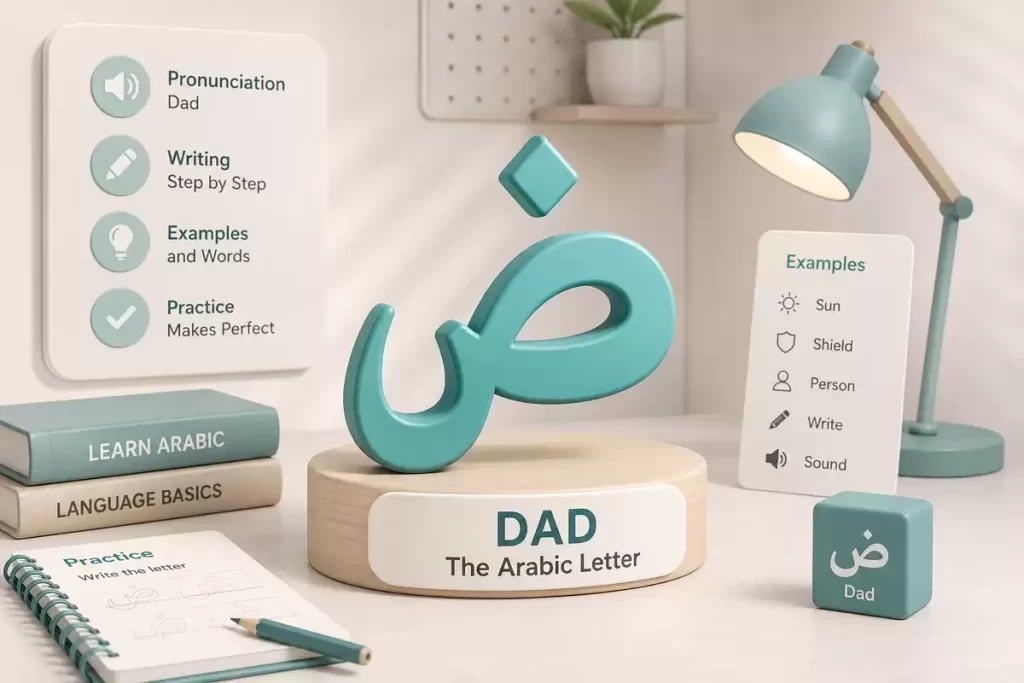
The Arabic Letter Dad (ض) stands as one of the most distinctive and often challenging sounds for learners of the Arabic language, frequently cited as the “hardest Arabic letter” to master. Its unique articulation and emphatic quality set it apart from other consonants, making its correct pronunciation a significant milestone for non-native speakers. This guide aims to demystify the Arabic Letter Dad ض, offering a comprehensive approach to understanding, pronouncing, and distinguishing it from similar sounds, ultimately helping learners achieve fluency and accuracy in their Arabic speech. Mastering this letter is essential for anyone serious about Arabic.
What is the Arabic Letter Dad ض?
The Arabic letter Dad (ض) is one of the 28 letters of the Arabic alphabet. Renowned for its unique emphatic sound, it has led to Arabic often being referred to as “Lughat al-Dad” (the language of Dad).
Understanding Its Phonetic Characteristics
- Sound Mechanics: It is a voiced, heavy emphatic consonant that requires raising the back of the tongue toward the soft palate to create deep resonance.
- Articulation Point: The unique sound is achieved by pressing the side of the tongue directly against the upper molars while air is expelled.
The Significance of Dad in Arabic Phonology
- Semantic Precision: The letter holds immense structural weight, preventing word ambiguity and ensuring completely precise communication.
- Sacred Recitation: It features prominently in Classical Arabic and Tajweed, where exact pronunciation is paramount for accurate recitation of the holy text.
قال الله تعالى: “وَرَتِّلِ الْقُرْآنَ تَرْتِيلًا” (سورة المزمل 73:4).
Allah says: “And recite the Quran with measured recitation.” (Surah Al-Muzzammil 73:4).
How to Pronounce the Arabic Letter Dad ض Correctly?
To pronounce Dad (ض) correctly, you must master the precise tongue placement and airflow required for this unique emphatic sound. This deep, resonant articulation differs significantly from typical “D” sounds found in other languages, demanding focused practice to achieve accuracy.
Articulation points for the emphatic ‘D’ sound
- The Grip: Press the middle-to-back sides of your tongue firmly against your upper molars on one or both sides of your mouth.
- The Lift: Simultaneously raise the back of your tongue toward the soft palate to create the characteristic heavy, emphatic depth.
- The Release: Expel air while actively vibrating your vocal cords to produce a fully voiced, echoing consonant.
Common pronunciation challenges for non-native speakers
- Letter Flattening: Accidentally substituting Dad with a lighter “D” or “Dh” sound, which strips the letter of its required thickness.
- Misplacement: Placing the tongue too far forward in the mouth, leading to a weak sound that lacks the deep resonance chamber.
- Meaning Alteration: Mispronouncing words by flattening the sound, such as turning ضابط (officer) into دابط, which completely changes the meaning.
Exercises for accurate Dad pronunciation
- Sound Isolation: Practice the sound completely on its own, then combine it into repetitive vowel sets like ḍā, ḍī, and ḍū.
- Minimal Pairs: Contrast similar-sounding words directly against each other, such as practicing ضَرَبَ (hit) versus دَرَبَ (trained).
- Imitation Drills: Listen closely to native speakers and repeat targeted contextual words like أبيض (white) and مريض (sick).
قال رسول الله ﷺ: “خَيْرُكُمْ مَنْ تَعَلَّمَ الْقُرْآنَ وَعَلَّمَهُ” (صحيح البخاري، 5027).
The Prophet ﷺ said: “The best among you are those who learn the Quran and teach it.” (Sahih al-Bukhari, 5027).
Comparing the Arabic Letter Dad ض with Similar Sounds
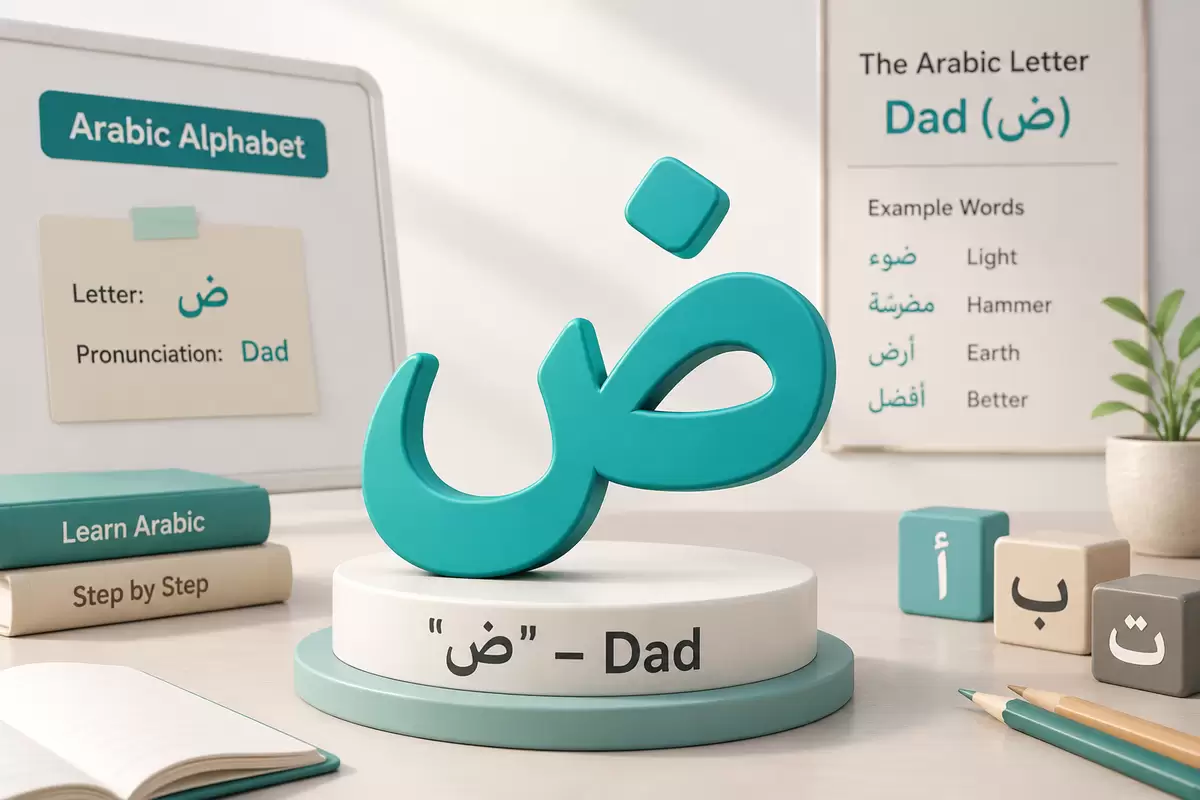
Comparing the Arabic letter Dad (ض) with phonetically similar sounds helps you accurately distinguish it, avoiding common pronunciation errors and achieving ultimate speech clarity.
| Feature | Dad (ض) | Dal (د) | Dha (ظ) |
| Sound Quality | Emphatic and voiced (heavy). | Non-emphatic and voiced (light). | Emphatic and voiced (heavy). |
| Articulation Point | Sides of the tongue press against the upper molars. | Tip of the tongue touches the ridge behind upper front teeth. | Tip of the tongue is placed between the upper and lower front teeth. |
| Vowel Effect | Thickens and darkens adjacent vowels. | Keeps adjacent vowels light and clear. | Thickens and darkens adjacent vowels. |
| Meaning Shift Example | ضَلَّ (went astray) / حَضَرَ (attended) | دَلَّ (indicated/guided) | حَظَرَ (banned/forbade) |
قال الله تعالى: “وَرَتِّلِ الْقُرْآنَ تَرْتِيلًا” (سورة المزمل 73:4).
Allah says: “And recite the Quran with measured recitation.” (Surah Al-Muzzammil 73:4).
Common Mistakes When Learning the Arabic Letter Dad ض
Learners frequently fall into common pitfalls due to the unique phonetic demands of Dad (ض). Identifying these errors directly is the first step toward correcting them and achieving an authentic accent.
Confusing Dad with other Arabic letters
- Sound Substitution: Substituting the non-emphatic Dal (د) or the interdental Dha (ظ) for the lateral Dad (ض) due to superficial similarities.
- Semantic Impact: Failing to recognize subtle distinctions, which leads to mispronunciations that completely alter the intended meaning of words.
Incorrect tongue placement and airflow
- Forward Placement: Positioning the tongue too far forward in the mouth, which accidentally produces a basic “D” or “Dh” sound.
- Weak Articulation: Failing to press the tongue firmly against the molars or neglecting to lift the back of the tongue toward the soft palate.
- Improper Airflow: Managing breath poorly, which distorts the sound and leaves it weak, unclear, or lacking its characteristic deep resonance.
Overcoming typical learning hurdles
- Auditory Internalization: Practicing daily while actively listening to native speakers and precise Classical Arabic or Quranic recitations to anchor the sound.
- Feedback and Recording: Seeking direct corrections from a qualified instructor and recording your own voice to systematically compare and improve performance.
How does the Arabian Tongue shape your journey of learning the Quran and Arabic?
At Arabian Tongue, we help you understand the Quran deeply and connect with its meanings through simple and effective teaching methods. Our courses are designed to make your learning journey clear, engaging, and spiritually enriching.
Guidance from the Quran and Hadith
قال الله تعالى: “كِتَابٌ أُحْكِمَتْ آيَاتُهُ ثُمَّ فُصِّلَتْ مِنْ لَدُنْ حَكِيمٍ خَبِيرٍ” (سورة هود 11:1).
Allah says: “A Book whose verses have been perfected and then presented in detail from One who is Wise and Aware.” (Surah Hud 11:1).
قال رسول الله ﷺ: “أَحَبُّ الأَعْمَالِ إِلَى اللهِ أَدْوَمُهَا وَإِنْ قَلَّ” (صحيح البخاري وصحيح مسلم).
The Prophet ﷺ said: “The most beloved deeds to Allah are those that are done consistently, even if they are few.” (Sahih al-Bukhari and Sahih Muslim).
FAQs:
What is the correct way to pronounce the Arabic letter Dad?
Press the middle-to-back sides of your tongue firmly against your upper molars while raising the back of the tongue toward the soft palate. Then, release a voiced, emphasized breath to create its characteristic deep, resonant sound.
How many forms does the Arabic letter Dad have when written?
Like most Arabic letters, Dad has four contextual forms: isolated (ض), initial (ضـ), medial (ـضـ), and final (ـض). These distinct shapes allow it to connect smoothly with adjacent letters within written words.
What are the most common errors learners make with the letter Dad?
Learners frequently substitute it with the lighter Dal (د) or the interdental Dha (ظ) due to superficial phonetic similarities. They also struggle with placing the tongue tip forward instead of using the sides against the molars.
Is the pronunciation of Dad different in various Arabic dialects?
While Classical Arabic maintains a consistent standard, regional variations exist in colloquial speech across the Arab world. In certain dialects, such as some Gulf varieties, the sound can shift closer to a Dha (ظ) or a Z sound.
Why is the Arabic letter Dad often considered one of the hardest to pronounce?
Its specific mechanics—combining lateral tongue pressure against the molars with velarized emphasis—are extremely rare in other world languages. This lack of a direct native equivalent forces learners to build entirely new muscle memory.