
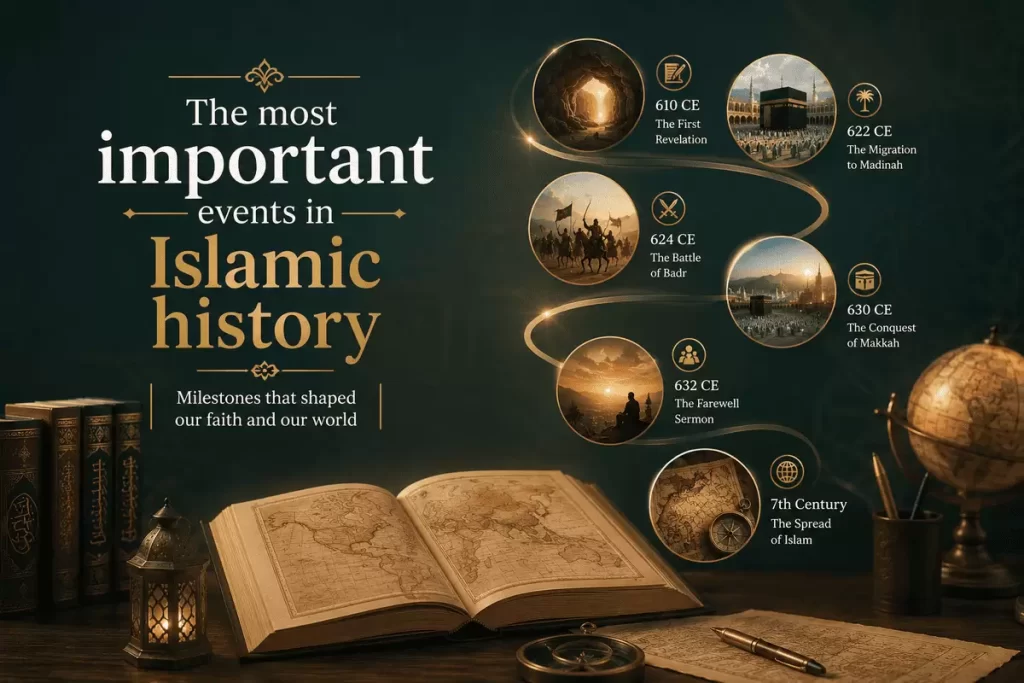
History remembers the powerful, but Islam was built by the faithful. From a single revelation in a cave outside Makkah to a civilization that stretched across continents, the most important events in Islamic history tell a story unlike any other. Every battle, every migration, every moment of loss and triumph carried the weight of a divine message taking root in the world. If you think you know this story, read on, because history always has more to reveal.
The Most Important Events in Islamic History
Islam is one of the world’s most influential religions, shaping civilizations, governance, and human thought for over 1,400 years. The most important events in Islamic history trace the journey of a message that changed the world forever, from the harsh deserts of Arabia to the courts of empires. Understanding these events is a window into the lives of the Prophet ﷺ, his companions, and the communities they built.
1. The Condition of Arabia Before Islam
Before Islam, the Arabian Peninsula was dominated by tribal societies, each with its own customs and deities. Known as Jahiliyyah (the Age of Ignorance), this era was marked by:
- Deep social inequalities with limited rights for women
- Honor-based conflicts are settled through tribal vengeance rather than justice
- Religious diversity combining polytheism, Christianity, and Judaism
This backdrop set the stage for the transformative message of Islam.
2. The Birth of Prophet Muhammad ﷺ
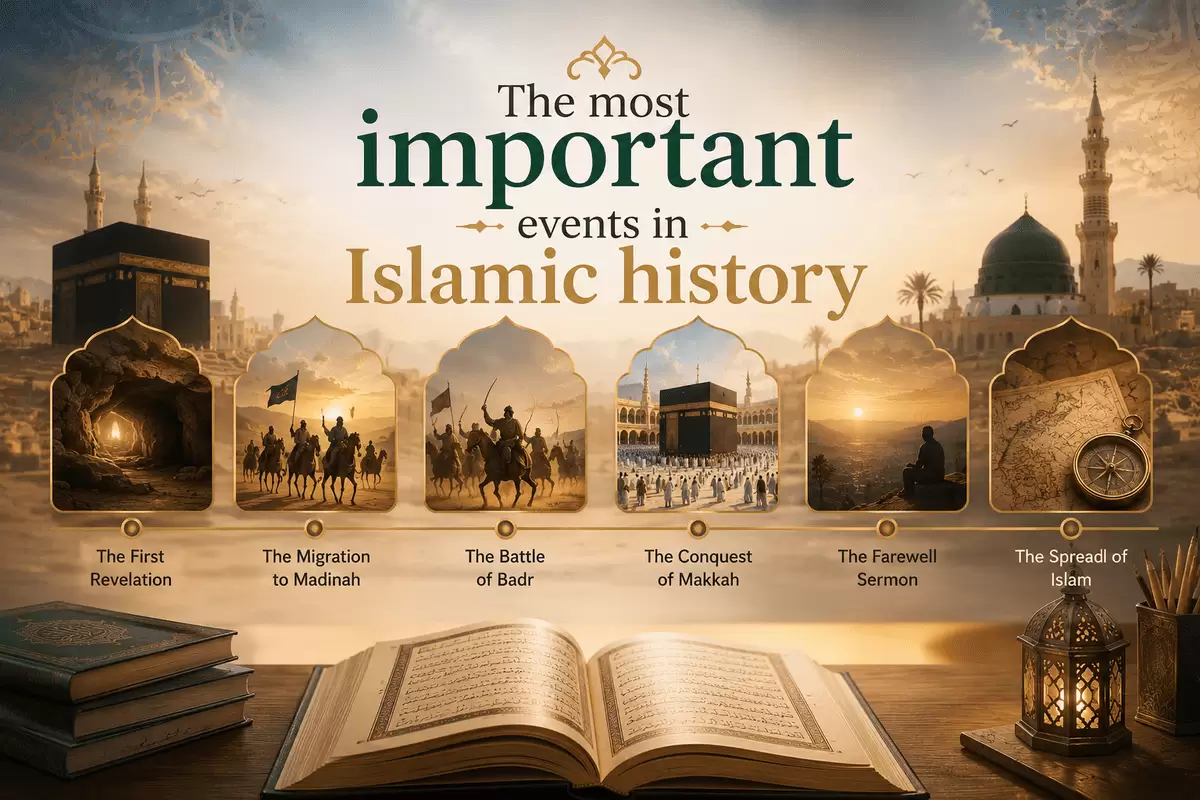
Prophet Muhammad ﷺ was born in 570 CE in Makkah, from the noble tribe of Quraysh. In the Cave of Hira, he received his first revelation from the angel Gabriel, marking the beginning of his prophethood during the Night of Power (Laylat al-Qadr). His role was not just spiritual but also social and political, as he challenged the prevailing norms of Arabian society, advocating for:
- Justice and equality
- The worship of one God
- The rights of the oppressed
3. The Migration to Abyssinia
As persecution of early Muslims intensified in Makkah, a small group sought refuge in the Christian kingdom of Abyssinia (modern-day Ethiopia). Key highlights of this migration include:
- The just king, Negus, granted them asylum after listening to a Quranic recitation
- It demonstrated the early Muslims’ commitment to their faith under adversity
- It reinforced the concept of hijrah (migration for the sake of faith), a theme that would define the broader Islamic experience
4. The Hijrah to Madinah
In 622 CE, Prophet Muhammad ﷺ and his companion Abu Bakr migrated to Yathrib, later renamed Madinah. This was not just a physical relocation but the establishment of the first Muslim state. Key outcomes included:
- The Constitution of Madinah, outlining the rights and responsibilities of Muslims, Jews, and other residents
- The beginning of the Islamic calendar
- The formation of the Brotherhood of Madinah, uniting Muslims and non-Muslims under a shared covenant
The Hijrah is celebrated annually as the Islamic New Year, symbolizing the birth of the Islamic ummah.
5. The Battle of Badr and Its Importance
In 624 CE, a Muslim army of 313 faced a Quraysh force of approximately 1,000 men. Despite the odds, the Muslims emerged victorious. Key outcomes of this battle:
- Established the principle that justice and righteousness would prevail
- Led to the establishment of the first Islamic treasury
- Boosted Muslim morale and shifted the Quraysh’s perception of the Muslim community
- The victory was seen as a miracle, reinforcing belief in divine support
6. The Battle of Uhud
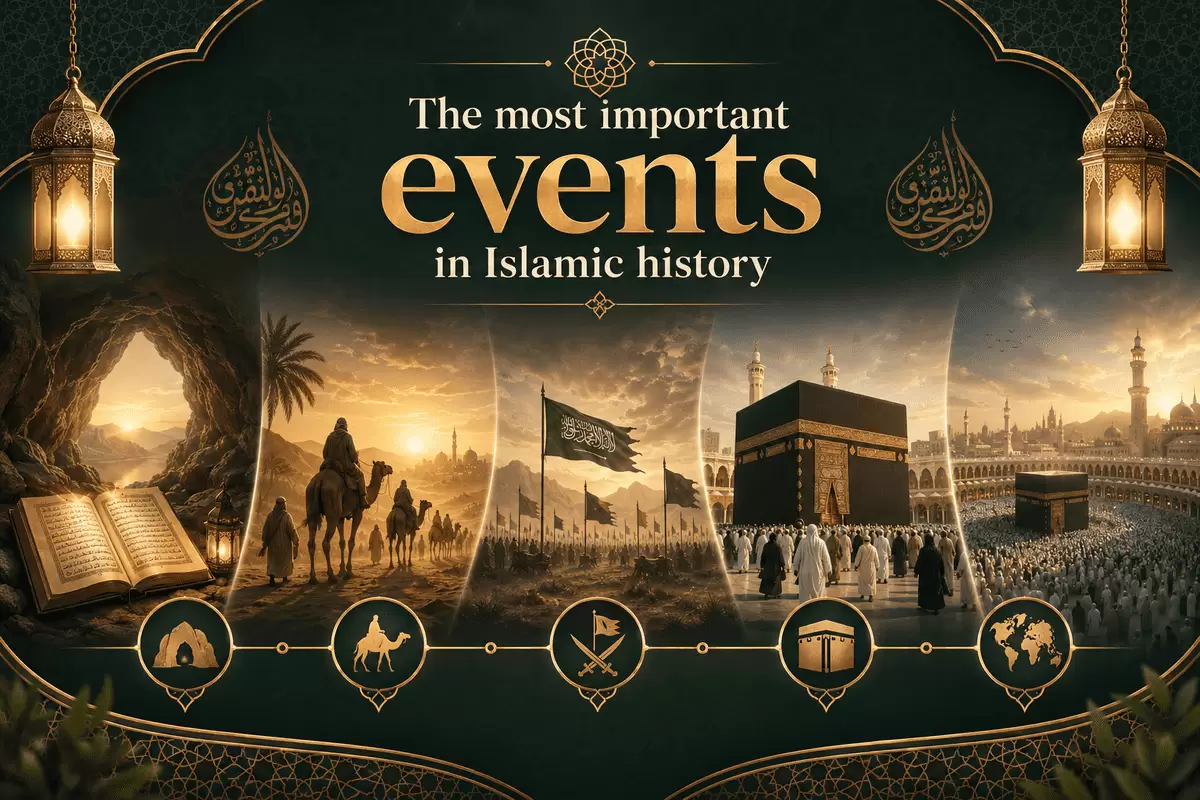
The Battle of Uhud in 625 CE revealed both the strengths and vulnerabilities of the young Islamic state. A critical mistake — disobeying Prophet Muhammad ﷺ’s order to hold position — led to:
- A devastating counterattack by the Quraysh
- The martyrdom of Hamzah ibn Abdul-Muttalib, the Prophet’s uncle
- Heavy losses that tested the resolve of the Muslim community
Rather than collapsing under defeat, the Muslims used the lessons from Uhud to strengthen their strategies, embodying the Islamic concept of fitnah (trial or tribulation) as a path to spiritual growth.
7. The Conquest of Makkah
In 630 CE, Prophet Muhammad ﷺ led an army into Makkah not as a conqueror, but as a liberator. This conquest was defined by:
- The Quraysh surrendered without resistance
- A general amnesty, forgiving all who had persecuted the Muslims
- The purification of the Kaaba from its idols
- The unification of the Arabian Peninsula under Islam
This event symbolized the triumph of justice over oppression, unity over division, and faith over idolatry.
8. The Farewell Pilgrimage of Prophet Muhammad ﷺ
In 632 CE, Prophet Muhammad ﷺ led approximately 100,000 Muslims in his final Hajj. On the Plain of Arafat, his farewell sermon addressed:
- The equality of all believers regardless of race or origin
- The rights of women, non-Muslims, and the poor
- The Five Pillars of Islam and the prohibition of interest (riba)
- The obligation to convey his teachings globally
This pilgrimage marked the transition from the Prophet’s personal guidance to the collective responsibility of the ummah.
9. The Death of Prophet Muhammad ﷺ
On the 12th of Rabi’ al-Awwal, 11 AH (632 CE), Prophet Muhammad ﷺ passed away after 23 years of prophethood. The events that followed included:
- Abu Bakr was chosen as the first Caliph, marking the beginning of the Rashidun Caliphate
- The Ridda Wars (Wars of Apostasy) against tribes who refused to pledge allegiance
- The compilation of the Quran into a single authoritative text, led by Abu Bakr and completed under Uthman
- His burial in his house in Madinah, in accordance with his wish for simplicity
His death marked not an end, but the beginning of a new chapter in the global spread of Islam.
How does the Arabian Tongue shape your journey of learning the Quran and Arabic?
At Arabian Tongue, we help you understand the Quran deeply and connect with its meanings through simple and effective teaching methods. Our courses are designed to make your learning journey clear, engaging, and spiritually enriching.
Guidance from the Quran and Hadith
قال الله تعالى: “إِنَّ اللَّهَ بَالِغُ أَمْرِهِ قَدْ جَعَلَ اللَّهُ لِكُلِّ شَيْءٍ قَدْرًا” سورة الطلاق: 65
Allah Almighty said: “Indeed, Allah will accomplish His purpose. Allah has already set for everything a decreed extent.” Surah At-Talaq: 65
عن عبدالله بن عمر رضي الله عنهما، قال رسول الله ﷺ: “لَا هِجْرَةَ بَعْدَ الْفَتْحِ وَلَكِنْ جِهَادٌ وَنِيَّةٌ” رواه البخاري ومسلم
Narrated by Abdullah ibn Umar (may Allah be pleased with them both), the Messenger of Allah ﷺ said: “There is no migration after the conquest, but there is jihad and intention.” Narrated by Al-Bukhari and Muslim
FAQs
Why is the Hijrah considered a major event in Islam?
The Hijrah marked the establishment of the first Muslim state in Madinah, where Prophet Muhammad ﷺ could govern and build a community based on Islamic principles. It also marks the beginning of the Islamic calendar, symbolizing the birth of the Muslim ummah as a unified community.
What happened during the Battle of Badr?
In 624 CE, a Muslim army of 313 faced a Quraysh force of approximately 1,000 men near the oasis of Badr, emerging victorious through divine intervention and strategic brilliance. The battle resulted in the capture of 70 Quraysh prisoners and the establishment of the first Islamic treasury, marking a turning point in the Muslim community's strength and confidence.
How did Islam spread in the early years?
Islam spread through a combination of preaching, trade, and migration, as early Muslims carried the message across Arabia and beyond despite intense persecution. The establishment of the Muslim state in Madinah provided a political and social foundation that enabled the faith to expand through diplomacy, military campaigns, and the compelling message of justice and equality.
What was the significance of the conquest of Makkah?
The conquest of Makkah in 630 CE unified the Arabian Peninsula under Islam and marked the end of the era of tribal divisions and idolatry. Prophet Muhammad ﷺ's declaration of general amnesty set a lasting precedent for mercy and reconciliation, demonstrating that Islamic governance was built on justice rather than vengeance.