
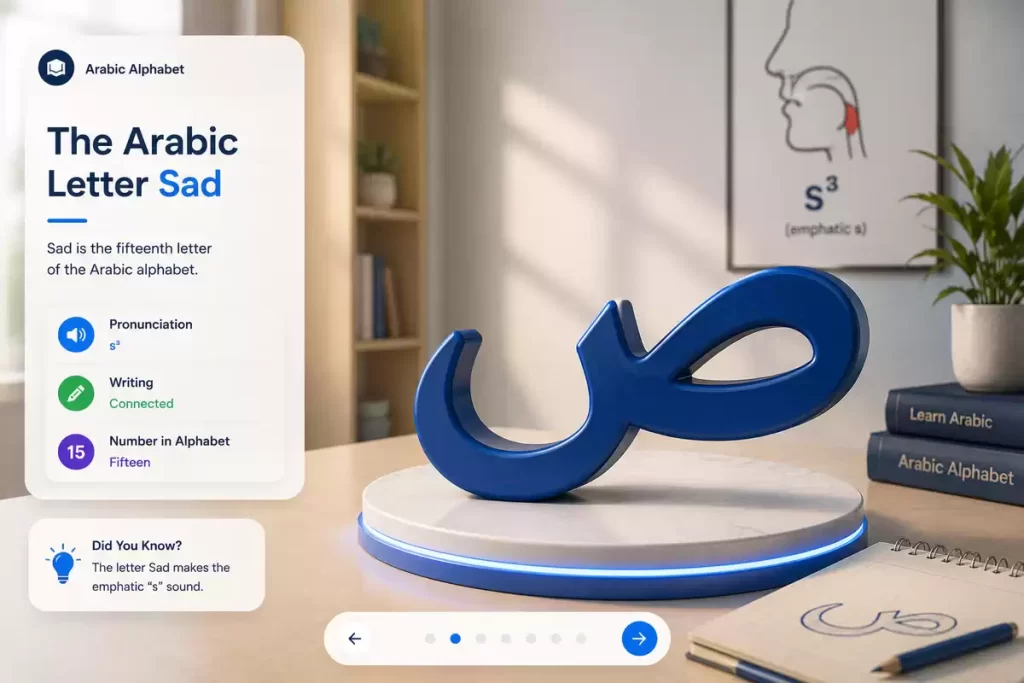
The Arabic letter Sad (ص) stands as a distinctive and often challenging component of the Arabic alphabet. It’s crucial for both accurate pronunciation and a deeper appreciation of the language’s phonetic richness. Its unique emphatic quality sets it apart, demanding precise articulation that can initially perplex learners. Mastering this letter isn’t just about sound production; it unlocks a deeper understanding of Arabic phonetics and significantly impacts the clarity and meaning of spoken and recited Arabic. This guide delves into the intricacies of this letter, offering practical insights for learners at every stage.
What is the Arabic Letter Sad ص?
Sad (ص) is an emphatic Arabic letter that produces a thick, heavy “S” sound, which naturally deepens the surrounding vowels in a word and distinguishes it from the softer Seen (س).
- Emphatic Sound: Pronounced with a heavy, velarized sound by raising the back of the tongue toward the soft palate.
- Unvoiced & Fricative: Produced without vocal cord vibration, forcing airflow through a narrow channel to create friction.
- Front Articulation: Formed using the front part of the tongue positioned right behind the lower teeth.
- Visual Form: Features a unique horizontal loop, a small tooth, and a deep bowl, written entirely without dots.
قال الله تعالى: «وَرَتِّلِ الْقُرْآنَ تَرْتِيلًا» (سورة المزمل 73:4) .
Allah says: “And recite the Quran with measured recitation.” (Surah Al-Muzzammil 73:4).
How to Pronounce the Arabic Letter Sad ص Correctly?
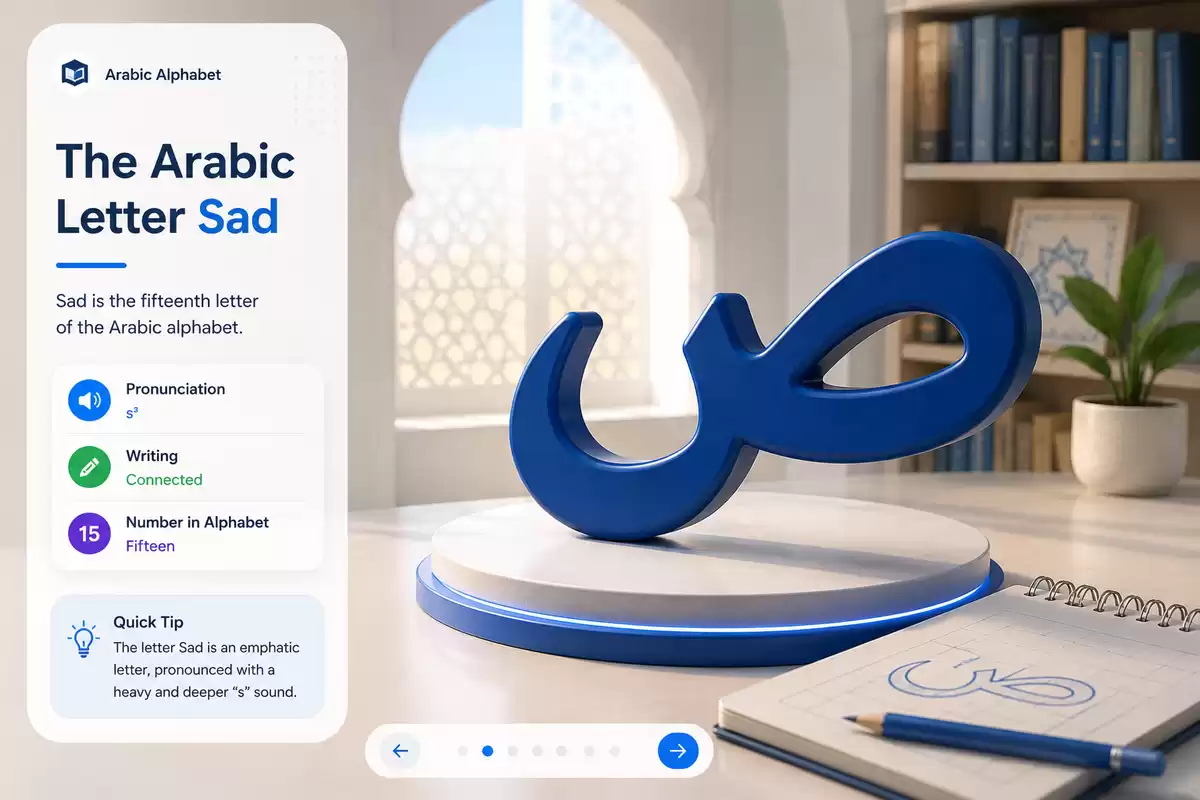
Pronouncing Sad (ص) requires a deliberate “thickening” of the voice called velarization, which distinguishes it from its lighter counterpart, Seen (س).
Step-by-Step Guide
- The Base: Start with a standard “s” sound (like Seen), keeping the tip of your tongue behind your lower front teeth.
- The Elevation: Raise the back of your tongue toward the soft palate while widening the middle of your tongue to flatten the airflow.
- The Finish: Slightly round your lips to deepen the resonance, ensuring adjacent vowels also sound heavy and thick.
Learning Aids
- Digital Tools: Use Tajweed apps (Tajweed Tutor) and YouTube tutorials to analyze audio samples and visual tongue movements.
- Self-Evaluation: Practice in front of a mirror to check mouth shapes and record your voice to compare it with native speakers.
Mistakes to Avoid
- Flat Sound: Confusing Sad with Seen (س), which alters meanings (e.g., changing صبر / patience into سبر / to test).
- Over-exaggeration: Forcing a strained, overly guttural tone instead of a natural heavy sound.
- Vowel Neglect: Failing to apply the thick, heavy quality to the surrounding short vowels.
قال الله تعالى: “الَّذِينَ آتَيْنَاهُمُ الْكِتَابَ يَتْلُونَهُ حَقَّ تِلَاوَتِهِ” (سورة البقرة 2:121).
Allah says: “Those to whom We have given the Book recite it with its true recitation.” (Surah Al-Baqarah 2:121).
The Difference Between Sad ص and Seen س in Arabic
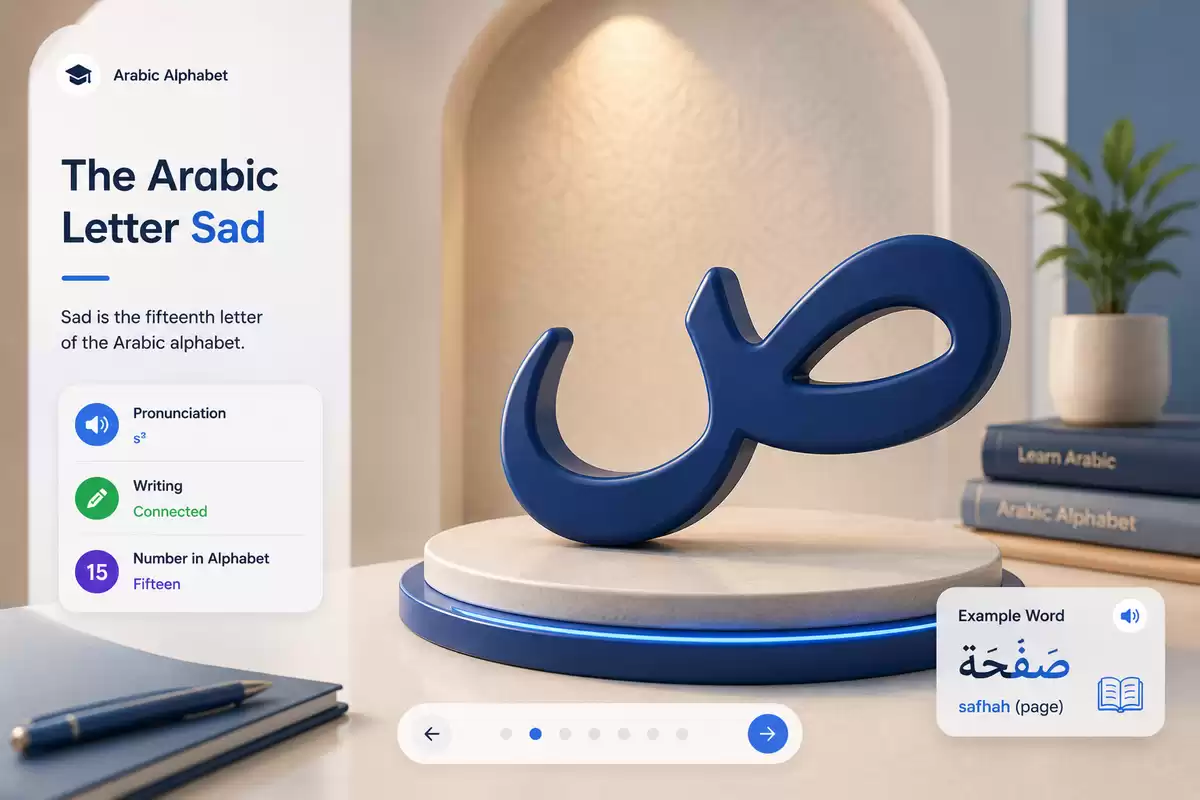
The distinction between the emphatic Sad (ص) and the plain Seen (س) is a fundamental aspect of Arabic phonetics that alters both word meanings and vowel pronunciation.
| Feature | Sad (ص) | Seen (س) |
| Sound Quality | Thick, heavy, and dark “s” sound. | Light, thin, and bright “s” sound (like English ‘s’). |
| Velarization | Velarized (back of the tongue raises toward the soft palate). | Non-velarized (back of the tongue remains low). |
| Vowel Impact | Deepens and thickens adjacent vowels. | Does not affect the sound of adjacent vowels. |
| Visual Shape | Features an elongated loop/oval body at the start. | Features three distinct “teeth” or humps at the start. |
| Examples | صبر (patience), صلح (reconciliation), صراط (path) | سبر (to test), سلح (to arm), سراط (non-existent word) |
قال الله تعالى: “وَرَتِّلِ الْقُرْآنَ تَرْتِيلًا” (سورة المزمل 73:4).
Allah says: “And recite the Quran with measured recitation.” (Surah Al-Muzzammil 73:4).
The Role of the Arabic Letter Sad ص in Arabic Calligraphy
The letter Sad (ص) serves as a key visual anchor in Arabic calligraphy, balancing weight and flow across various artistic scripts.
Script Variations
- Thuluth & Kufic: Rendered with grand, sweeping curves in Thuluth to show visual weight, or with rigid, geometric angles in Kufic for architectural inscriptions.
- Naskh & Ruq’ah: Written compactly and rounded in Naskh to ensure print readability, or heavily simplified and condensed in Ruq’ah for fast daily writing.
- Diwani & Maghrebi: Intertwined with ornamental loops and fluid flourishes in Diwani, or styled with broad, deeply elongated tails in Maghrebi scripts.
Art & Historic Artifacts
- Cultural Use: Features prominently in architectural arabesques, gold-leaf Quranic manuscripts, historical ceramics, and abstract modern Arab art.
- Famous Masterpieces: Seen in the 7th-century Kufic inscriptions of the Dome of the Rock, the gold-on-indigo Blue Quran, and imperial Ottoman Thuluth panels.
How does the Arabian Tongue shape your journey of learning the Quran and Arabic?
At Arabian Tongue, we help you understand the Quran deeply and connect with its meanings through simple and effective teaching methods. Our courses are designed to make your learning journey clear, engaging, and spiritually enriching.
Guidance from the Quran and Hadith
قال الله تعالى: “كِتَابٌ أُحْكِمَتْ آيَاتُهُ ثُمَّ فُصِّلَتْ مِنْ لَدُنْ حَكِيمٍ خَبِيرٍ” (سورة هود 11:1).
Allah says: “A Book whose verses have been perfected and then presented in detail from One who is Wise and Aware.” (Surah Hud 11:1).
قال رسول الله ﷺ: “خَيْرُكُمْ مَنْ تَعَلَّمَ الْقُرْآنَ وَعَلَّمَهُ” (صحيح البخاري، 5027).
Muhammad ﷺ said: “The best among you are those who learn the Quran and teach it.” (Sahih al-Bukhari, 5027).
FAQs:
How is the Arabic Letter Sad ص written in different word positions?
It retains its oval loop and connects to the left in its initial form (صـ) and connects from both sides in its medial form (ـصـ). In its final (ـص) and isolated (ص) forms, it drops the connection line and finishes with its deep, signature tail bowl.
What does the Arabic Letter Sad ص mean in English?
As a standalone letter of the alphabet, Sad does not carry an independent dictionary definition or meaning in English. Its role is purely phonetic, providing the heavy, resonant S sound needed to build and differentiate words in the language.
Are there specific Tajweed rules for the Arabic Letter Sad ص?
It requires Isti'laa (tongue elevation) and Itbaaq (tongue closure), which trap the air to thicken the letter and its surrounding vowels. Note that Sad is a soft, whispered letter and never receives Qalqalah (echoing), correcting a common misconception about its rules.
What are some common words that use the Arabic Letter Sad ص?
Everyday examples include صلاة (salat - prayer), صديق (sadeeq - friend), صباح (sabah - morning), and صبر (sabr - patience). You also find it frequently in words like صورة (sura - picture), صوت (sawt - voice), and صغير (saghir - small or young).
Why is the Arabic letter ص considered an emphatic letter?
It is classified as emphatic because its articulation requires velarization, meaning you must lift the back of your tongue. This movement creates a deep acoustic resonance chamber inside your mouth, giving the letter its characteristically thick, heavy sound.