
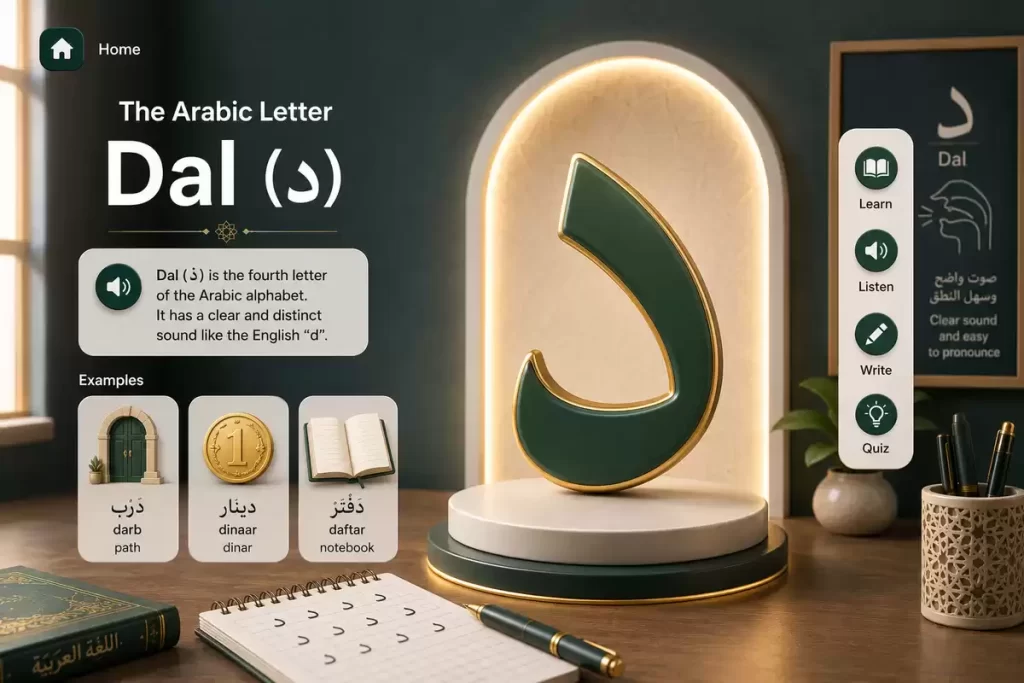
The Arabic letter Dal (د), a fundamental component of the Arabic script, serves as a cornerstone for both everyday communication and profound religious texts, embodying a rich history and distinct phonetic characteristics. Mastering this letter is crucial for anyone aspiring to achieve fluency in Arabic, as it appears frequently across various linguistic contexts. Its unique sound and form are integral to understanding the language’s phonology and morphology, making it a key element in developing strong Arabic reading skills. This guide delves into the intricacies of Dal, offering insights for learners at all stages.
What is The Arabic Letter Dal?
The Arabic letter Dal (د) is the eighth letter in the Arabic alphabet, representing a sound like the English ‘d’ in ‘dog’.
- Key characteristic: It is a non-connector (does not join with the following letter).
- Identification: It has a simple, distinct shape that is easy to identify.
- Importance: Recognizing its non-connecting nature early on prevents common writing errors.
Origin and Significance of Dal in Arabic
The letter Dal traces its lineage back to ancient scripts like Phoenician and Aramaic, evolving over millennia into its modern single-stroke form.
- Significance: It has maintained a consistent phonetic value and serves as a foundational consonant in countless Arabic root words.
- Examples: “house” (دَار), “lesson” (دَرْس), and “religion” (دِين).
Position of Dal in the Arabic Alphabet
The Arabic letter Dal occupies the eighth position in the alphabet, following Khā (خ) and preceding Dhāl (ذ).
- Numerical value: It has a value of 4 in the Abjad notation system.
- Practical tip: Memorize its position relative to its counterpart, Dhāl (ذ), which has a dot above it, to avoid confusion.
. قال الله تعالى: “وَرَتِّلِ الْقُرْآنَ تَرْتِيلًا” (سورة المزمل 73:4)
Allah says: “And recite the Quran with measured recitation.” (Surah Al-Muzzammil 73:4).
Common Words and Sentences Featuring The Arabic Letter Dal
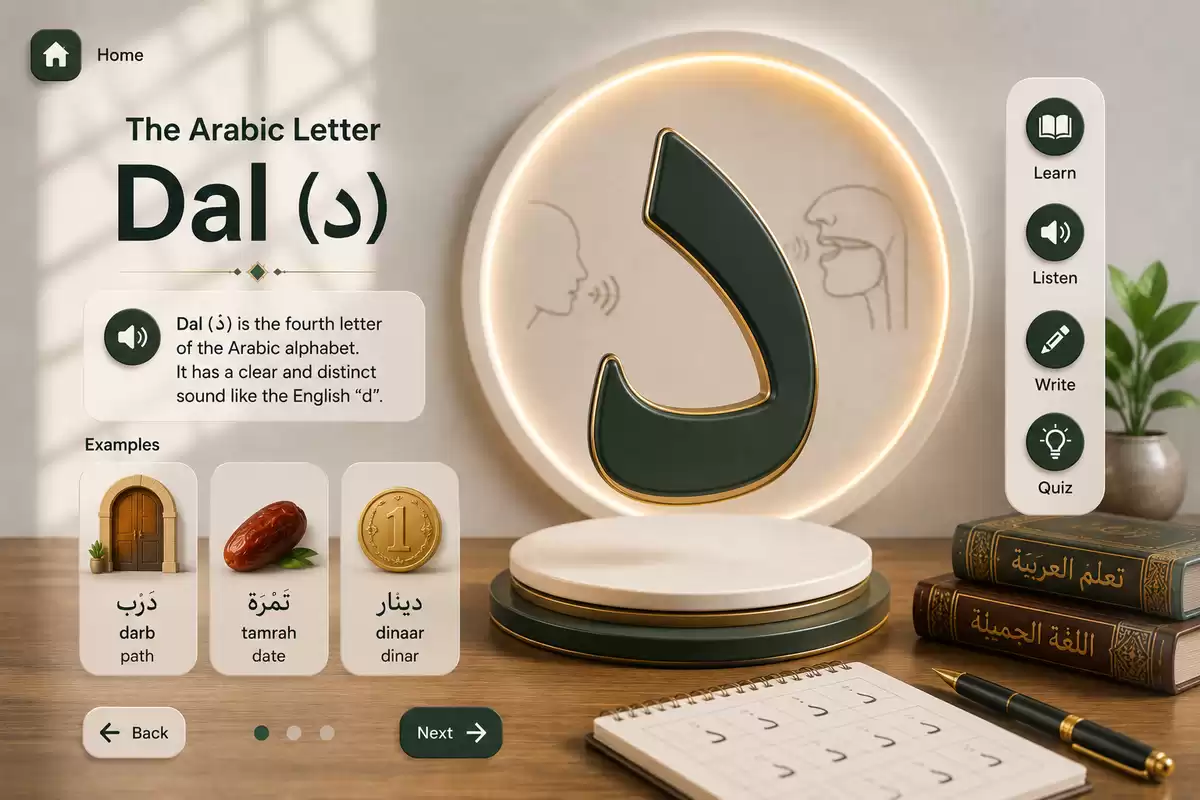
Familiarity with words and sentences featuring Dal is vital for practical language acquisition, reinforcing its recognition and pronunciation in real-world contexts.
| Category | Arabic Text | Transliteration | English Meaning |
| Word | دَار | dār | house/home |
| Word | دَرْس | dars | lesson |
| Word | يَد | yad | hand |
| Word | بَرْد | bard | cold (noun) |
| Word | جَدِيد | jadīd | new |
| Word | دُبّ | dubb | bear |
| Word | وَرْد | ward | roses |
| Sentence | هَذَا دَرْسٌ جَدِيدٌ. | Hādhā darsun jadīd. | This is a new lesson. |
| Sentence | لَدَيْنَا دَارٌ كَبِيرَةٌ. | Ladaynā dārun kabīrah. | We have a big house. |
| Sentence | أَنَا أُرِيدُ يَدَكَ. | Anā urīdu yadaka. | I want your hand. |
| Sentence | الْجَوُّ بَارِدٌ الْيَوْمَ. | Al-jawwu bāridun al-yawm. | The weather is cold today. |
| Sentence | أَكَلَ الدُّبُّ الْوَرْدَ. | Akala ad-dubbu al-ward. | The bear ate the roses. |
قال الله تعالى: “ذَٰلِكَ الْكِتَابُ لَا رَيْبَ ۛ فِيهِ ۛ هُدًى لِّلْمُتَّقِينَ” (سورة البقرة 2:2).
Allah says: “This is the Book about which there is no doubt, a guidance for those conscious of Allah.” (Surah Al-Baqarah 2:2).
Understanding Dal in Quranic Contexts
The Arabic letter Dal holds significance within the Quran, contributing to words denoting guidance, religion, and divine decree.
- Theological Significance: The word دِين (dīn), meaning religion, is central to Islamic theology. Similarly, هُدًى (hudā), meaning guidance, features Dal, emphasizing its role in conveying divine direction.
- Tajweed Rules: Rules dictate precise articulation for Dal. It is a “qalqalah” letter when it has a sukoon, requiring a slight echo or bounce in its pronunciation to ensure clarity and correctness.
- Common Mistake: Pronouncing Dal too softly and losing the “qalqalah” effect; actively focusing on this slight bounce improves recitation.
قال الله تعالى: “إِنَّ الدِّينَ عِندَ اللَّهِ الْإِسْلَامُ” (سورة آل عمران 3:19).
Allah says: “Indeed, the religion in the sight of Allah is Islam.” (Surah Aal-Imran 3:19).
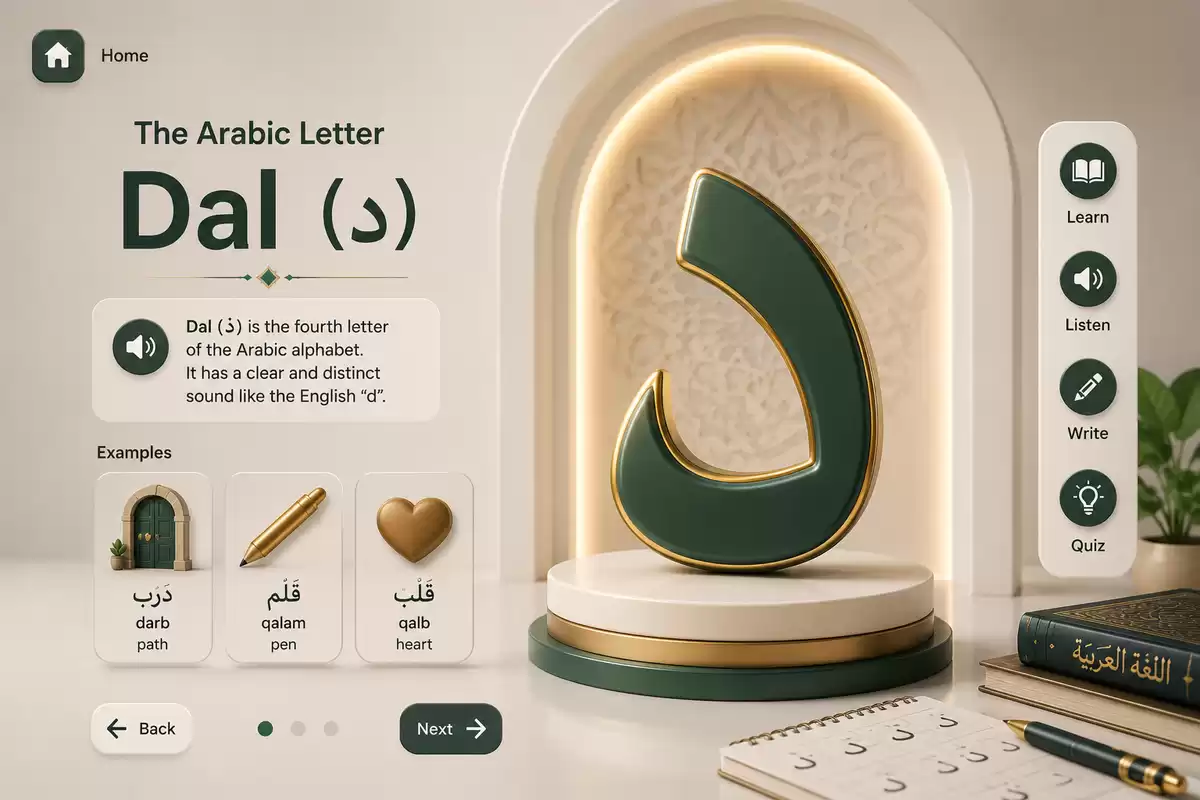
Advanced Applications and Linguistic Nuances of Dal
The letter Dal participates in complex linguistic structures, grammar, morphology, and idioms.
Dal in Arabic Grammar and Morphology
Dal forms verbs and nouns through various morphological patterns and maintains its sound across tenses.
- Root Example (د-ر-س): Gives rise to دَرَسَ (he studied), يَدْرُسُ (he studies), دَرْس (lesson), and مَدْرَسَة (school).
- Verb Forms: Appears in specific forms, such as Form II (doubled) or Form V (preceded by ‘tā’).
Idiomatic Expressions Involving Dal
- دَقَّ جَرَسَ الْخَطَرِ: To sound the alarm or warn of danger.
- دَارَ الْحَدِيثُ بَيْنَهُمَا: They conversed or discussed.
- وَدَّ لَوْ: He wished that.
- دَخَلَ فِي صُلْبِ الْمَوْضُوعِ: To get to the heart of the matter.
Historical Evolution of Dal’s Usage
Originating in ancient Semitic alphabets like Nabataean and Aramaic, Dal has consistently retained its phonetic sound while adapting to various calligraphic styles:
- Kufic script: Angular and robust.
- Naskh script: Smoother and more flowing for everyday writing.
How does the Arabian Tongue shape your journey of learning the Quran and Arabic?
At Arabian Tongue, we help you understand the Quran deeply and connect with its meanings through simple and effective teaching methods. Our courses are designed to make your learning journey clear, engaging, and spiritually enriching.
Guidance from the Quran and Hadith
Allah says: “Guide us to the straight path.” (Surah Al-Fatihah 1:6).
Allah says: “Guide us to the straight path.” (Surah Al-Fatihah 1:6).
قال النبي ﷺ: “خَيْرُكُمْ مَنْ تَعَلَّمَ الْقُرْآنَ وَعَلَّمَهُ” (صحيح البخاري، 5027).
The Prophet ﷺ said: “The best among you are those who learn the Quran and teach it.” (Sahih al-Bukhari, 5027).
FAQs:
How do you correctly pronounce the Arabic letter Dal?
The letter Dal is pronounced as a voiced dental stop, similar to the d in dog. To produce it, the tip of your tongue touches the back of your upper front teeth and releases with a voiced expulsion of air.
What is the difference between the Arabic letters Dal and Dhaad?
Dal (د) is a light dental sound made by touching the front teeth. Dhaad (ض) is a heavy, emphatic letter pronounced by pressing the tongue against the side molars, creating a much deeper sound.
What are common examples of the letter Dal in Arabic?
Common examples include words like دَرْس (lesson), يَد (hand), جَدِيد (new), and دَار (house). These words are frequently encountered in daily conversation, making them excellent starting points for learners.
How can I practice writing the Arabic letter Dal effectively?
Begin by tracing the single downward stroke repeatedly, then move to freehand practice. Pay attention to its non-connecting nature, ensuring it stands alone without joining the following letter.
Are there any specific tips for learners in non-Arabic-speaking countries to master Dal?
Focus on auditory exercises and native audio to distinguish its pronunciation from similar sounds. Practice reading Dal aloud in simple sentences, and avoid confusing it with the dotted letter Dhāl (ذ).