
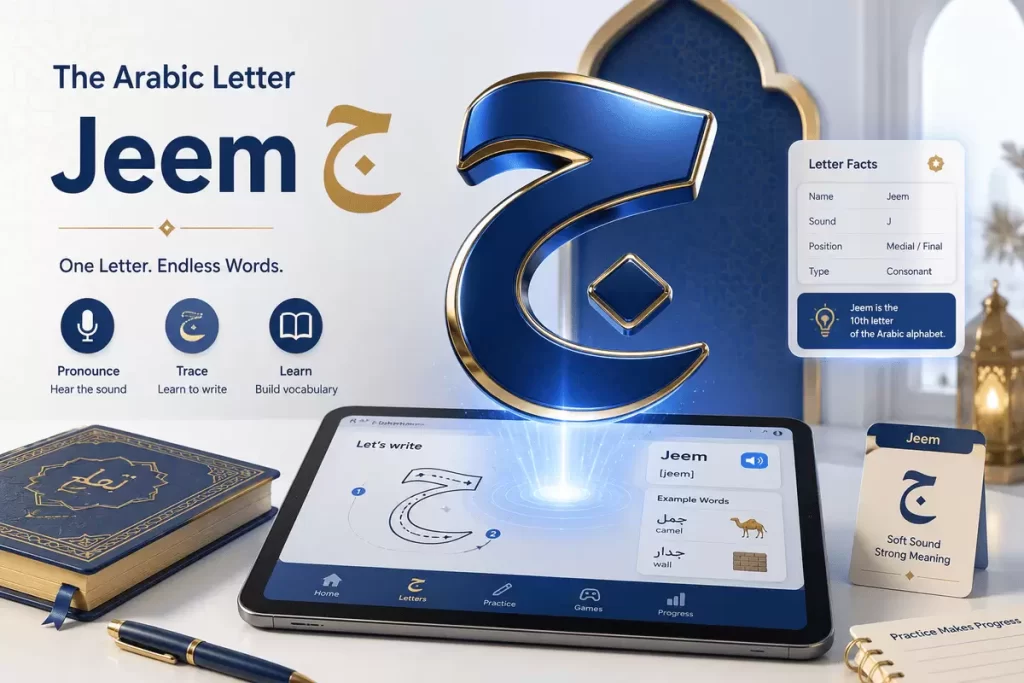
The Arabic letter Jeem (ج) stands as a fundamental component of the Arabic alphabet, a versatile character whose correct pronunciation and understanding are crucial for anyone embarking on the journey of learning Arabic. This letter, with its unique sound and varied regional pronunciations, often presents a fascinating challenge for non-native speakers, yet mastering it unlocks a deeper comprehension of the language’s phonetic richness. Delving into its characteristics, articulation, and common pitfalls will equip learners with the tools to confidently navigate its complexities.
What is the Arabic Letter Jeem (ج) and its significance in Arabic?
The Arabic letter Jeem (ج) is the fifth letter of the Arabic alphabet, representing a voiced palato-alveolar affricate sound, similar to the “j” in “jump” in English. Its accurate recognition is vital for comprehensive understanding, as it is a cornerstone of vocabulary appearing in everyday greetings and religious texts.
Key Characteristics of Jeem (ج)
- Phonetic Value: It produces a voiced sound, meaning vocal cords vibrate during its articulation.
- Numerical Value: In the ancient Abjad numeral system, Jeem corresponds to the number three.
- Morphological Importance: This letter is integral to numerous Arabic root words. For example, the root “ج-م-ل” (j-m-l) gives rise to words like “جمال” (beauty), “جمل” (camel), and “جميل” (beautiful).
- Quranic Arabic Letters: Jeem is a prominent letter in the Quran, and its precise articulation is crucial for correct recitation and understanding of sacred texts.
- Visual Distinctiveness: Its unique shape, featuring a dot below the main body, helps differentiate it from similar-looking letters like Haa (ح) and Khaa (خ).
يقول الله تعالى: “إِنَّا أَنزَلْنَاهُ قُرْآنًا عَرَبِيًّا لَّعَلَّكُمْ تَعْقِلُونَ” (سورة يوسف: 2).
Allah says: “Indeed, We have sent it down as an Arabic Quran that you might understand.” (Surah Yusuf 12:2).
How to Pronounce This Arabic Letter Correctly?
To pronounce Jeem (ج) correctly, place the middle of your tongue against the hard palate behind the alveolar ridge, block the airflow briefly, and release it with slight friction while vibrating your vocal cords. Keep your jaw slightly open and your lips neutral.
Articulation Point and Characteristics
- Mid-Palate Contact: It is a voiced palato-alveolar affricate combining a complete airflow closure with a turbulent air release.
- Non-Emphatic & Strong: The back of the tongue stays down, producing a distinct, crisp, and fully voiced sound.
Pronunciation Challenges
- Unvoiced Substitution: Confusing it with the unvoiced “ch” sound, turning “جمل” (jamal) into “chamal.”
- Weak Voicing & Breathy Air: Failing to vibrate the vocal cords or releasing too much air.
- Position & Dialect Shifts: Misplacing the tongue or shifting to regional sounds like the Egyptian hard “g.”
- Haa (ح) Confusion: Mixing up the mid-palate friction of Jeem with the guttural throat sound of Haa.
Practice Exercises
- Isolated Focus: Practice the “j” sound alone (“jjjjjj”) to isolate and feel the vocal cord vibration.
- Minimal Pairs: Drill contrasting word sets like “جمل” / “شمل” and “جاء” / “شاء.”
- Tongue Twisters & Reading: Build structural speed with phrases like “جدي جدير بالجد” and read contextual sentences like “الجمال في الجبل جميل جداً.”
- Shadowing: Mimic native speakers, record your pronunciation, and compare to self-correct.
قال النبي ﷺ: «من قرأ حرفًا من كتابِ اللهِ فله به حسنةٌ، والحسنةُ بعشرِ أمثالِها» (جامع الترمذي).
Prophet Muhammad ﷺ said: “Whoever recites a letter from the Book of Allah will receive one good deed, and the good deed is multiplied by ten.” (Jami` at-Tirmidhi).
The Arabic Letter Jeem (ج) in Regional Dialects
The letter Jeem (ج) varies significantly across dialects. In Egypt, it is pronounced as a hard “g” (like “go”), while in the Gulf, it usually retains the classical “j” sound or softens to a “y” sound in informal speech. Understanding these nuances is vital for comprehension and regional identity.
- Egyptian: Always a hard “g” (e.g., “جميل” becomes “gameel”).
- Levantine & Maghrebi: Maintain the classical “j” sound (e.g., “جمل” is “jamal”).
- Gulf: Uses the classical “j” but can soften to a “y” sound (e.g., “جميل” becomes “yameel”).
Variations in Jeem pronunciation across Egyptian and Gulf Arabic
- Egyptian Arabic (G-sound): Pronounced /ɡ/ in all word positions (e.g., “جمل” is /ɡamal/, “جديد” is /ɡadiːd/).
- Gulf Arabic (J-sound and Y-sound): Maintains classical /dʒ/ in regions like Saudi Arabia and Kuwait (e.g., “جمل” is /dʒamal/). However, urban or informal speech can shift it to a /j/ sound (e.g., “جميل” as /jamiːl/, or “دجاجات” as “dayaajaat”).
Impact of dialectal differences on learning Jeem
- Communication & Listening: Misunderstandings occur if a speaker expects one sound and hears another (e.g., “gabal” vs “jabal” for mountain). Learners must train their ears to recognize all variations.
- Integration & Accent: Adopting the local pronunciation helps learners sound natural, build rapport, and master a specific regional accent.
- Materials: Learners must choose resources carefully to avoid dialect confusion and look past monolithic views of the language.
Resources for understanding regional Jeem pronunciations
- Dialect Courses: Programs like “Kallimni Arabi” (Egyptian) or “Pimsleur.”
- Audio Dictionaries & YouTube: Sites like Forvo or Reverso Context, and channels focused on dialect phonetics.
- Interaction & Media: Language exchange apps (HelloTalk, Tandem), tutors, and regional media like Egyptian films or Syrian dramas.
يقول الله تعالى: “إِنَّا جَعَلْنَاهُ قُرْآنًا عَرَبِيًّا لَّعَلَّكُمْ تَعْقِلُونَ” (سورة الزخرف: 3).
Allah says: “Indeed, We have made it an Arabic Quran that you might understand.” (Surah Az-Zukhruf 43:3).
Common Mistakes and How to Avoid Them with The Arabic Letter Jeem (ج)
To avoid mistakes with Jeem (ج), focus on its exact tongue-palate contact point, write its dots carefully, and test your pronunciation.
- Substituting with “Ch”: Pronouncing it unvoiced. Solution: Vibrate your vocal cords and feel the throat shake.
- Confusing with Haa (ح): Making a throat sound. Solution: Use tongue-to-palate placement, not the throat.
- Lack of Affricate Quality: Dropping the tongue block. Solution: Practice the “stop-then-friction” sequence slowly.
- Incorrect Vowel Length & Accent Shifts: Mispronouncing Harakat or applying classical sounds in dialect contexts. Solution: Pay attention to markings and build muscle memory.
Differentiating Jeem from similar-sounding letters
- Jeem (ج) vs. Sheen (ش): Jeem is a voiced affricate (“j” in “jump”); Sheen is an unvoiced fricative (“sh” in “ship”). Example: “جاء” vs. “شاء”.
- Jeem (ج) vs. Haa (ح): Jeem is palato-alveolar; Haa is an unvoiced, guttural throat sound. Example: “جمل” vs. “حمل”.
- Jeem (ج) vs. Qaaf (ق): Jeem is mid-palate; Qaaf is a deep uvular throat stop. Example: “جال” vs. “قال”.
- Jeem (ج) vs. Daal (د): Jeem has friction; Daal is a simple dental stop (“d” in “dog”). Example: “جد” vs. “دَد”.
Spelling errors related to Jeem in Arabic words
- Dot Placement Errors: Confusing Jeem (ج, dot below) with Haa (ح) or Khaa (خ), changing word meanings (e.g., “حمل” for “جمل”).
- Dialect & Transliteration Influence: Writing words based on English spellings or local dialect sounds (like the Egyptian hard “g”) instead of standard Arabic rules.
- Misremembering Roots & Handwriting: Dropping dots in fast writing or mixing up the base root letters due to low exposure.
Strategies for correcting Jeem-related errors
- Focused Auditory Training: Listen to native speakers across multiple dialects to recognize different Jeem styles.
- Pronunciation Drills & Feedback: Practice aloud, record your voice, and get corrections from a tutor.
- Visual Discrimination: Practice separating Jeem, Haa, and Khaa in texts based entirely on dot placement.
- Spelling Quizzes & Dictation: Write down words from audio dictations to lock in correct visual forms.
- Flashcards for Similar Letters: Study flashcards showing Jeem in its initial, medial, and final structural shapes.
- Contextual Reading & Writing: Read and write full paragraphs regularly to build natural muscle memory.
How does the Arabian Tongue shape your journey of learning the Quran and Arabic?
At Arabian Tongue, we help you understand the Quran deeply and connect with its meanings through simple and effective teaching methods. Our courses are designed to make your learning journey clear, engaging, and spiritually enriching.
Guidance from the Quran and Hadith
يقول الله تعالى: “فَاسْأَلُوا أَهْلَ الذِّكْرِ إِن كُنتُمْ لَا تَعْلَمُونَ” (سورة النحل: 43).
Allah says: “Ask the people of knowledge if you do not know.” (Surah An-Nahl 16:43).
قال النبي ﷺ: «نضَّرَ اللهُ امرأً سمِعَ مِنَّا شيئًا فبلَّغَهُ كما سمِعَهُ» (جامع الترمذي).
The Prophet ﷺ said: “May Allah brighten the face of a person who hears something from us and conveys it as he heard it.” (Jami` at-Tirmidhi).
FAQs:
What is the Arabic Letter Jeem (ج) and its position in the alphabet?
The letter Jeem (ج) is the fifth letter of the Arabic alphabet, representing a voiced j sound like jump. It consistently follows the letter Tha (ث) and precedes Haa (ح) in the standard script order.
How do you write the letter Jeem in its different forms?
Jeem has four contextual forms: isolated (ج), initial (جـ) as in جمل, medial (ـجـ) as in مسجد, and final (ـج) as in ثلج. Mastering these connections is essential for legible and correct Arabic handwriting.
What is the correct pronunciation of the Arabic letter Jeem (ج)?
It is pronounced as a voiced palato-alveolar affricate, sounding exactly like the j in the English word judge. To say it, touch the middle of your tongue to the hard roof of your mouth while vibrating your vocal cords.
What are some common spelling mistakes with the letter Jeem?
The most common mistake is mixing it up with Haa (ح) or Khaa (خ) due to their identical base shapes. Misplacing or omitting the bottom dot entirely changes the word root, such as writing حبل instead of جبل.
What are examples of the letter Jeem in initial, medial, and final positions?
Examples include initial position in جمل (camel), medial position in شجرة (tree), and final position in ثلج (snow). These examples show how the letter alters its visual shape depending on where it sits in a word.
Can you guess how Arabs write hahahaha?
Arabs write laughter by repeating the letter Haa as هههههه for a normal laugh, or Khaa as خخخخخخ for a deep snort. The letter Jeem (ج) is never used to write out laughter in Arabic.