
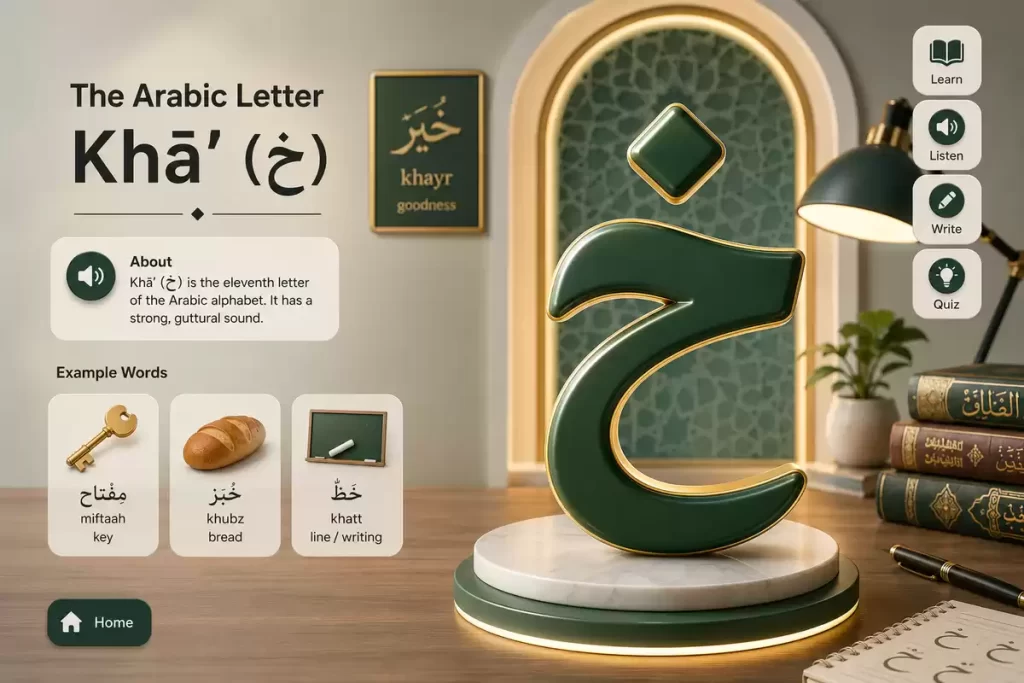
Mastering the Arabic Letter Kh خ is often considered a significant hurdle for Arabic language learners, yet it is a fundamental sound that unlocks a deeper understanding and fluency in the language. This distinctive guttural sound, unique to Arabic and a few other languages, requires precise articulation and consistent practice. This article will provide a comprehensive guide to understanding, pronouncing, and distinguishing this letter from similar sounds, offering practical strategies to help learners achieve mastery and confidence in their spoken Arabic.
What is the Arabic Letter Kh خ?
The Arabic letter Kh (خ) is the seventh letter in the traditional alphabet and represents a voiceless uvular fricative sound. It holds a numerical value of 600 in the Abjad system (Hisab al-Jumal).
Produced deep in the back of the mouth, this throat letter is voiceless and fricative, made by forcing air through a narrow channel. It is always pronounced with tafkheem (emphasis), giving it a heavy quality. Its written form changes depending on whether it appears in the initial, medial, or final position within a word.
يقول الله تعالى: “إِنَّا أَنزَلْنَاهُ قُرْآنًا عَرَبِيًّا لَّعَلَّكُمْ تَعْقِلُونَ” (سورة يوسف: 2).
Allah says: “Indeed, We have sent it down as an Arabic Quran that you might understand.” (Surah Yusuf 12:2).
How to Pronounce This Letter Correctly?
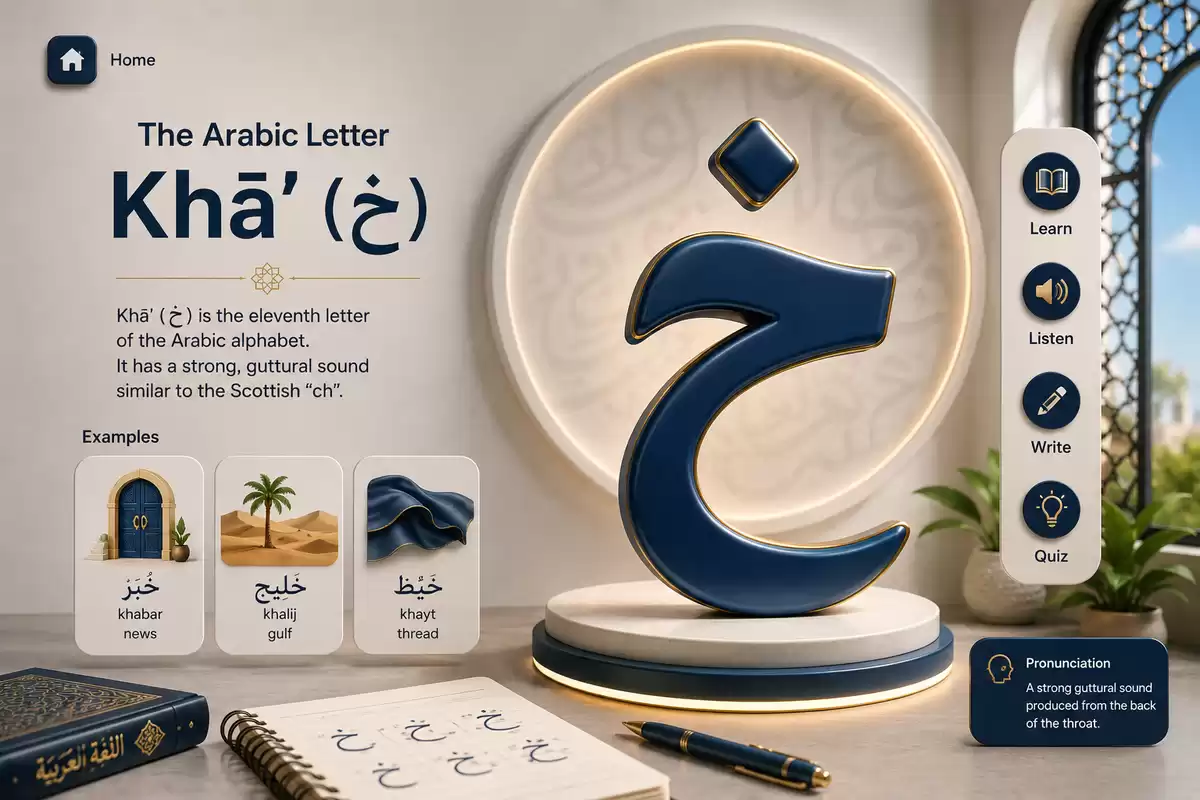
To pronounce Kh (خ) correctly, create friction at the back of your throat without vibrating your vocal cords, similar to the “ch” in the Scottish “loch” or German “Bach.”
Steps to pronounce it:
- Position your tongue: Raise the back of your tongue toward the soft palate and uvula to create a narrow gap.
- Exhale air: Force air from your lungs through this narrow gap.
- Create friction: Let the air produce a rough, scratchy sound as it passes through.
- Keep it voiceless: Ensure your vocal cords do not vibrate.
- Practice with vowels: Combine it with short vowels to form “kha,” “khu,” “khi,” like “خا” in “خارج” (outside).
Articulation Point and Manner
The articulation point is the uvula and the back of the soft palate. It is a voiceless uvular fricative, produced by air friction at the very back of the mouth without vocal cord vibration.
Key aspects of its articulation:
- Makhraj: The root of the tongue touching the uvula and soft palate.
- Sifah (Voiceless): It is mahmūs (no vocal cord vibration).
- Sifah (Fricative): It is rakhw (continuous airflow).
- Sifah (Elevated): It is mustaʿliyah (back of the tongue raised).
- Sifah (Covered): It is muṭbaqah (giving it a heavy, emphasized quality).
- Sifah (Sibilant): It is ṣafīr (hissing quality from the friction).
Common Mistakes and How to Avoid Them
- Confusing it with “H” (ح): Avoid softening “kh” into “h” by maintaining significant friction at the back of the throat.
- Voicing the sound: Do not vibrate your vocal cords, which turns “kh” into “gh” (غ). Keep it purely air-based.
- Pronouncing it like “k”: Do not replace “kh” with a hard stop “k”; it must be a continuous friction sound.
- Under-emphasizing: It is a heavy letter, so exaggerate the emphasis initially to prevent it from sounding weak.
- Lack of word practice: Overcome hesitation by practicing specific words like “خُبز” (bread) or “خَريف” (autumn).
Practice Exercises for Kh خ Pronunciation
- Isolated Sound Practice: Gently clear your throat, then sustain that rough, continuous sound without vocal cord vibration.
- Vowel Combination Drills: Practice with short vowels (“kha,” “khu,” “khi”) and long vowels (“khaa,” “khoo,” “khee”).
- Minimal Pair Practice: Compare words differing only by this sound, like “خال” (maternal uncle) and “حال” (state).
- Tongue Twisters: Repeat sentences heavily featuring the letter, like “خالد خائف من الخراف” (Khalid is afraid of sheep).
- Reading Aloud: Read passages with high frequencies of “kh” words, focusing on clear articulation.
- Record and Compare: Record your voice and compare it to a native speaker to adjust any discrepancies.
يقول الله تعالى: “وَرَتِّلِ الْقُرْآنَ تَرْتِيلًا” (سورة المزمل: 4).
Allah says: “And recite the Quran with measured recitation.” (Surah Al-Muzzammil 73:4).
Comparing the Arabic Letter Kh خ with Similar Sounds (Gap Identified)
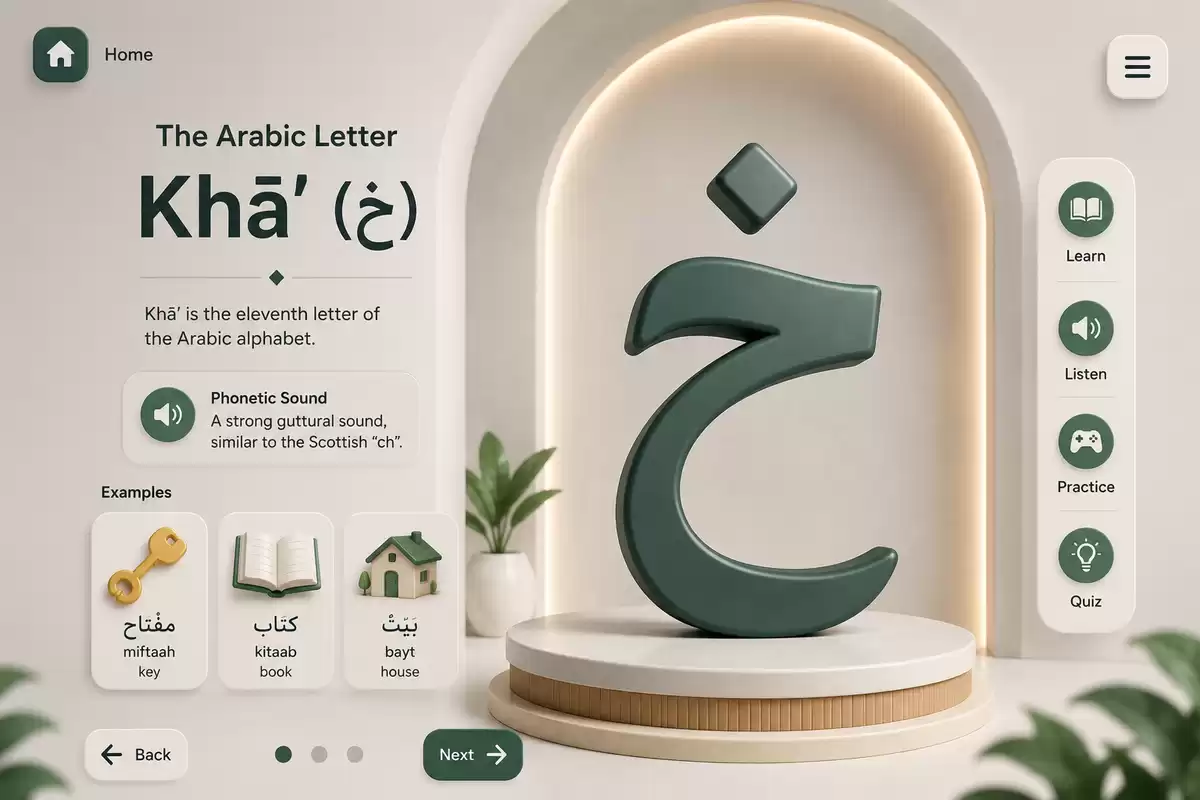
Distinguishing the heavy “kh” from nearby throat letters like “ḥ” or “gh” is critical, as subtle shifts completely change word meanings and impact your clarity.
| Feature | Kh خ | H ح | Gh غ |
| Articulation Point | Back of soft palate/uvula (uvular) | Middle of the throat/pharynx (pharyngeal) | Back of soft palate/uvula (uvular) |
| Voicing | Voiceless (mahmūs) — no vocal cord vibration | Voiceless (mahmūs) — no vocal cord vibration | Voiced (majhoor) — vocal cords vibrate |
| Emphasis | Mufakhkham (heavy) — back of tongue raised | Muraqqaq (light) — tongue flat | Mufakhkham (heavy) — back of tongue raised |
| Sound Quality | Rough, intense, and raspy friction | Softer, clearer, like a sigh | Buzzing or gargling sound with voice |
| Airflow | Fricative (continuous airflow) | Fricative (continuous airflow) | Fricative (continuous airflow) |
Why Clear Differentiation Matters?
Meaning Preservation: Altering the sound changes words entirely (e.g., “خال” / maternal uncle becomes “حال” / state).
Clear Communication: Accurate pronunciation avoids conversational misunderstandings and builds natural speaking fluency.
Textual Precision: Exact articulation is vital for comprehension and traditional contexts like Quranic Tajweed.
يقول الله تعالى: “كِتَابٌ أُحْكِمَتْ آيَاتُهُ ثُمَّ فُصِّلَتْ مِن لَّدُنْ حَكِيمٍ خَبِيرٍ” (سورة هود: 1).
Allah says: “A Book whose verses have been perfected and then presented in detail from One who is Wise and Aware.” (Surah Hud 11:1).
Tips and Strategies for Mastering the Arabic Letter Kh خ
Mastering this letter requires integrating listening, speaking, and writing. These targeted strategies provide a clear path to fluency.
- Consistent Daily Practice: Dedicate short, focused sessions daily to the sound.
- Mimic Native Speakers: Listen closely to native speakers and imitate their pronunciation.
- Use Pronunciation Guides: Refer to online guides or apps for audio examples.
- Focus on Minimal Pairs: Practice words differing only by this sound to train your ear.
- Engage in Conversation: Speak with native speakers and ask for direct feedback.
- Exaggerate Initially: Slightly overstate the sound at first to hit the right articulation point.
Auditory Training and Listening Practice
Accurate pronunciation relies on accurate hearing. Consistent listening helps your brain distinguish “kh” from “h” or “gh.”
- Active Listening: Focus on how native speakers produce the “kh” sound in sentences.
- Minimal Pair Listening: Listen to word pairs like “خال” and “حال” to isolate the sound.
- Shadowing: Repeat what an Arabic speaker says simultaneously, mimicking their intonation.
- Dictation Exercises: Listen to short phrases and write them down, focusing on the letters.
- Media Immersion: Tune your ear to the sound through Arabic podcasts, news, or songs.
- Feedback Verification: Have a native speaker read “kh” words and test your identification.
Repetitive Writing Drills
Writing reinforces the letter’s visual form across different positions and connects the sound to its written shape, aiding memorization.
- Isolated Practice: Write the letter “خ” repeatedly on its own.
- Initial Position: Write words starting with “خ,” like “خُبز” (bread) or “خَريف” (autumn).
- Medial Position: Write words with “خ” in the middle, like “مَطبَخ” (kitchen) or “أَخضر” (green).
- Final Position: Write words ending in “خ,” like “بَطّيخ” (watermelon) or “شَيخ” (sheikh).
- Sentence Copying: Copy short sentences containing multiple “خ” letters to practice connections.
- Dictation Writing: Write down words containing “خ” dictated by a native speaker or audio.
Utilizing Online Resources and Native Speakers
Leveraging online tools and native speakers accelerates mastery through authentic exposure and feedback.
- Language Exchange Apps: Use HelloTalk or Tandem to connect with native speakers.
- YouTube Tutorials: Search for pronunciation tutorials showing mouth movements.
- Audio Dictionaries: Use Reverso Context or Almaany to hear individual words.
- Learning Websites: Access targeted lessons on sites like arabiantongue.com.
- Online Tutors: Hire a tutor for personalized sessions focused on your pronunciation.
- Arabic Media: Immerse yourself in podcasts and news to hear natural articulation.
How does the Arabian Tongue shape your journey of learning the Quran and Arabic?
At Arabian Tongue, we help you understand the Quran deeply and connect with its meanings through simple and effective teaching methods. Our courses are designed to make your learning journey clear, engaging, and spiritually enriching.
Guidance from the Quran and Hadith
قال النبي ﷺ: “أَحَبُّ الأَعْمَالِ إِلَى اللهِ أَدْوَمُهَا وَإِنْ قَلَّ” (صحيح البخاري وصحيح مسلم).
Prophet ﷺ said: “The most beloved deeds to Allah are those that are done consistently, even if they are few.” (Sahih al-Bukhari and Sahih Muslim).
يقول الله تعالى: “اقْرَأْ بِاسْمِ رَبِّكَ الَّذِي خَلَقَ” (سورة العلق: 1).
Allah says: “Read in the name of your Lord who created.” (Surah Al-‘Alaq 96:1).
FAQs:
How do you correctly pronounce the Arabic Letter Kh خ?
Create a voiceless, guttural friction sound by raising the back of your tongue towards your uvula and soft palate. Exhale air to produce a raspy, continuous sound without vibrating your vocal cords.
What are the different writing forms of the Arabic Letter Kh خ?
This letter has four forms depending on its position: isolated (خ), initial (خـ), medial (ـخـ), and final (ـخ). These forms connect to surrounding letters, while the dot above remains consistent throughout.
What is the difference between the Arabic Letter Kh خ and H ح?
Kh خ is produced at the uvula and is always emphasized, creating a rough, heavy sound. In contrast, H ح is produced lower in the throat, always light, resulting in a softer sound.
Are there any common mistakes when pronouncing the Arabic Letter Kh خ?
Common mistakes include softening it to an h, voicing it to sound like gh, or replacing it with a hard k. Learners often fail to create enough throat friction or accidentally vibrate their vocal cords.
Why is the Arabic Letter Kh خ important in Arabic?
This distinct phoneme differentiates word meanings, and mispronouncing it can lead to complete misunderstandings. Mastering it is crucial for clear communication, accurate textual reading like the Quran, and fluency.