

What happens when three simple dots are placed above a letter instead of below it? You get an entirely new sound and identity. The Arabic letter Ta ت is the third letter of the Arabic alphabet, easily recognized by its two dots on top, and forms the backbone of countless everyday and Quranic words. Despite its simple shape, Ta carries specific pronunciation rules and grammatical roles that every Arabic learner must master early on. Let’s uncover its full details.
What is the Arabic Letter Ta ت and its Significance?
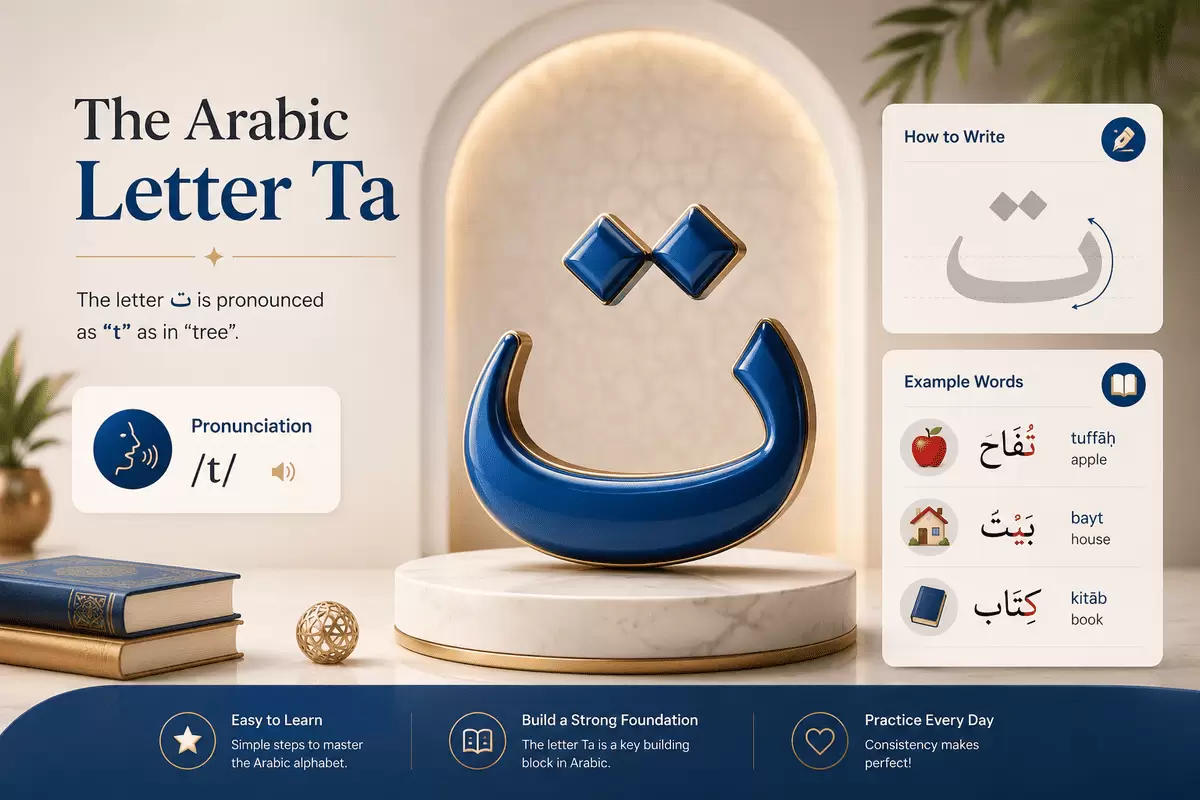
The Arabic letter Ta (ت) is the third letter in the Arabic alphabet. It is a non-emphatic (unvelarized) consonant that produces a sharp, clear sound similar to the English ‘t’ in words like “tea” or “table” (unlike the heavier ‘t’ sound in “top”).
Its significance extends beyond mere phonetics, serving as a foundational element in countless Arabic words that influences grammar, morphology, and meaning.
Word Positions and Forms
Like most characters in the Arabic script, this letter changes its shape depending on its position within a word to maintain the cursive flow:
- Isolated form (ت): Used when the letter stands entirely alone, unconnected to any other character.
- Initial form (تـ): Used at the beginning of a word, connecting to the following letter from its left side.
- Medial form (ـتـ): Used in the middle of a word, acting as a bridge by connecting to both the preceding letter (right) and the succeeding letter (left).
- Final form (ـت): Used at the end of a word, connecting to the preceding letter from its right side and closing with its full tail.
يقول الله تعالى: “إِنَّا أَنزَلْنَاهُ قُرْآنًا عَرَبِيًّا لَّعَلَّكُمْ تَعْقِلُونَ” (سورة يوسف: 2).
Allah says: “Indeed, We have sent it down as an Arabic Quran that you might understand.” (Surah Yusuf 12:2).
How to Pronounce the Letter Ta ت Correctly?

To pronounce this letter correctly, position the tip of your tongue against the back of your upper front teeth, then release a sharp, clear ‘t’ sound. This articulation ensures the sound remains light and distinct, without any emphasis or heaviness.
Steps to Achieve the Correct Pronunciation
- Tongue Placement: Gently press the very tip of your tongue against the inner surface of your upper front teeth.
- Airflow Control: Allow a small burst of air to escape as you release your tongue from the teeth.
- Sound Production: Produce a crisp, unvoiced ‘t’ sound, similar to the ‘t’ in “tea” or “table.”
- Avoid Emphatic Sounds: Ensure your tongue remains flat and relaxed, preventing any rounding of the mouth or deepening of the sound.
- Practice Consistently: Repeat words containing Ta (ت) to maintain the light, sharp quality of the sound.
- Examples: تمر (tamar – dates) or تفاح (tuffah – apples).
Articulation Points and Sound Production for Ta ت
The precise articulation of this letter involves specific points within the mouth. It is categorized as a dental consonant (the tongue interacts with the teeth), unvoiced (vocal cords do not vibrate), and a plosive (air is briefly stopped and then released).
The sound production relies on:
- Tip of the Tongue: The primary active articulator.
- Upper Front Teeth (Incisors): The back surface of the upper incisors acts as the passive articulator.
- Airflow: A brief blockage of air created by the tongue against the teeth, followed by a sudden release.
- Lack of Vocal Cord Vibration: Produced solely by air expulsion, ensuring the light, distinct quality of the letter.
Common Pronunciation Mistakes and How to Avoid Them
Common mistakes include softening the sound, confusing it with similar letters, or using an aspirated, less sharp English ‘t’. To avoid these pitfalls, focus on precise tongue placement and breath control:
- Over-aspiration: Do not exhale too much air; it should be a quick, clean release.
- Softening the Sound: Ensure the ‘t’ is sharp and distinct, not a soft ‘th’ or ‘d’ sound.
- Confusing with Emphatic Taa (ط): Keep the tongue flat and avoid raising the back of the tongue to prevent producing the heavier ‘ط’ sound.
- Lack of Clarity: Practice isolating the sound before integrating it into words.
- Regional Dialect Influence: Be mindful of how your native language or regional dialect might influence pronunciation, and actively work to align with standard Arabic.
Distinguishing Ta (ت) from Similar Arabic Letters
Distinguishing this letter from Taa (ط) and Thaa (ث) is crucial, as mispronunciation can completely change the meaning of words. Learners, particularly in the GCC region, must pay extra attention to maintaining the distinction between the light ت and the emphatic ط for formal Arabic and Quranic recitation.
- Ta ت (ت): A light, unvoiced dental plosive. The tip of the tongue touches the back of the upper front teeth, creating a sound similar to the ‘t’ in “tea” but without aspiration. Example: تمر (tamar – dates).
- Taa ط (ط): An emphatic, unvoiced dental plosive. The tongue is raised towards the soft palate, creating a heavier, deeper sound with no direct English equivalent. Example: طفل (ṭifl – child).
- Thaa ث (ث): An unvoiced interdental fricative. The tip of the tongue is placed between the upper and lower front teeth, allowing air to pass through like the ‘th’ in “think.” Example: ثلج (thalj – snow).
يقول الله تعالى: “وَرَتِّلِ الْقُرْآنَ تَرْتِيلًا” (سورة المزمل: 4).
Allah says: “And recite the Quran with measured recitation.” (Surah Al-Muzzammil 73:4).
Advanced Concepts: Ta Marbuta (ة) and its Relationship to the Arabic Letter Ta ت
The Ta Marbuta (ة) is a fascinating and often challenging aspect of Arabic grammar, representing a unique relationship with the Arabic letter Ta ت. It is a variant of the letter Ta, primarily indicating femininity in nouns and adjectives, and its pronunciation changes based on context. This special letter is a key differentiator in Arabic morphology and requires careful attention from learners.
Its dual pronunciation, either as a ‘t’ sound or a silent ‘h’ sound, depends on whether the word is connected to another word in speech or paused upon. This dynamic nature makes it a crucial element in understanding the flow and structure of Arabic sentences. Mastering Ta Marbuta (ة) is an advanced step that significantly enhances your ability to read and speak Arabic accurately.
What is Ta Marbuta (ة) and When to Use It?
Ta Marbuta (ة) is a special form of the letter Ta ت that appears only at the end of nouns, primarily indicating femininity. Its pronunciation changes depending on whether it is connected to another word or paused upon. It looks like a Ha (ه) with two dots above it, signifying its connection to the Ta sound. This grammatical marker is fundamental to Arabic noun and adjective agreement.
Here are the primary uses and pronunciation rules for Ta Marbuta (ة):
- Feminine Nouns: It is most commonly used to form the feminine singular of nouns and adjectives. For example, معلم (mu’allim – male teacher) becomes معلمة (mu’allimah – female teacher).
- Pronunciation in Pause: When a word ending in Ta Marbuta (ة) is paused upon (i.e., it’s the last word in a sentence or phrase), it is pronounced as a silent ‘h’ sound, or sometimes not pronounced at all, like a silent letter.
- Pronunciation in Connection: When a word ending in Ta Marbuta (ة) is followed by another word (especially if it’s the first part of an – possessive construction), it is pronounced as a full ‘t’ sound.
- Plurals: It can also appear in some broken plural forms, though less frequently than in singular feminine nouns.
- Adjectives: Used to make adjectives agree in gender with feminine nouns.
Key Differences Between Ta ت and Ta Marbuta (ة)
While both Ta ت and Ta Marbuta (ة) are related to the ‘t’ sound in Arabic, they possess distinct differences in form, function, and pronunciation. Understanding these distinctions is vital for accurate reading and writing. The Arabic letter Ta ت is a fundamental consonant that can appear anywhere in a word, while Ta Marbuta (ة) is a grammatical marker with specific positional and functional constraints.
Here’s a comparison highlighting their key differences:
- Form: Ta ت has consistent forms (initial, medial, final, isolated). Ta Marbuta (ة) has only two forms: connected (ـة) and isolated (ة)، and always appears at the end of a word.
- Position: Ta ت can appear at the beginning, middle, or end of a word. Ta Marbuta (ة) only appears at the end of a word.
- Grammatical Function: Ta ت is a basic consonant forming part of the root or structure of a word. Ta Marbuta (ة) primarily indicates femininity in nouns and adjectives, and sometimes serves as a marker for certain plural forms.
- Pronunciation: Ta ت always retains its ‘t’ sound. Ta Marbuta (ة) has a variable pronunciation: ‘t’ when connected to another word, and a silent ‘h’ (or silent) when paused upon.
- Derivation: Ta Marbuta (ة) is considered a derivative or variant of Ta ت, specifically used for grammatical purposes, rather than being an independent letter in the alphabet sequence.
Examples of Ta Marbuta (ة) in Arabic Nouns
To solidify your understanding of Ta Marbuta (ة), examining practical examples is essential. These examples demonstrate how its pronunciation shifts based on context, a critical aspect of mastering this unique letter. The ability to correctly identify and pronounce Ta Marbuta (ة) is a hallmark of advanced Arabic proficiency.
Here are some examples of Ta Marbuta (ة) in Arabic nouns:
- مدرسة (madrasah – school): When paused, it’s pronounced “madrasah” (with a silent ‘h’). When connected, e.g., مدرسة الأولاد (madrasatu al-awlad – the boys’ school), it’s pronounced: “madrasatu.”
- سيارة (sayyarah – car): Paused, it’s “sayyarah.” Connected, e.g., سيارة الشرطة (sayyaratu ash-shurṭah – police car), it’s “sayyaratu.”
- طاولة (ṭawilah – table): Paused, it’s “ṭawilah.” Connected, e.g., طاولة الطعام (ṭawilatu aṭ-ṭa’am – dining table), it’s “ṭawilatu.”
- جامعة (jami’ah – university): Paused, it’s “jami’ah.” Connected, e.g., جامعة القاهرة (jami’atu al-Qahirah – Cairo University), it’s “jami’atu.”
- قصة (qiṣṣah – story): Paused, it’s “qiṣṣah.” Connected, e.g., قصة قصيرة (qiṣṣatun qaṣirah – a short story), it’s “qiṣṣatun.”
How does the Arabian Tongue shape your journey of learning the Quran and Arabic?
At Arabian Tongue, we help you understand the Quran deeply and connect with its meanings through simple and effective teaching methods. Our courses are designed to make your learning journey clear, engaging, and spiritually enriching.
Guidance from the Quran and Hadith
يقول النبي ﷺ: “خَيْرُكُمْ مَنْ تَعَلَّمَ الْقُرْآنَ وَعَلَّمَهُ” (صحيح البخاري، 5027).
The Prophet ﷺ said: “The best among you are those who learn the Quran and teach it.” (Sahih al-Bukhari, 5027).
يقول الله تعالى: “إِنَّا جَعَلْنَاهُ قُرْآنًا عَرَبِيًّا لَّعَلَّكُمْ تَعْقِلُونَ” (سورة الزخرف: 3).
Allah says: “Indeed, We have made it an Arabic Quran that you might understand.” (Surah Az-Zukhruf 43:3).
FAQs:
What is the difference between the Arabic letters ت (Ta) and ط (Taa)?
The primary difference lies in emphasis; Ta (ت) is a light, crisp sound produced by the tip of the tongue against the front teeth. In contrast, Taa (ط) is an emphatic, deeper sound produced by raising the back of the tongue towards the soft palate, which changes word meanings completely, like تِين (figs) versus طِين (mud).
What are common mistakes when learning the Arabic letter Ta?
Learners often over-aspirate the sound, make it too soft, or confuse it with the heavy Taa (ط). They also tend to substitute it with an English 't' that is too heavily pronounced or carries a slight 'sh' sound instead of keeping it sharp and light.
Is this ت and this ة the same?
No, they are different; ت is a core alphabet letter that always sounds like 't' and can appear anywhere in a word. On the other hand, ة is a grammatical suffix that only appears at the end of nouns to indicate femininity, sounding like 't' when connected and a silent 'h' when paused.
How does the letter Ta ت affect word meanings in Arabic?
Its presence, absence, or substitution with other letters completely transforms the definition, grammatical tense, or gender of a word. For example, a single letter change completely alters the meaning between بيت (house) and بنت (girl).
Why is it important to master the letter Ta ت for Quranic recitation?
Precise articulation is mandatory in Tajweed rules to preserve the correct meaning and spiritual integrity of the sacred verses. Mispronouncing it or blending it with the emphatic Taa (ط) can alter the words of the Quran, which is considered a major error.