

The Arabic letter Noon (ن) is a fundamental component of the Arabic alphabet, playing a pivotal role not only in pronunciation but also in the intricate grammar and Tajweed rules that govern the language. Mastering this letter is crucial for anyone learning Arabic, as its correct usage and articulation significantly impact meaning and proper recitation, especially in the Quran. This comprehensive guide will delve into its various forms, grammatical functions, and the specific Tajweed rules associated with it, offering practical insights to help learners overcome common challenges related to the Arabic Letter Noon ن.
What is the Arabic Letter Noon ن?
The Arabic letter Noon (ن) is the twenty-fifth letter of the alphabet. It represents a clear /n/ sound, similar to the “n” in “nose.”
Key Characteristics:
- Pronunciation: Produced by touching the tip of the tongue to the upper gum line, allowing air to pass through the nose for a distinct nasal quality.
- Visual Shape: Characterized by an open, bowl-like cup with a single dot resting directly above it.
- Importance: Mastering its basic form and sound is a vital step for both general reading and advanced Tajweed rules.
قال تعالى: {وَرَتِّلِ الْقُرْآنَ تَرْتِيلًا} [سورة المزمل: 4].
Allah says: “And recite the Quran with measured recitation.” (Surah Al-Muzzammil 73:4).
The Role of Noon in Arabic Grammar
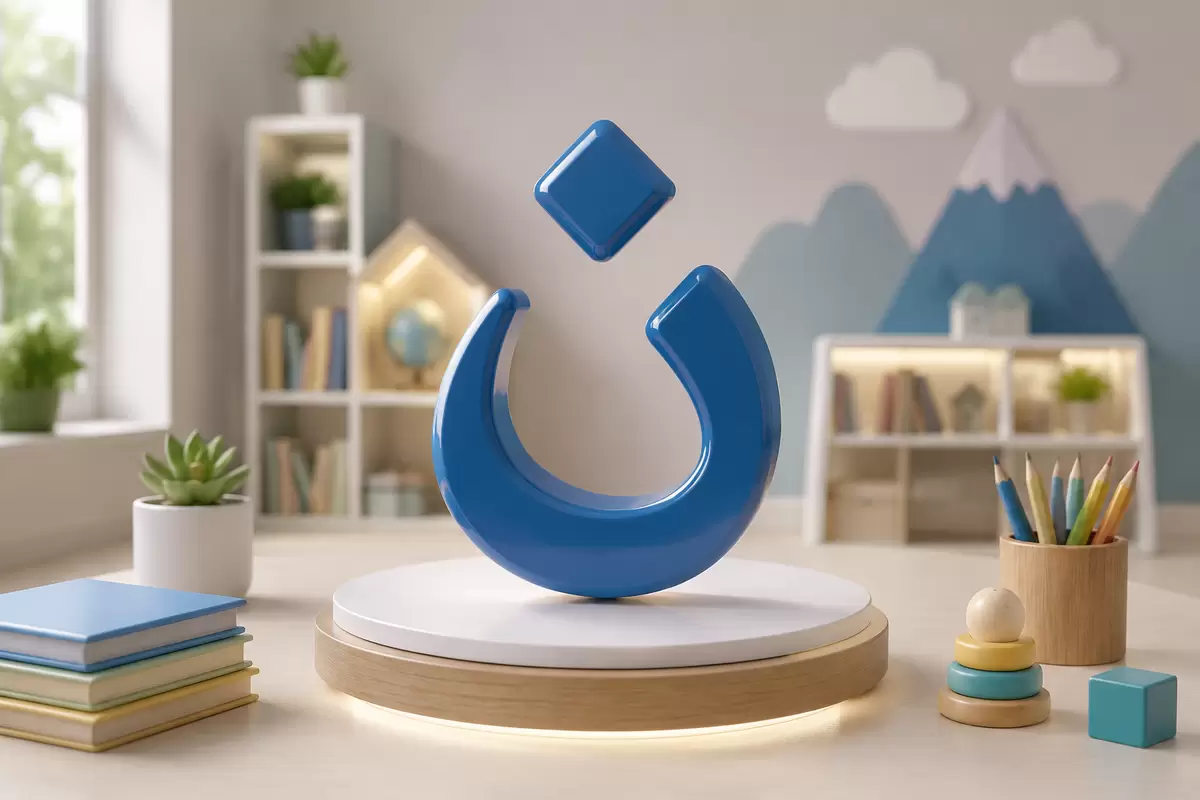
The letter Noon (ن) has vital grammatical functions. Its placement or phonetic presence changes word structure, cases, and verb protections.
Noon al-Wiqaya (Protection Noon)
- • Function: A protective bridge inserted between a verb and the first-person pronoun (ياء المتكلم), like ضربني.
- • Purpose: It protects the verb’s final letter from taking a kasra, which is grammatically incorrect for verbs.
Tanween: The Nunation Mark
- Concept: A phonetic, unwritten silent “N” sound at the end of indefinite nouns and adjectives.
- Forms:
- Dammatan (ٌ): Nominative case, e.g., كتابٌ.
- Fathatan (ً): Accusative case, e.g., كتابًا.
- Kasratan (ٍ): Genitive case, e.g., كتابٍ.
Noon and the Definite Article (Lam al-Ta’reef)
- Rule: When (الـ) precedes a word starting with Noon, the Lam (ل) assimilates completely into the Noon.
- Example: Pronounced as النُّور (An-Noor), where the “L” sound vanishes entirely and the Noon becomes doubled.
قال تعالى: {اللَّهُ نُورُ السَّمَاوَاتِ وَالْأَرْضِ} [سورة النور: 35].
Allah says: “Allah is the Light of the heavens and the earth.” (Surah An-Nur 24:35).
Tajweed Rules for Noon: Noon Sakinah and Tanween

Four main rules govern the pronunciation of Noon Sakinah and Tanween to ensure correct Quranic recitation.
Idhhar (Clear Pronunciation)
- Rule: Pronounce the Noon clearly without merging or nasalization.
- Letters: The six throat letters: ء, هـ, ع, ح, غ, خ.
- Example: مَنْ آمَنَ
Idgham (Merging)
- Rule: Merge the Noon into the following letter (ي, ر, م, ل, و, ن).
- Types:
- With Ghunnah: Nasalized merging for ي, ن, م, و (e.g., مَن يَعْمَلْ).
- Without Ghunnah: Complete merging without nasal sound for ل, ر (e.g., مِن رَبِّهِمْ).
Iqlab (Changing)
- Rule: Convert the Noon sound into a silent Meem (م) with a light nasal sound when followed by ب.
- Example: مِن بَعْدِ
Ikhfa (Concealment)
- Rule: Conceal the Noon sound, blending its nasalization into the next letter.
- Letters: The remaining 15 Arabic letters.
- Example: مَنْصُورًا
قال رسول الله ﷺ: «زَيِّنُوا الْقُرْآنَ بِأَصْوَاتِكُمْ» [سنن أبي داود].
The Prophet ﷺ said: “Beautify the Quran with your voices.” (Sunan Abi Dawud).
Common Mistakes When Learning the Arabic Letter Noon ن
Learners frequently face challenges with pronunciation, writing consistency, and dot placement.
Mispronunciation Errors and How to Correct Them
- Mistakes: Pronouncing it too heavily or neglecting its nasal vibration.
- Correction: Touch the tongue tip to the upper gum line, engage nasal airflow, and mimic native speakers.
Writing Challenges and Practice Techniques
- Mistakes: Inconsistent curves and misplacing the dot across forms.
- Correction: Trace and copy all forms, use grid paper for alignment, and center the single dot above the body.
Confusing Noon with Other Dotted Letters
The Confusion: Mixing up letters with similar base shapes:
- Noon (ن): One dot above.
- Ba (ب): One dot below.
- Ta (ت): Two dots above.
- Tha (ث): Three dots above.
• Correction: Pay strict attention to the exact dot count and vertical position relative to the letter body.
How does the Arabian Tongue shape your journey of learning the Quran and Arabic?
At Arabian Tongue, we help you understand the Quran deeply and connect with its meanings through simple and effective teaching methods. Our courses are designed to make your learning journey clear, engaging, and spiritually enriching.
Guidance from the Quran and Hadith
قال رسول الله ﷺ: «الْمَاهِرُ بِالْقُرْآنِ مَعَ السَّفَرَةِ الْكِرَامِ الْبَرَرَةِ» [صحيح البخاري وصحيح مسلم].
The Prophet ﷺ said: “The one who is skilled in the Quran will be with the noble and obedient scribes.” (Sahih al-Bukhari and Sahih Muslim).
قال تعالى: {كِتَابٌ أُحْكِمَتْ آيَاتُهُ ثُمَّ فُصِّلَتْ مِن لَّدُنْ حَكِيمٍ خَبِيرٍ} [سورة هود: 1].
Allah says: “A Book whose verses have been perfected and then presented in detail from One who is Wise and Aware.” (Surah Hud 11:1).
FAQs:
Why does Noon sound different from the English N?
Noon's articulation point is further back on the upper gum line, which creates a more distinct and pronounced nasal resonance (ghunnah). The English n is often lighter and has a more variable tongue placement.
How do I know which of the four Noon Sakinah rules to apply?
Look at the letter immediately following the Noon Sakinah or Tanween: throat letters trigger Idhhar; the letters in يرملون trigger Idgham; ب triggers Iqlab; and the remaining 15 letters trigger Ikhfa.
Is tanween really treated the same as a silent Noon?
Yes, Tanween is phonetically identical to a silent Noon (Noon Sakinah). Because it ends with an unwritten N sound, it follows the same Tajweed rules of Idhhar, Idgham, Iqlab, and Ikhfa.
How can I tell Noon apart from Ba, Ta, and Tha when writing or reading?
Differentiate them by checking the dot count and position: Noon (ن) has one dot above; Ba (ب) has one dot below; Ta (ت) has two dots above; and Tha (ث) has three dots above.
How can Arabs write hahahaha?
Arabs write laughter by repeating the letter Haa (هـ) as ههههههه While this does not involve the letter Noon, it is the standard way to represent the sound of laughing in text.