

Mastering proper Quran recitation starts with one essential skill: Tajweed. Many beginners assume this requires years of formal study or costly classes, but that’s no longer true. A well-structured Tajweed rules online course for beginners can teach you everything from pronunciation points to advanced rules, all from the comfort of your home. With the right guidance, even complete newcomers can build a strong foundation in weeks, not years. Ready to discover how to start learning Tajweed the right way, completely free? Let’s dive in.
Tajweed Rules Online Course for Beginners
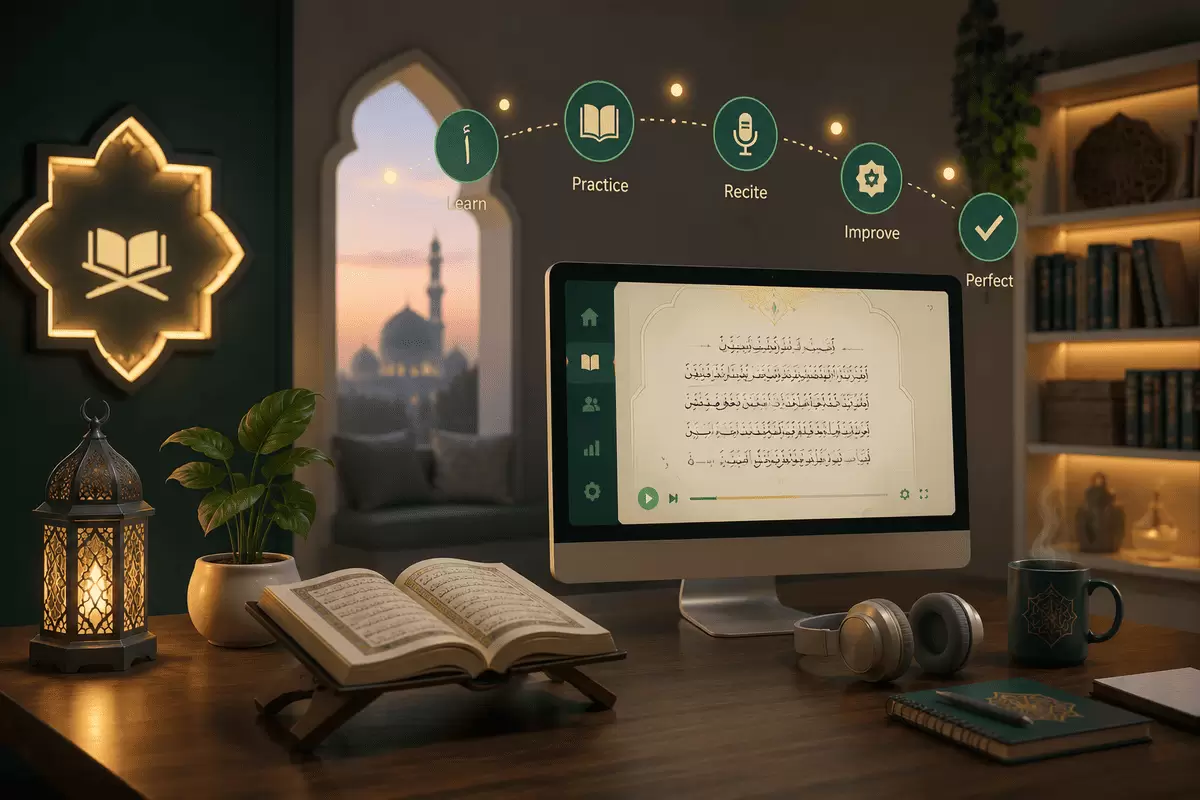
Tajweed, derived from the Arabic root meaning “to improve” or “to perfect,” refers to the systematic rules governing the correct pronunciation, articulation, and recitation of the Quran.
Why Tajweed is Important?
- Preserving Accuracy: It is the cornerstone of accurate Quranic recitation, ensuring alignment with the Prophet Muhammad’s (peace be upon him) tradition. Without Tajweed, even fluent readers may unknowingly mispronounce words, altering meanings or missing the Quran’s rhythmic beauty.
- Divine and Linguistic Precision: The Quran is not merely a book of guidance but a divine revelation with linguistic rules that preserve its perfection.
- Spiritual Connection: When recited with Tajweed, every letter, pause, and elongation carries spiritual significance, deepening the reciter’s connection to the divine message.
يقول الله تعالى: “وَاقْتُلُوا الْقُرْآنَ بِالْقِيَامَةِ” (سورة المزمل 73:4).
Allah says: “And recite the Quran with measured recitation.” (Surah Al-Muzzammil73:4).
Why Every Muslim Should Learn Tajweed?
Learning tajweed is both a spiritual obligation and a means to honor the Quran. Here’s why every Muslim should prioritize it:
- Spiritual Connection: Tajweed ensures purity in recitation, believed to increase the spiritual reward (thawab) for reading the Quran. Correct pronunciation aligns your recitation with the divine intent behind the verses.
- Preservation of Meaning: Mispronunciations can distort the meaning of verses. Tajweed rules prevent such errors, ensuring the Quran’s message remains intact and accurate.
- Melodic Beauty: Tajweed enhances the rhythmic and melodic quality of Quranic recitation, transforming it into a captivating and emotionally resonant experience.
- Personal Growth: Mastering tajweed sharpens Arabic language skills, aiding comprehension of Islamic texts and fostering a deeper understanding of the Quran’s context.
- Community Respect: Reciting with tajweed earns admiration from scholars and fellow Muslims, reflecting dedication to the Quran’s sanctity and precision.
يقول الله تعالى: “الذين آتيناهم الكتاب يقرأونه بقراءته الصحيحة” (سورة البقرة 2:121).
Allah says: “Those to whom We have given the Book recite it with its true recitation.” (Surah Al-Baqarah 2:121).
Essential Tajweed Rules & Key Learning Tips for Beginners
For those new to tajweed, the sheer number of rules can feel overwhelming. However, focusing on the core principles and using the right learning strategies will build a strong foundation.
Part 1: Essential Rules Every Beginner Should Master
- Positions of the Tongue (Makharij): Learn the articulation points of each letter, such as the throat for ha or the tongue tip for dal. This ensures accurate pronunciation from the outset.
- Characteristics of Letters (Sifaat al-Huruf): Understand attributes like shaddah (double letters), hamzah (glottal stop), and sakinah (silent letters), as these influence how subsequent letters are pronounced.
- Rules of Noon Sakinah and Tanwin:
- Idgham: Merging noon with the following letter (e.g., an-nas becomes annas).
- Ikhfa: Softening the noon (e.g., an-nasr becomes annasr).
- Iqlab: Changing noon to meem (e.g., inna becomes imma).
- Rules of Meem Sakinah: Similar to noon sakinah, these rules dictate when to merge, soften, or leave meem unchanged when followed by a sakinah.
- Elongation (Madd): Master the rules for extending vowels, which add rhythm and beauty to recitation, making it more melodious and engaging.
- Stopping Rules (Waqf): Learn where to pause in the Quran to avoid incorrect recitation when stopping mid-verse, ensuring continuity and accuracy.

Part 2: Key Tips to Learn Tajweed Online Effectively
- Choose the Right Course: Opt for a structured online path that offers interactive lessons, audio comparisons, and progress tracking with visual aids and audio examples to break down rules into manageable steps.
- Practice Daily: Consistency is key. Dedicate 30-60 minutes daily to tajweed exercises, focusing on one rule at a time before moving to the next.
- Use Audio Tools: Record your recitation and compare it to professional references. Utilizing feedback tools will help you refine your pronunciation and identify gaps instantly.
- Start with Basics: Focus on foundational rules like makharij and noon sakinah before tackling advanced topics to ensure a strong base for future learning.
- Join a Community: Engage with fellow learners in forums or study groups. Sharing experiences and challenges can accelerate your progress and keep you motivated.
يقول الله تعالى: “وَلَقَدْ سَيْرْنَا الْقُرْآنَ لِلذِّكْرِ فَأَمَّا مَنْ يَذْكُرُ؟” (سورة القمر 54:17).
Allah says: “And We have certainly made the Quran easy for remembrance, so is there any who will remember?” (Surah Al-Qamar 54:17).
The Spiritual and Practical Benefits of Learning Tajweed Correctly
Beyond its religious significance, tajweed offers transformative benefits that enrich personal and communal life. Here’s how mastering tajweed can elevate your relationship with the Quran:
- Deeper Understanding: Tajweed rules, such as idgham (merging letters) and iqlaf (stopping at a letter), reveal the nuances of Arabic grammar, making the Quran’s context clearer and more accessible.
- Emotional Impact: Reciting with tajweed evokes awe and emotion, as the words flow with precision and grace, creating a profound spiritual experience.
- Corrective Feedback: Modern approaches often include audio tools that compare your recitation to professional references, helping you identify and correct pronunciation errors instantly.
- Confidence in Prayer: Tajweed skills extend beyond the Quran, enhancing the accuracy of prayers (duas) and supplications, ensuring your words reach Allah with clarity.
- Lifelong Skill: Once learned, tajweed skills remain with you forever, allowing you to recite the Quran correctly for a lifetime, regardless of future challenges.
Getting Started
For beginners, the key is to start with foundational rules, such as the positions of the tongue (makharij) and the characteristics of letters (sifaat al-huruf), before progressing to advanced topics like qalqalah (vibration) or tafkhim (heaviness).
How does the Arabian Tongue shape your journey of learning the Quran and Arabic?
At Arabian Tongue, we help you understand the Quran deeply and connect with its meanings through simple and effective teaching methods. Our courses are designed to make your learning journey clear, engaging, and spiritually enriching.
Guidance from the Quran and Hadith
يقول الله تعالى: “إنا أنزلناه قرآناً عربياً لعلكم تعقلون” (سورة يوسف 12:2).
Allah says: “Indeed, We have sent it down as an Arabic Quran that you might understand.” (Surah Yusuf 12:2).
قال النبي محمد (صلى الله عليه وسلم): “أحب الأعمال إلى الله أدومها ولو قلّت”. (صحيح البخاري وصحيح مسلم).
The Prophet Muhammad (peace and blessings be upon him) said: “The most beloved deeds to God are those that are done consistently, even if they are few.” (Sahih al-Bukhari and Sahih Muslim).
FAQs
Can a complete beginner learn tajweed online without prior Arabic knowledge?
Yes, many online courses are designed specifically for non-Arabic speakers, starting with basic phonetics. They use visual aids, audio examples, and step-by-step guidance to simplify complex rules for absolute beginners.
How long does it typically take to master basic tajweed rules in 2026?
With consistent daily practice of 30 to 60 minutes, beginners can grasp basic tajweed rules within 3 to 6 months. Advanced rules may take longer, but structured online courses offer flexible pacing to accommodate different learning speeds.
What are the most important tajweed rules I should focus on first as a beginner?
Prioritize the positions of the tongue (makharij), the rules of noon sakinah (idgham, ikhfa, iqlab), and elongation (madd). These form the backbone of correct recitation and build a strong foundation for advanced topics.
Are there free online resources to practice tajweed rules before enrolling in a course?
Yes, several websites, YouTube channels, and mobile apps offer free introductory lessons, audio samples, and basic exercises. While helpful for initial practice, structured courses provide deeper guidance and personalized feedback.
How can I tell if I’m pronouncing tajweed rules correctly without a teacher?
Use interactive online tools and apps to record your recitation and compare it directly to a professional reference (qari). Listening closely to certified reciters and repeating after them helps train your ear to recognize correct pronunciation.