

Did you know that a single dot can completely change the identity of an Arabic letter? The Arabic letter Ba ب is a perfect example: distinguished from similar-looking letters only by the dot placed beneath it. As the second letter of the Arabic alphabet, Ba plays a vital role in forming countless words throughout the Quran, carrying its own distinct sound and grammatical functions. Let’s explore its pronunciation, characteristics, and significance in detail.
What is The Arabic Letter Ba (ب) and its significance?
The Arabic letter Ba (ب) is the second letter of the Arabic alphabet, functioning as a fundamental consonant in forming countless words. It is a voiced bilabial stop, pronounced exactly like the English ‘b’ in “book” by bringing both lips together.
Key Aspects and Functions
- Phonetic Consistency: Its sound is stable and consistent across almost all Arabic dialects.
- Grammatical Preposition: It functions as a versatile prefix preposition meaning “in,” “with,” or “by means of” (e.g., بِسْمِ اللَّه – Bismillah: “In the name of Allah”).
- Abjad Numerical Value: In the traditional Abjad system, this character holds the numerical value of 2.
- Lunar Letter (حرف قمري): It is a lunar letter, meaning the “l” sound in the definite article “al-” (ال) is fully pronounced when preceding it.
يقول الله تعالى: “إِنَّا أَنزَلْنَاهُ قُرْآنًا عَرَبِيًّا لَّعَلَّكُمْ تَعْقِلُونَ” (سورة يوسف: 2).
Allah says: “Indeed, We have sent it down as an Arabic Quran that you might understand.” (Surah Yusuf 12:2).
The Various Forms of this Arabic Letter in Writing
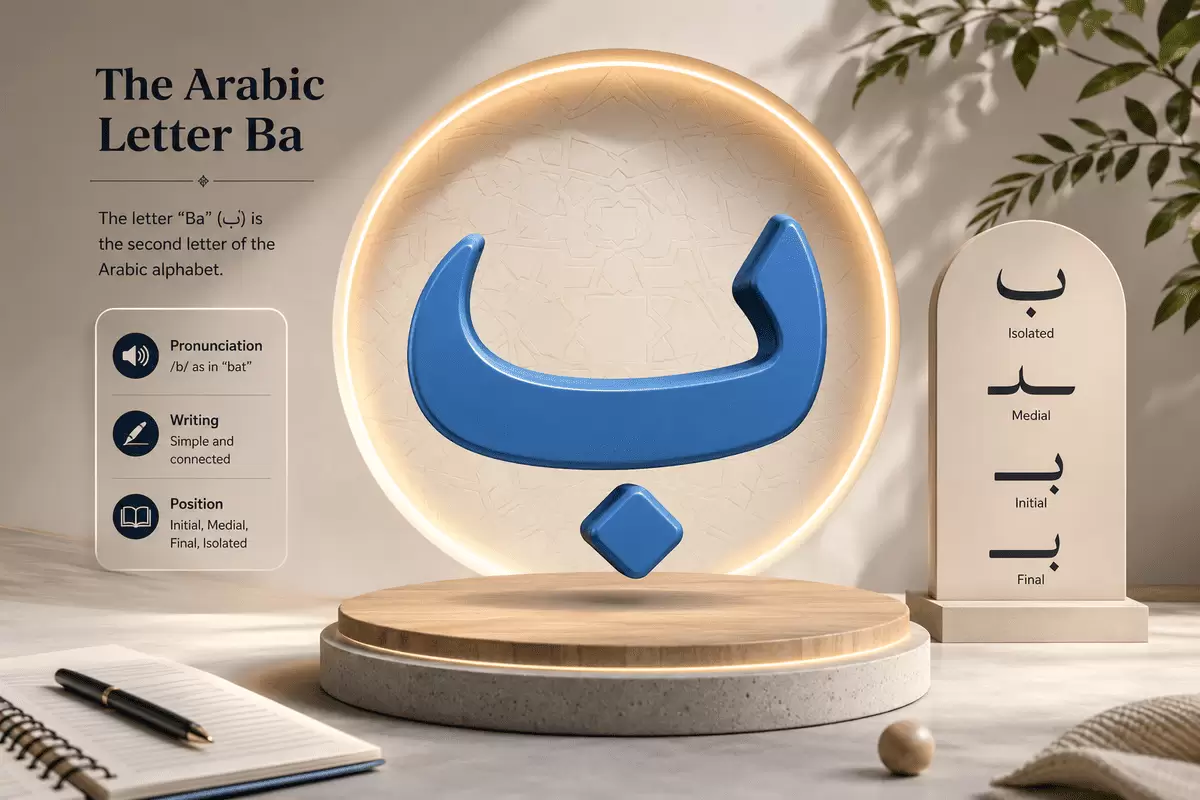
This letter changes its shape depending on its position within a word: initial, medial, final, or isolated. These variations dictate how letters connect to each other.
Initial form of The Arabic Letter Ba (ب)
When this letter appears at the beginning of a word, it connects to the following letter from its left side. Its shape is characterized by a short horizontal stroke extending to the left, with the single dot positioned underneath.
- Example: بيت (bayt – house) – the word begins with the connected form of Ba.
Medial form of The Arabic Letter Ba (ب)
In the middle of a word, this letter connects to both the preceding letter (from the right) and succeeding letter (from the left). It typically appears as a small, horizontal segment with the dot underneath, forming a bridge between the two adjacent characters.
- Note on text example: (The example of “كتاب” provided in the text is incorrect for a medial Ba, as the Ba here is isolated at the end).
Final form of The Arabic Letter Ba (ب)
At the end of a word, this letter connects to the preceding letter from its right side and then extends into its full, elongated tail shape. This final form resembles the isolated form but with a connection point on its right, curving upwards to provide a sense of completion.
- Example: باب (baab – door) – where the letter Ba appears at the end connected to the letter preceding it.
Isolated form of The Arabic Letter Ba (ب)
When this letter stands alone, not connected to any other letter, it takes its full, distinct shape. This isolated form is a horizontal line with a slight curve at both ends, and the single dot is placed directly underneath its center.
- Example: Writing the letter ب entirely by itself.
يقول النبي ﷺ: “مَنْ قَرَأَ حَرْفًا مِنْ كِتَابِ اللَّهِ فَلَهُ بِهِ حَسَنَةٌ، وَالحَسَنَةُ بِعَشْرِ أَمْثَالِهَا” (جامع الترمذي).
The Prophet Muhammad ﷺ said: “Whoever recites a letter from the Book of Allah will receive one good deed, and the good deed is multiplied by ten.” (Jami` at-Tirmidhi).
The Role of The Arabic Letter Ba (ب) in Arabic Calligraphy and Art

The Arabic letter Ba (ب) transcends its linguistic function to become a significant element in calligraphy and art, celebrated for its aesthetic versatility and symbolic depth. Calligraphers often use its single dot as a fundamental unit of measurement, proportion, and spacing, as well as a point of artistic balance within compositions.
- It serves as a starting point for beginners in calligraphy due to its relatively straightforward structure.
- Its presence in sacred texts, particularly the Basmala, elevates its artistic importance.
- Its curves and lines are adapted to convey different emotions and styles across diverse scripts.
- Artists frequently incorporate it into abstract designs, showcasing its inherent beauty.
Aesthetic variations of The Arabic Letter Ba (ب) in different calligraphic styles
The appearance of this letter varies dramatically across different calligraphic styles, each offering a unique interpretation:
- Kufic Script (الخط الكوفي): One of the oldest forms; the letter Ba is often angular and geometric, reflecting monumental and architectural origins (e.g., ancient inscriptions on mosques).
- Naskh Script (خط النسخ): A more common and legible script; the letter is characterized by rounded, flowing lines, making it ideal for daily writing and printing.
- Thuluth Script (خط الثلث): A majestic and ornamental script; renders the letter with grand, sweeping curves and often exaggerated proportions, emphasizing its artistic flourish.
Cultural significance of The Arabic Letter Ba (ب) in Islamic art
This letter holds profound cultural and spiritual significance in Islamic art, largely due to its prominent role in the Basmala (بِسْمِ اللَّهِ الرَّحْمَٰنِ الرَّحِيمِ), which begins with it. As a phrase ubiquitous in Islamic art, architecture, and manuscripts, the initial Ba serves as a symbol of divine blessing and commencement.
Additionally, in some Sufi traditions, the single dot beneath the letter Ba is interpreted as a symbol of the universe’s origin from a single point, representing the unity of God.
يقول الله تعالى: “بِسْمِ اللَّهِ الرَّحْمَٰنِ الرَّحِيمِ” (سورة الفاتحة: 1).
Allah says: “In the name of Allah, the Entirely Merciful, the Especially Merciful.” (Surah Al-Fatihah 1:1).
Advanced Tips for Integrating هذا الحرف into Fluent Reading and Writing
Moving beyond basic recognition to fluent application requires focused practice and strategic learning. The goal is to integrate this letter into your active vocabulary and writing rather than just identifying it passively.
- Actively seek out words containing this letter in authentic Arabic texts to reinforce recognition.
- Practice writing full sentences and paragraphs that frequently feature this letter.
- Engage in dictation exercises to improve your ability to hear and correctly transcribe words with this letter.
- Focus on the subtle differences when it appears with different vowel marks (harakat) for precise pronunciation.
- Create flashcards with words containing this letter in various positions (initial, medial, final) for quick recall.
- Challenge yourself to compose short stories or descriptions using as many words with this letter as naturally possible.
Practice drills for speed and accuracy with The Arabic Letter Ba (ب)
To achieve speed and accuracy, you can implement several effective practice drills:
- Timed Reading Exercises: Quickly scanning texts to identify and pronounce all instances of this letter can significantly boost recognition speed.
- Dictation Practice: Writing down words or short sentences containing this letter as they are spoken enhances listening comprehension and writing accuracy.
- Visual Games: Engaging in “find the Ba” games in stories—where you circle every Ba (ب) encountered—reinforces visual memory.
Utilizing digital tools for mastering The Arabic Letter Ba (ب)
Digital tools offer a dynamic and interactive way to master this letter:
- Language Learning Apps: Platforms like Duolingo and Memrise provide interactive tracing exercises, helping learners internalize the correct stroke order and various forms.
- Educational Websites: Sites like Arabiantongue.com feature pronunciation guides with audio examples for the correct sound.
- Online Quizzes and Worksheets: Interactive games focusing on identifying examples in Arabic words make learning engaging, while using a dedicated tracing worksheet provides valuable hands-on practice.
How does the Arabian Tongue shape your journey of learning the Quran and Arabic?
At Arabian Tongue, we help you understand the Quran deeply and connect with its meanings through simple and effective teaching methods. Our courses are designed to make your learning journey clear, engaging, and spiritually enriching.
Guidance from the Quran and Hadith
يقول النبي ﷺ: “يَا غُلَامُ، سَمِّ اللَّهَ، وَكُلْ بِيَمِينِكَ، وَكُلْ مِمَّا يَلِيكَ” (صحيح البخاري وصحيح مسلم).
he Prophet ﷺ said to a young boy: “O young boy, mention the name of Allah, eat with your right hand, and eat from what is nearest to you.” (Sahih al-Bukhari and Sahih Muslim).
يقول الله تعالى: “اقْرَأْ بِاسْمِ رَبِّكَ الَّذِي خَلَقَ” (سورة العلق: 1).
Allah says: “Read in the name of your Lord who created.” (Surah Al-‘Alaq 96:1).
FAQs:
What is the pronunciation of the Arabic letter Ba (ب)?
It is pronounced like the English letter 'b' in words such as book or ball. As a voiced bilabial stop, it is produced by bringing both lips together while the vocal cords vibrate.
What is the difference between the Arabic letter Ba (ب) and Pa (پ)?
The letter Ba (ب) is a standard Arabic letter pronounced as 'b', while Pa (پ) is not part of the classical Arabic alphabet but is used in Persian, Urdu, and Kurdish for the 'p' sound.
What are some common examples of the letter Ba (ب) in Arabic?
Common examples include باب (baab - door), بيت (bayt - house), بنت (bint - girl), and كتاب (kitaab - book). These words demonstrate the letter's appearance in all positions.
Why do learners confuse the Arabic letter Ba (ب) with other letters?
They confuse it with letters like Ta (ت) and Tha (ث) because they share the same base shape, differing only in dots: Ba (ب) has one below, Ta (ت) has two above, and Tha (ث) has three above.
How do we pronounce the letter Ba (ب) with a damma?
When accompanied by a damma (ُ) above it, it is pronounced as bu, representing a short 'u' sound similar to the 'u' in put. (Note: The combination forms the sound bu, not the long vowel بو).