
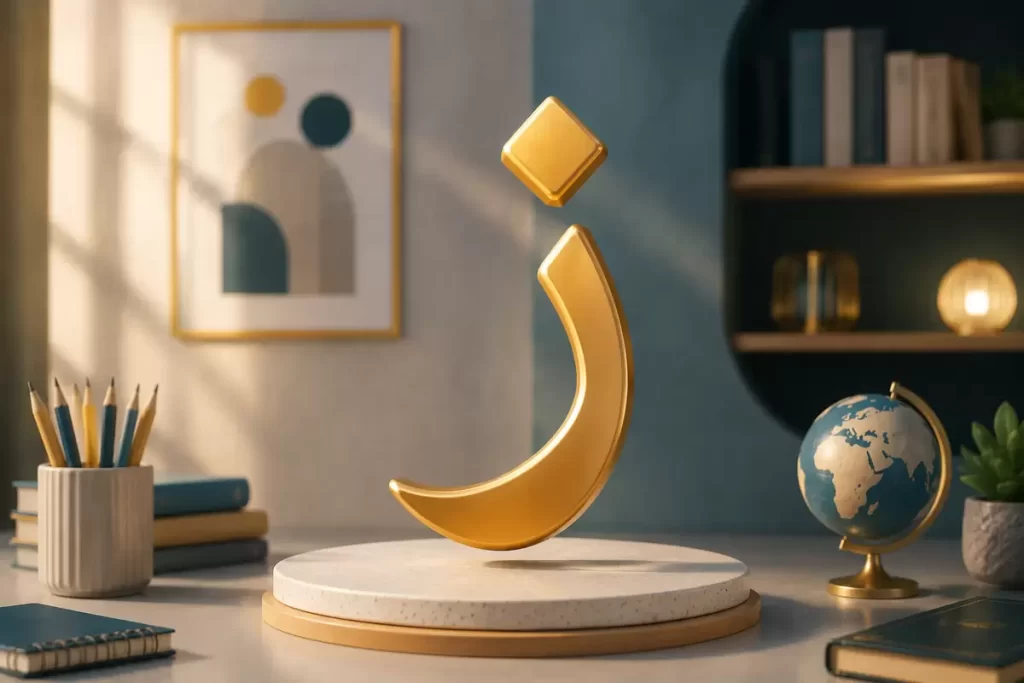
The Arabic letter Zay (ز) is a fundamental component of the Arabic script, carrying a distinct sound and playing a crucial role in both everyday communication and the precise recitation of the Quran. For learners, mastering this letter is essential not only for accurate reading and writing but also for understanding the nuances of Arabic phonetics. This guide delves into the intricacies of this letter, offering detailed comparisons with similar letters, tailored advice for Gulf region learners, and advanced applications within Tajweed, ensuring a comprehensive learning experience.
What is The Arabic Letter Zay?
The Arabic letter Zay (ز) is the eleventh letter of the Arabic alphabet, sounding like the English ‘z’ in “zebra.” It connects only to the preceding letter and holds an Abjad value of 7.
- Sun Letter: The ‘lam’ of al- (ال) assimilates into it during pronunciation.
- Articulation: Produced by placing the tongue tip near the upper front teeth ridge with vocal cord vibration.
- Sibilant Quality: It shares the whistling family with Seen (س) and Saad (ص).
- Form: It shares the shape of Raa (ر) but has a dot above, written isolated as ز and connected as ز
.. قال الله تعالى: “وَرَتِّلِ الْقُرْآنَ تَرْتِيلًا” (سورة المزمل 73:4).
Allah says: “And recite the Quran with measured recitation.” (Surah Al-Muzzammil 73:4).
Comparing The Arabic Letter Zay with Similar Letters

Distinguishing Zay from visually or phonetically similar letters is crucial for accurate reading. Subtle differences in articulation and form prevent misinterpretation.
Zay vs. Raa (ر)
While sharing the same body shape, Zay and Raa differ significantly in sound and articulation.
- Articulation: Zay (ز) is a continuous, buzzing sound, while Raa (ر) is a tapped or vibrating trill against the gums.
- Phonetic Variations: Zay is always uniform, whereas Raa shifts between being heavy (مفخمة) or light (مرققة) based on vowels.
- Form & Meaning: Zay features a dot above; Raa has none. Confusing them changes word meanings, like Zayt (زيت – oil) vs. Rayt (ريت).
Zay vs. Dhal (ذ)
Differentiating Zay from Dhal is a common challenge settled by tongue placement.
- Articulation Point: Zay (ز) keeps the tongue tip behind the teeth, while Dhal (ذ) requires placing the tongue tip between the front teeth (like ‘th’ in “this”).
- Sound & Clarity: Zay produces a sharp buzz, whereas Dhal creates a soft friction sound. Mispronouncing Dhal as Zay changes Dhurrah (ذرة – corn) to Zurrah (زرة – button).
قال الله تعالى: “اقْرَأْ بِاسْمِ رَبِّكَ الَّذِي خَلَقَ” (سورة العلق 96:1).
Allah says: “Read in the name of your Lord who created.” (Surah Al-‘Alaq 96:1).
Tips for Mastering The Arabic Letter Zay for Learners in the Gulf Region

Mastering the letter Zay (ز) in the Gulf region requires navigating local speech habits, neighboring letter influences, and connected speech. Targeted practice helps learners transition from simple recognition to clear, natural pronunciation.
Regional Pronunciation Nuances
Gulf dialects generally preserve interdental sounds, which helps keep Zay (ز) distinct from Dhal (ذ) and the heavy Zaa (ظ).
- Sound Profile: Zay must remain a light, fronted, and voiced ‘z’ sound.
- Tongue Placement: Keep the tongue tip strictly behind the upper teeth ridge.
- Prevention: Do not let it drift into a “th” sound or mimic the deep, emphatic weight of Zaa (ظ).
Recommended Practice Resources
Building reliable muscle memory depends on structured audio drills and consistent feedback loops.
- Minimal Pairs: Practice contrasting word pairs (Zay vs. Dhal vs. Zaa) to train your ear and tongue on the differences.
- Self-Recording: Record your speech and compare it directly against native Gulf speakers to isolate gaps.
- Instruction: Read vocalized passages aloud daily, and work with a live tutor for immediate real-time corrections.
قال الله تعالى: “فَاسْأَلُوا أَهْلَ الذِّكْرِ إِن كُنتُمْ لَا تَعْلَمُونَ” (سورة النحل 16:43).
Allah says: “Ask the people of knowledge if you do not know.” (Surah An-Nahl 16:43).
Advanced Applications of The Arabic Letter Zay in Tajweed
Advanced recitation requires mastering Zay’s unique acoustic qualities and its interaction with surrounding letters to ensure the text remains clear and accurate.
Zay in Quranic Recitation
Every time Zay (ز) appears, it must carry a specific set of permanent characteristics (Sifaat):
- Jahr (Voiced): The vocal cords must vibrate. If voicing is lost, Zay risks sounding like Seen (س).
- Istifal (Light): It must remain soft and lower-tongue. Adding unwanted emphasis pushes it toward Zaa (ظ).
- Safeer (Whistling): A natural, faint whistling sound produced by focused airflow, which must be clear but not overly harsh, whether the letter has a vowel or a Sukoon (e.g., رِزْق).
Rules of Noon Sakinah and Tanween with Zay
When a Noon Sakinah (نْ) or Tanween is followed by Zay, the correct ruling is Ikhfa’ Haqiqi (إخفاء حقيقي), not Idgham.
- The Rule: You must hide the Noon sound at the articulation point of Zay while holding a Ghunnah (nasal sound) for two counts.
- Example: In the phrase مِنْ زَقُومٍ, it is pronounced with Ikhfa’ (min-zaqqum with a nasal transition), rather than merging the letters entirely.
How does the Arabian Tongue shape your journey of learning the Quran and Arabic?
At Arabian Tongue, we help you understand the Quran deeply and connect with its meanings through simple and effective teaching methods. Our courses are designed to make your learning journey clear, engaging, and spiritually enriching.
Guidance from the Quran and Hadith
قال الله تعالى: “الَّذِينَ آتَيْنَاهُمُ الْكِتَابَ يَتْلُونَهُ حَقَّ تِلَاوَتِهِ” (سورة البقرة 2:121).
Allah says: “Those to whom We have given the Book recite it with its true recitation.” (Surah Al-Baqarah 2:121).
قال رسول الله ﷺ: «أَحَبُّ الأَعْمَالِ إِلَى اللَّهِ أَدْوَمُهَا وَإِنْ قَلَّ» (صحيح البخاري وصحيح مسلم).
The Prophet ﷺ said: “The most beloved deeds to Allah are those that are done consistently, even if they are few.” (Sahih al-Bukhari and Sahih Muslim).
FAQs:
What is how is the Arabic Letter Zay pronounced?
The letter Zay (ز) is pronounced by placing the tip of your tongue near the ridge behind your upper front teeth. It produces a continuous, voiced buzzing sound that matches the pronunciation of the English letter Z in zebra.
What are the different forms of the Arabic Letter Zay?
Zay is a non-connecting letter, meaning it has only two visual forms depending on its placement. It is written as an isolated shape (ز) when standalone, and connects only from the right side as (ـز).
How do you write the Arabic Letter Zay?
To write Zay, start slightly above the line, curve downward through the line like a banana, and add a single dot above. It shares its exact structural base with the letter Raa (ر), but is distinguished entirely by its upper dot.
What is the difference between Zay and Raa?
Phonetically, Zay (ز) is a buzzing sound, whereas Raa (ر) is produced as a rapidly tapped or vibrating trill. Visually, Zay features a single dot above its body, while Raa is written without any dots or markings.
Are there any common mistakes when pronouncing the Arabic Letter Zay?
A frequent mistake is losing the vocal cord vibration, which accidentally turns the Zay sound into a Seen (س). Learners also tend to let it drift into the interdental th sound of Dhal (ذ) or give it too much heavy emphasis like Zaa (ظ).
How can I practice writing the Arabic Letter Zay effectively?
Practice drawing the smooth downward curve repeatedly on lined paper to master its correct position and height. Write words that combine it in both its isolated and right-connected forms to build muscle memory for transitions.