
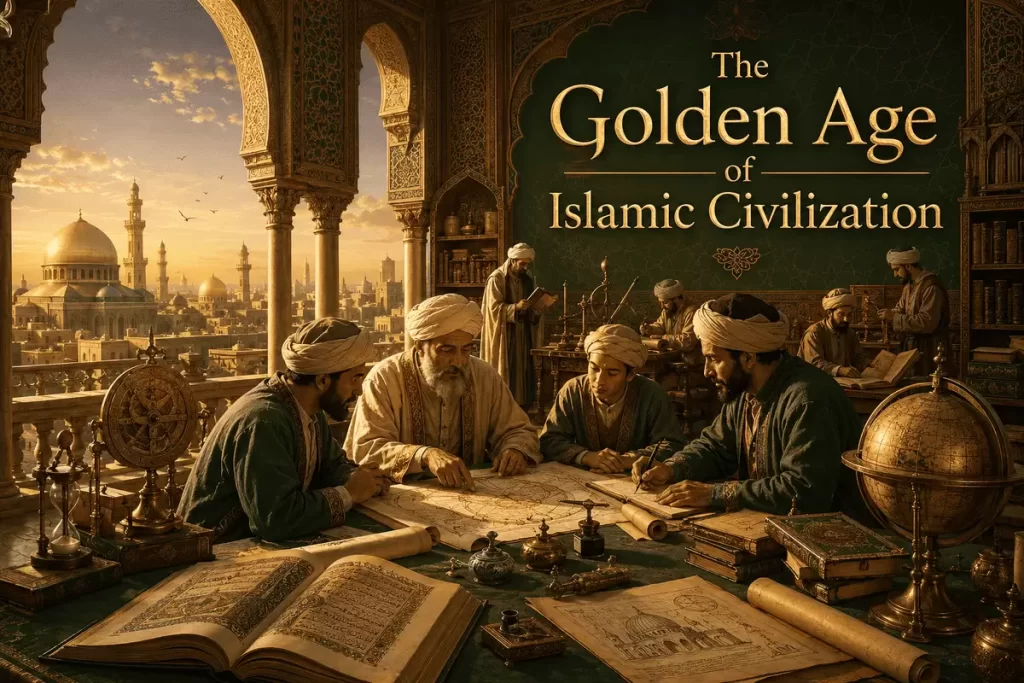
While Europe remained shrouded in the Dark Ages, a brilliant revolution was ignited in the heart of the East. Imagine a world where Baghdad’s libraries held the secrets of the universe and Cairo’s clinics pioneered modern surgery. This was the Golden Age of Islamic Civilization, a transformative era that bridged ancient wisdom with modern discovery. From the invention of algebra to mapping the distant stars, these pioneers didn’t just preserve history—they rewrote it. Dive in to discover how this radiant epoch shaped our world today.
What Was the Golden Age of Islamic Civilization?
The golden age of Islamic civilization represents one of the most transformative periods in human history, when Islamic scholars, scientists, and thinkers made groundbreaking contributions that reshaped global knowledge. Unlike conventional narratives that portray this era as isolated, it was a vibrant crossroads of cultures, ideas, and innovations that bridged the ancient world with the modern. This period, spanning roughly from the 8th to the 14th centuries, saw the Islamic world emerge as a beacon of intellectual and scientific advancement, preserving and expanding upon the legacies of Greece, Persia, India, and China while adding original breakthroughs in fields like astronomy, medicine, mathematics, and philosophy.
Definition and Historical Background
At its core, the golden age of Islamic civilization was not confined to a single region but flourished across a vast empire stretching from the Iberian Peninsula in the west to the Indus Valley in the east. Cities like Baghdad, Cairo, Córdoba, and Samarkand became epicenters of learning, where scholars from diverse backgrounds collaborated in grand libraries and research institutions. The era was characterized by a spirit of inquiry that encouraged translation, adaptation, and original research, ensuring that knowledge from antiquity was refined and passed forward.
What set this era apart was its emphasis on empirical evidence and systematic inquiry, a departure from the dogmatic approaches of earlier civilizations. Islamic scholars didn’t merely accept ancient texts at face value; they questioned, experimented, and built upon existing knowledge. This methodological rigor laid the foundation for the scientific revolution in Europe centuries later.
The golden age also fostered a unique blend of religious tolerance and intellectual freedom, allowing scholars of different faiths, including Muslims, Christians, Jews, and Zoroastrians,s to contribute to a shared body of knowledge. This multicultural exchange was not just academic but also social, with advancements in governance, law, and urban planning that set new standards for civilization.
To understand the depth of this era, consider three defining milestones:
- The Rise of the Abbasid Caliph. te In the 8th century, Baghdad became the political and cultural heart of the Islamic world, marking a turning point in the region’s intellectual development.
- The House of Wisdom (Bayt al-Hikma) Established under Caliph Harun al-Rashid and his son al-Ma’mun, it cemented Baghdad’s reputation as a global hub of learning and scholarship.
- The Translation Movement The 9th and 10th centuries saw classical texts from Aristotle, Galen, and Plato not only preserved but critiqued and expanded upon by Islamic scholars, creating a dynamic intellectual ecosystem where innovation thrived.
When the Islamic Golden Age Began
Determining the exact starting point of the golden age of Islamic civilization is a topic of scholarly debate, but most historians agree that its foundations were laid in the early 8th century, following the Islamic conquests that expanded the empire’s reach. The transition from the Umayyad Caliphate to the Abbasid Caliphate in 750 CE is often cited as a critical juncture, as the Abbasids shifted the capital from Damascus to Baghdad, a city strategically positioned along trade routes and near the ancient centers of learning in Persia. This move was not merely political but also symbolic, signaling a new era of intellectual and cultural renaissance.
The golden age truly took shape under the Abbasids, who institutionalized patronage for scholars, artists, and scientists. Two caliphs were particularly instrumental:
- Harun al-Rashid (786–809 CE): Established the foundations of scholarly patronage and cultural flourishing
- Al-Ma’mun (813–833 CE): Championed the translation movement, systematically translating Greek, Persian, Indian, and Syriac texts into Arabic through a team of Muslim, Christian, and Jewish scholars
Another defining moment was the establishment of the House of Wisdom in Baghdad, a grand academy serving as both a library and a research center. Unlike earlier institutions tied to religious settings, it was a secular space dedicated to inquiry and innovation, attracting scholars from as far as India and China.
The timeline of the golden age can be divided into three broad phases:
- The Abbasid Era (8th–10th centuries) The foundational period marked by the translation movement and the rise of Baghdad as the center of learning.
- The Persian and Turkish Influence (10th–12th centuries) As the Abbasid Caliphate weakened, regional dynasties like the Buyids and Seljuks took the lead, preserving and advancing Islamic scholarship.
- The Decline and Legacy (13th–14th centuries) The Mongol invasions disrupted the golden age, but its intellectual and scientific contributions had already left an indelible mark on world history.
Understanding these phases is crucial, as each reflects the dynamic interplay of politics, culture, and innovation that defined this extraordinary era and cemented its place as a cornerstone of human achievement.
Major Islamic Dynasties During the Golden Age
The Islamic Golden Age was an era of unprecedented intellectual growth fueled by the patronage of powerful dynasties. These regimes transformed cities into global hubs of science, philosophy, and medicine, laying the foundational pillars of modern human knowledge.
1. The Seljuk Empire (1037–1194 CE)
- Capital: Nishapur (later Baghdad).
- Key Contributions:
- Restored political stability to the Abbasid Caliphate.
- Established the Nizamiyyah Madrasa, a pioneering systematic educational institution.
- Sponsored the Isfahan Observatory for astronomical research.
- Notable Figures: Omar Khayyam (Astronomy & Poetry), Ibn Sina (Medicine), and Al-Khujandi (Earth measurement).
2. The Ayyubid Dynasty (1171–1250 CE)
- Capital: Cairo.
- Key Contributions:
- Unified Egypt and the Levant.
- Transformed Al-Azhar into a leading center for Islamic learning and sciences.
- Maintained intellectual exchange with Europe, facilitating knowledge transfer.
- Notable Figures: Salah ad-Din, Ibn al-Nafis (Pulmonary circulation), and Al-Farisi (Optics).
3. The Mamluk Sultanate (1250–1517 CE)
- Capital: Cairo.
- Key Contributions:
- Protected scientific heritage and manuscripts from Mongol destruction.
- Maintained advanced libraries and private scientific academies.
- Acted as a vital link for transmitting knowledge to the West through trade networks.
- Notable Figures: Ibn al-Shatir (Astronomy), Taqi al-Din (Engineering/Clocks), and Al-Dimashqi (Geography).
How does the Arabian Tongue shape your journey of learning the Quran and Arabic?
At Arabian Tongue, we help you understand the Quran deeply and connect with its meanings through simple and effective teaching methods. Our courses are designed to make your learning journey clear, engaging, and spiritually enriching.
Guidance from the Quran and Hadith
قال الله تعالى: {هُوَ أَنشَأَكُم مِّنَ الْأَرْضِ وَاسْتَعْمَرَكُمْ فِيهَا} [سورة هود: 61]
Allah the Almighty said: “He produced you from the earth and settled you in it to build and civilize it.” [Surah Hud: 61]
قال رسول الله صلى الله عليه وسلم: “مَنْ سَلَكَ طَرِيقًا يَلْتَمِسُ فِيهِ عِلْمًا سَهَّلَ اللَّهُ لَهُ بِهِ طَرِيقًا إِلَى الْجَنَّةِ” [رواه مسلم]The Prophet (peace be upon him) said: “Whoever follows a path in pursuit of knowledge, Allah will make easy for him a path to Paradise.” [Narrated by Muslim]
FAQs
Why was Baghdad important during the Islamic Golden Age?
Baghdad was the global center of trade and intellect, serving as the capital of the Abbasid Caliphate. Its strategic location and immense wealth allowed it to attract the world's greatest scholars, scientists, and philosophers.
What was the House of Wisdom?
The House of Wisdom (Bayt al-Hikmah) was a massive library and translation institute in Baghdad where Greek, Indian, and Persian texts were translated into Arabic. It served as a hub for original research, fostering breakthroughs in mathematics, astronomy, and medicine.
How did Muslims contribute to science and medicine?
Muslim scholars pioneered the scientific method, developed Algebra, and accurately mapped the stars using astrolabes. In medicine, they established the first teaching hospitals and authored encyclopedias, like Ibn Sina’s Canon of Medicine, that were used for centuries.
When did the Islamic Golden Age begin and end?
It traditionally began in the mid-8th century (around 750 CE) with the rise of the Abbasid Caliphate and the founding of Baghdad. The era came to a symbolic end in 1258 CE following the Mongol Siege and destruction of Baghdad.