
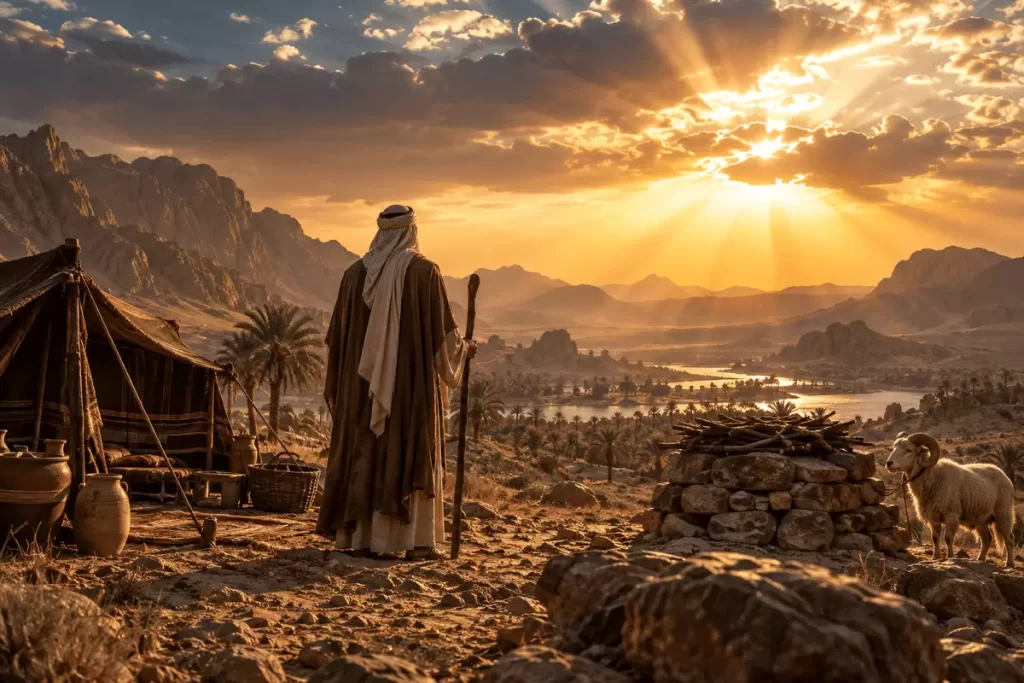
The Story of Prophet Ibrahim is one of the most important narratives in the Quran, presenting a prophet whose faith was tested by fire, exile, and sacrifice. Ibrahim, peace be upon him, challenged the idol worship of his people, survived the flames of a tyrant king, built the Kaaba with his son Ismail, and became the father of many prophets. Allah honored him with the title Khalilullah, the Friend of Allah, and commanded believers to follow his way of pure monotheism. His life remains a complete model of devotion, courage, and submission, deeply honored across all of the Abrahamic faiths.
The Story of Prophet Ibrahim: A Summary
Ibrahim’s life spanned several lands and many trials. The main stages of his journey can be summarized as follows:
- He was born in Mesopotamia among a people who worshipped idols and stars.
- He called his father and people to Allah and broke their idols.
- He was thrown into a fire, which Allah made cool and safe.
- He migrated with Sarah and Lut to the land of Sham.
- He settled Hajar and Ismail in Makkah, where Zamzam appeared.
- He was tested with the command to sacrifice his son.
- He built the Kaaba with Ismail and called people to Hajj.
Prophet Ibrahim Family Tree
Ibrahim is known as the father of the prophets, since many messengers came from his descendants. His closest family members include:
- Father: Azar, according to the Quran.
- Wives: Sarah and Hajar.
- Sons: Ismail from Hajar, and Ishaq from Sarah.
- Grandson: Ya’qub, son of Ishaq, whose descendants formed the Children of Israel.
- Nephew: Prophet Lut, who believed in him and migrated with him.
- Descendant: Prophet Muhammad ﷺ, through the line of Ismail.
Ibrahim Breaking the Idols
Ibrahim used wisdom and a bold plan to expose the weakness of his people’s gods. Surah Al-Anbiya describes the events:
- While his people left the city for a festival, Ibrahim stayed behind.
- He broke all the idols except the largest one.
- When questioned, he told them to ask the biggest idol, if the idols could speak.
- His people admitted that the idols could not speak, exposing the falsehood of their worship.
Prophet Ibrahim and Nimrod’s Fire
After the idols were broken, Ibrahim’s people and their king decided to burn him. Historians name this king Nimrod, though the Quran does not. Before the fire, Ibrahim debated him, declaring that Allah brings the sun from the east and challenging him to bring it from the west, which left the king speechless. When Ibrahim was thrown into a huge fire, Allah commanded it to be coolness and safety for him, and he emerged unharmed.
Ibrahim and the Four Birds Miracle
Ibrahim asked Allah to show him how He gives life to the dead, not out of doubt but to reassure his heart. Surah Al-Baqarah records Allah’s instructions:
- Take four birds and draw them close to you.
- Cut them into pieces and place a part on each hill.
- Call them, and they will come to you in haste.
- Know that Allah is Exalted in Might and Wise.
Ibrahim’s Dream to Sacrifice His Son
In his old age, Ibrahim saw in a dream that he was sacrificing his son Ismail. Both father and son submitted to Allah’s command, and when Ibrahim laid Ismail down, Allah ransomed him with a great sacrifice. Muslims remember this test every year on Eid al-Adha.
Ibrahim’s Dua for Makkah
Ibrahim made several supplications for Makkah and its people, many of which are recorded in Surah Al-Baqarah and Surah Ibrahim:
- That Allah make Makkah a secure city.
- That its people be provided with fruits.
- That he and his sons be kept away from idol worship.
- That a messenger be raised from among his descendants to teach them the Book and wisdom.
Meaning of Khalilullah and Millat Ibrahim
Two expressions are closely linked to Ibrahim’s unique status in Islam, and both carry deep meaning in Arabic.
Khalilullah
Khalil means an intimate friend whose love fills the heart completely. Allah declares in Surah An-Nisa that He took Ibrahim as a Khalil, the highest degree of love, a status also granted to Prophet Muhammad ﷺ.
Millat Ibrahim
Millat Ibrahim means the religion or way of Ibrahim, based on pure monotheism and complete submission to Allah. The Quran commands the Prophet ﷺ and the believers to follow this way, describing Ibrahim as a hanif who turned away from all falsehood.
Prophet Ibrahim in the Quran: Which Surahs?
Ibrahim is mentioned by name about 69 times in the Quran, across many surahs. The most important passages appear in:
- Surah Al-Baqarah: the debate with the king, the four birds, and building the Kaaba.
- Surah Al-An’am: his arguments against idol worship.
- Surah Maryam: his gentle call to his father.
- Surah Ibrahim: his supplication for Makkah.
- Surah Al-Anbiya: breaking the idols and the fire.
- Surah As-Saffat: the sacrifice of his son.
The Story of Prophet Ibrahim for Kids
Children can learn from Ibrahim that one brave person can stand for the truth. He showed his people that idols could not help them, Allah saved him from a fire, and he built the Kaaba with his son Ismail.
Lessons from the Life of Prophet Ibrahim
The Story of Prophet Ibrahim teaches lessons that every believer can carry through life:
- Use reason and wisdom when calling others to the truth.
- Trust Allah completely, even in the face of danger.
- Be gentle with parents, even when disagreeing with them.
- Sacrifice what you love when Allah commands it.
- Make dua for your family and future generations.
FAQs
Where is Prophet Ibrahim buried?
Prophet Ibrahim is believed to be buried in Hebron, known in Arabic as al-Khalil after his title, in Palestine. His tomb lies within the Ibrahimi Mosque, along with the tombs attributed to Sarah, Ishaq, and Ya'qub, according to historical tradition.
Was Azar the father of Ibrahim?
The Quran names Azar as Ibrahim's father, and most scholars accept this clearly stated meaning. Some historians mention the name Tarikh or Terah, and a minority suggested Azar was his uncle, but the Quranic wording remains the strongest available evidence.
What did Ibrahim say when he was thrown into the fire?
According to Sahih al-Bukhari, Ibrahim said, Allah is sufficient for us, and He is the best disposer of affairs, when he was thrown into the fire. Muslims still recite these same words today when facing fear, danger, or great hardship.
Why did Ibrahim refer to the stars, moon, and sun?
In Surah Al-An'am, Ibrahim observed a star, the moon, and the sun, and declared that each could not be a lord because it set. This was a carefully reasoned argument to show his people that only Allah, the Creator, deserves worship.
Was Ibrahim a Jew or a Christian?
The Quran states in Surah Al Imran that Ibrahim was neither a Jew nor a Christian, but a hanif who completely submitted to Allah. The Torah and the Gospel were revealed long after his time, as the same passage explains.