
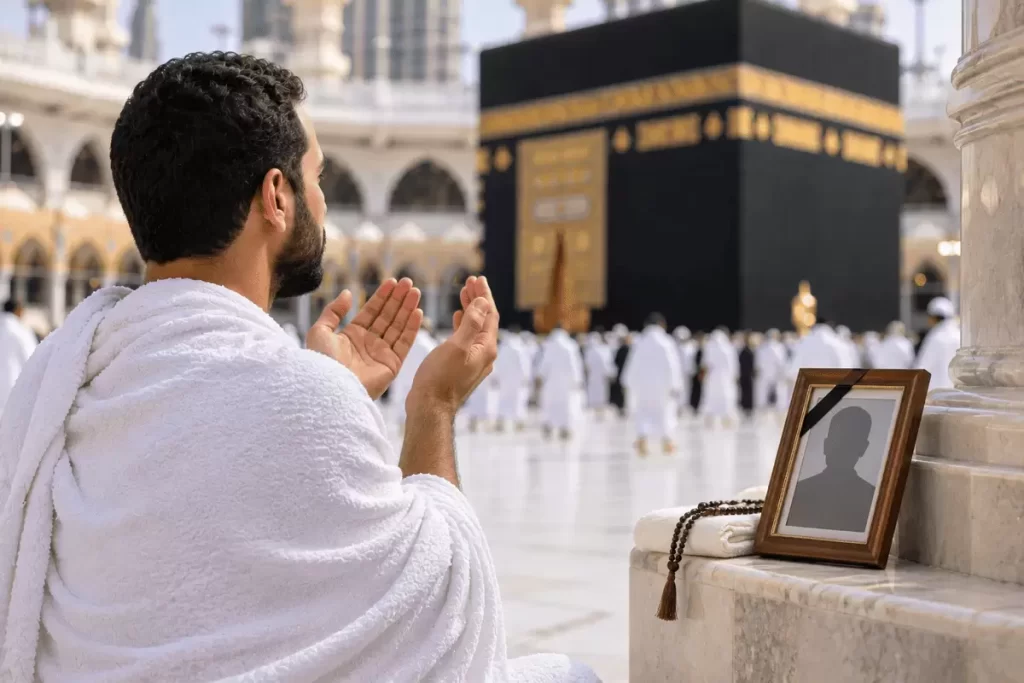
Losing a parent or relative does not end the bond of care, and many believers ask how they can benefit those who have died, which is why Umrah for deceased relatives is a frequent question among Muslims. Scholars generally permit a living person to perform Umrah on behalf of a deceased Muslim, based on narrations that allow pilgrimage to be performed for the dead and on the principle that Allah’s mercy reaches them through the good deeds of others. This guide explains the ruling, the conditions, the steps, and how this act compares with other ways of benefiting the deceased.
Umrah for Deceased in Islam: The Ruling
The ruling is built on the Sunnah and on the general teaching that the deceased continue to benefit from the deeds and supplications of the living.
- A man asked the Prophet ﷺ about his sister, who had vowed to perform Hajj and died before fulfilling it, and the Prophet ﷺ told him to pay it, since a debt owed to Allah has the greater right to be fulfilled;
- The Quran praises believers who ask forgiveness for those who came before them in faith, which shows that the living may pray for the dead;
- The Prophet ﷺ taught that a righteous child’s supplication continues to benefit a parent after death.
Because Umrah is a rite of the same nature as Hajj, many scholars extend the ruling by analogy, while others hold that the clearest evidence concerns Hajj, so a person may follow the view of a trusted scholar. It remains an act of kindness and not an obligation upon the children, so a person who cannot afford the journey may give charity or make supplication instead.
روى ابن عباس رضي الله عنهما: «أَتَى رَجُلٌ النَّبِيَّ ﷺ فَقَالَ لَهُ: إِنَّ أُخْتِي نَذَرَتْ أَنْ تَحُجَّ، وَإِنَّهَا مَاتَتْ»
فقال النبي ﷺ: «فَاقْضُوا اللَّهَ، فَهُوَ أَحَقُّ بِالْقَضَاءِ»
(صحيح البخاري، حديث 6699)
Ibn Abbas رضي الله عنهما narrated: “A man came to the Prophet ﷺ and said, ‘My sister vowed to perform Hajj, but she died before doing so.’”
The Prophet ﷺ instructed him: “Fulfill what is owed to Allah, for Allah has the greatest right to fulfillment.”
(Sahih al-Bukhari 6699)
Umrah for Deceased Compared With Other Acts of Benefit
The deceased benefit from several acts, and the table below compares them, which helps a person choose according to ability.
| Act | Ruling | Basis |
| Supplication and seeking forgiveness | Agreed upon | The Quran praises those who pray for the believers before them |
| Charity given on their behalf | Agreed upon | The charity of Sad ibn Ubadah for his mother |
| Fasting owed by the deceased | Permitted for the guardian | The narration on fasting by a guardian |
| Hajj or Umrah performed by a relative | Permitted according to many scholars | The narration of the man and his sister’s vow |
| Gifting the reward of Quran recitation | Scholars differ | No explicit narration, so opinions vary |
Conditions of Umrah for Deceased
Scholars set conditions so that Umrah for deceased relatives is valid and the intention is clear, and they apply to both the deceased and the one performing it.
- The deceased must have died as a Muslim, since the Quran forbids seeking forgiveness for those who died in disbelief;
- The performer must be a Muslim of sound mind who has already completed his own Umrah;
- The intention must name the deceased person and be made for that person alone;
- Every obligatory rite of Umrah must be completed, without omission;
- The performer should act sincerely for the sake of Allah, and not for show or payment.
قال النبي ﷺ: «إِنَّمَا الْأَعْمَالُ بِالنِّيَّاتِ، وَإِنَّمَا لِكُلِّ امْرِئٍ مَا نَوَى»
(صحيح البخاري، حديث 1)
The Prophet ﷺ said: “Actions are judged by intentions, and every person will have what they intended.”
(Sahih al-Bukhari 1)
How to Perform Umrah for Deceased Relatives
The rites are the same as in an ordinary Umrah, and the difference lies in the intention and in the supplication offered for the deceased.
- Complete your own Umrah first, if you have not performed it before;
- At the miqat, enter ihram and state that you are performing Umrah on behalf of the named person;
- Perform tawaf, pray two rakahs, and complete sai between Safa and Marwah;
- Shave or trim the hair to end the state of ihram;
- Ask Allah to accept the Umrah for the deceased, to forgive them and to raise their rank.
The intention may be expressed by saying that you are answering the call of Allah with an Umrah on behalf of the named person, and if the name is not remembered, the intention may be made for the deceased person whom you have in mind.
Who Should Perform It for the Deceased
The Sunnah places this responsibility first on those closest to the deceased, although any sincere Muslim may perform it.
- A child or close relative, whose supplication already benefits the deceased according to the Sunnah;
- An heir, especially where the deceased left an unfulfilled vow or obligation of pilgrimage;
- A trusted Muslim who performs it on request, when family members cannot travel;
- Several relatives who divide the acts of benefit, with one performing Umrah and others giving charity or making supplication.
How does the Arabian Tongue shape your journey of learning the Quran and Arabic?
At Arabian Tongue, we help you understand the Quran deeply and connect with its meanings through simple and effective teaching methods. Our courses are designed to make your learning journey clear, engaging, and spiritually enriching.
Guidance from the Quran and Hadith
سمع النبي ﷺ رجلًا يقول: «لَبَّيْكَ عَنْ شُبْرُمَةَ»
فسأله: «حَجَجْتَ عَنْ نَفْسِكَ؟»
قال: لا.
فقال: «حُجَّ عَنْ نَفْسِكَ، ثُمَّ حُجَّ عَنْ شُبْرُمَةَ»
(سنن أبي داود، حديث 1811)
The Prophet ﷺ heard a man saying: “Labbayk on behalf of Shubrumah.”
He asked: “Have you performed Hajj for yourself?”
When the man replied no, the Prophet ﷺ said: “Perform Hajj for yourself first, then perform Hajj on behalf of Shubrumah.”
(Sunan Abi Dawud 1811)
قال الله تعالى: ﴿وَأَتِمُّوا الْحَجَّ وَالْعُمْرَةَ لِلَّهِ﴾ (سورة البقرة 2:196)
Allah says: “Complete Hajj and Umrah for Allah.” (Surah Al-Baqarah 2:196)
FAQs
Is it enough to gift the reward of my own Umrah to the deceased?
Many scholars of the Hanafi and Hanbali schools allow a person to gift the reward of an act of worship to the deceased, while other scholars restrict this to the acts mentioned in the texts. The safer course is to perform Umrah specifically on behalf of the deceased with the intention made clear.
Is there a time limit after death?
No, there is no time limit, so a person may perform Umrah for a parent or relative who died recently or many years ago. Eligibility depends on the deceased having died as a Muslim, and the intention should be renewed each time the rite is performed.
Which supplications are recommended for the deceased during Umrah?
The best supplications are those the Prophet ﷺ taught for the deceased, which ask Allah to forgive them, have mercy on them, grant them well-being, honour their resting place and widen their grave. Any sincere supplication in a person’s own words is also valid at the Kaaba and between Safa and Marwah.
Is a will required before Umrah can be performed for the deceased?
No, a will is not required, and heirs or relatives may perform Umrah voluntarily as an act of kindness. Where the deceased left an obligation of pilgrimage unfulfilled, some scholars say it should be fulfilled from the estate before inheritance is divided, so the family should consult a trusted scholar.
How do scholars understand the verse that a person receives only what he strives for?
Scholars explain that the verse describes what a person earns by his own effort, while benefit from the deeds of others is an additional gift from Allah, supported by authentic narrations on supplication, charity, fasting and pilgrimage. The two ideas do not conflict, because mercy is not limited to personal effort.