

The Arabic letter Ain (ع) stands as one of the most distinctive and often challenging sounds for non-native speakers, yet mastering its unique guttural pronunciation is fundamental to truly engaging with the beauty and depth of the Arabic language. This unique pharyngeal consonant, which has no direct equivalent in English, is crucial for both comprehension and clear communication. Understanding its mechanics and cultural weight is essential for anyone aspiring to fluency, as it unlocks a deeper appreciation for Arabic phonetics and its rich linguistic heritage. This letter is a cornerstone of the language.
What is The Arabic Letter Ain (ع) and Its Place in the Alphabet?
The Arabic letter Ain (ع) is the eighteenth letter of the Arabic alphabet, a unique guttural sound produced in the middle of the throat. It is classified as a “throat letter” (حروف الحلق) and has no direct English counterpart, making it a key focus for learners. In the Abjad numeral system, it holds a value of 70.
Key Characteristics of Ain
- Alphabetical Position: It is the 18th letter of the standard Arabic alphabet.
- Makhraj (Origin): It is a pharyngeal consonant articulated from the middle of the throat.
- No English Equivalent: There is no direct phonetic match for this sound in English.
- Abjad Value: It historically represents the numerical value of 70.
- Semantic Importance: Proper pronunciation is essential, as missing the sound completely changes word meanings.
قال الله تعالى: “وَرَتِّلِ الْقُرْآنَ تَرْتِيلًا” (سورة المزمل 73:4).
Allah says: “And recite the Quran with measured recitation.” (Surah Al-Muzzammil 73:4).
How to Correctly Pronounce This Unique Arabic Sound?

Pronouncing Ain requires engaging the middle part of the throat (pharynx) to create a deep, voiced sound through gentle muscle constriction.
Understanding the Throat Position for Ain
To find the correct placement, constrict the middle section of your throat without closing it completely.
- The Sensation: It feels like the tightening in your throat right before you swallow, or a gentle throat-clearing motion.
- The Technique: Keep your tongue flat and relaxed, generating a sustained, voiced sound directly from that deep pharyngeal constriction.
Practicing Ain with Short and Long Vowels
| Vowel Type | Arabic | Transliteration | Example Word | Meaning |
| Short Vowel | عَ | ‘A | عَرَبِيّ | Arabic |
| Short Vowel | عُ | ‘U | عُلُوم | Sciences |
| Short Vowel | عِ | ‘I | عِلْم | Knowledge |
| Long Vowel | عَا | ‘Aa | عَالَم | World |
| Long Vowel | عُو | ‘Uu | عُود | Oud (Instrument) |
| Long Vowel | عِي | ‘Ee | عِيد | Eid (Festival) |
Common Pronunciation Mistakes to Avoid
- Substituting with Hamza (ء): Avoid making a sharp, abrupt glottal stop. The sound of Ain must be continuous.
- Replacing with an open ‘A’ vowel: Do not drop the throat constriction, which turns it into a plain vowel.
- Confusing it with Ghayn (غ): Ghayn is produced further back with a “gargling” quality, whereas Ain comes strictly from the mid-throat.
- Over-tensing the throat: Excessive squeezing leads to a strained sound; keep the muscles controlled but relaxed.
قال الله تعالى: “كِتَابٌ أُحْكِمَتْ آيَاتُهُ ثُمَّ فُصِّلَتْ مِن لَّدُنْ حَكِيمٍ خَبِيرٍ” (سورة هود 11:1).
Allah says: “A Book whose verses have been perfected and then presented in detail from One who is Wise and Aware.” (Surah Hud 11:1).
The Cultural and Religious Significance of The Arabic Letter Ain (ع)
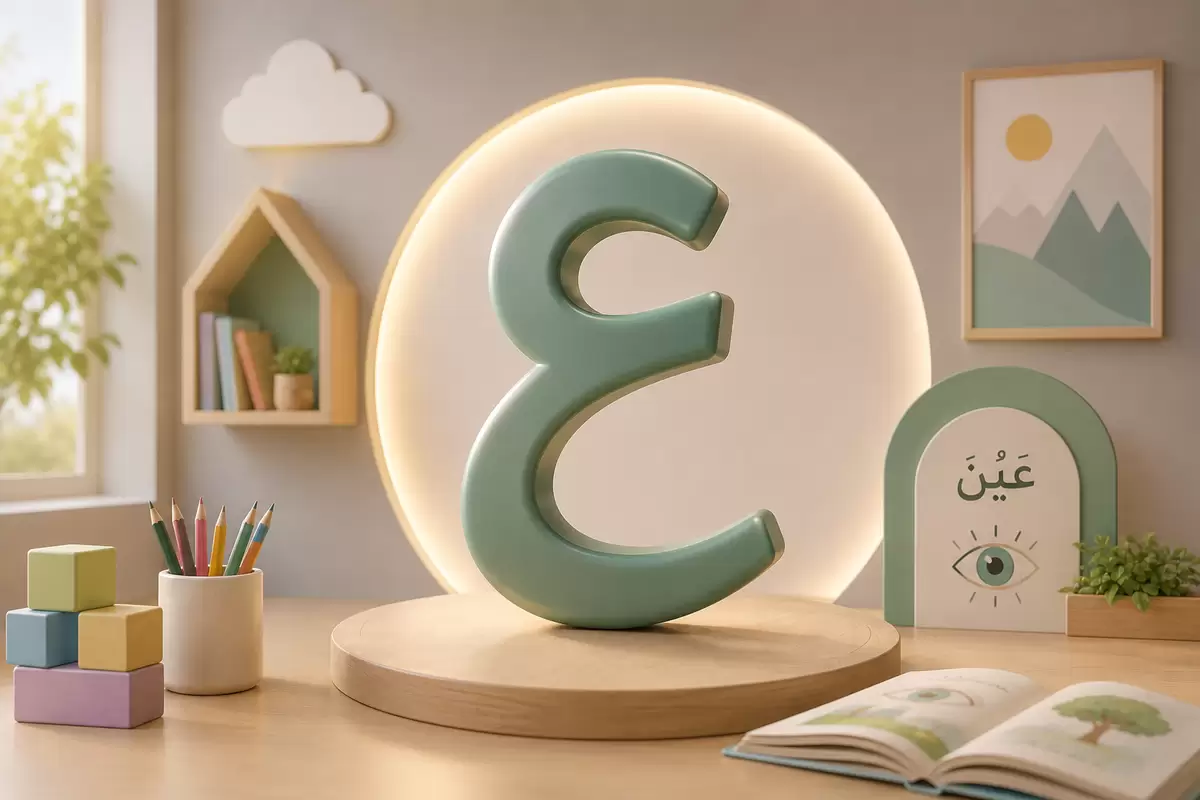
The Arabic letter Ain (ع) holds profound cultural and religious significance that extends far beyond its phonetic value, rooted deeply in Arab and Islamic heritage.
Ain’s Role in Quranic Recitation and Tajweed
In Tajweed, Ain is classified as a harf halqi (throat letter). Its precise articulation is vital for preserving the meaning of sacred texts.
- Preventing Semantic Errors: Mispronunciation can drastically alter the meaning of Quranic words. For example, mispronouncing عِلْم (‘ilm – knowledge) might turn it into أَلَم (alam – pain).
- A Duty in Recitation: Properly distinguishing Ain from similar-sounding letters like Hamza (ء) is essential for accurate, valid recitation of sacred verses.
Symbolic Meanings and Historical Context of Ain
The letter’s name, “Ain,” directly translates to both “eye” and “spring” (source of water) in Arabic, driving its rich symbolism.
- Vision and Insight: Representing the eye, it symbolizes perception, deep insight, and observation in philosophical and literary texts.
- Source of Life: Representing a spring, it signifies purity, origin, and sustenance, often used in classical poetry to evoke emotional and musical depth.
- Visual Artistry: In Islamic calligraphy, its visual shape is frequently stylized to mirror the form of an eye, serving as a tool for both artistic and spiritual expression.
How does the Arabian Tongue shape your journey of learning the Quran and Arabic?
At Arabian Tongue, we help you understand the Quran deeply and connect with its meanings through simple and effective teaching methods. Our courses are designed to make your learning journey clear, engaging, and spiritually enriching.
Guidance from the Quran and Hadith
قال الله تعالى: “إِنَّا جَعَلْنَاهُ قُرْآنًا عَرَبِيًّا لَّعَلَّكُمْ تَعْقِلُونَ” (سورة الزخرف 43:3).
Allah says: “Indeed, We have made it an Arabic Quran that you might understand.” (Surah Az-Zukhruf 43:3).
قال رسول الله ﷺ: “خَيْرُكُمْ مَنْ تَعَلَّمَ الْقُرْآنَ وَعَلَّمَهُ” (صحيح البخاري، 5027).
The Prophet ﷺ said: “The best among you are those who learn the Quran and teach it.” (Sahih al-Bukhari, 5027).
FAQs:
How can I practice pronouncing Ain (ع) if I am a beginner?
Listen to native speakers and mimic the sound while focusing on the physical sensation in your throat. Practice daily with short and long vowels, record your voice to compare, and use online video tutorials to guide your muscle placement.
What are the different shapes of Ain (ع) when written in a word?
Ain changes its appearance across four distinct forms depending on its position: isolated (ع), initial (عـ), medial (ـعـ), and final (ـع). Mastering these visual variations is essential for reading and writing cursive Arabic correctly.
Why is Ain (ع) often considered one of the most challenging Arabic letters for non-native speakers?
It has no phonetic equivalent in English or most Western languages, making the required muscle movement unfamiliar. Learners must actively train the middle throat muscles (pharynx) to isolate and consistently produce this unique sound.
Are there any specific words where the correct pronunciation of Ain (ع) is crucial for meaning?
Yes, mispronouncing it completely shifts meanings; for example, عِلْم ('ilm - knowledge) can sound like أَلَم (alam - pain). This distinct contrast makes precise throat articulation critical, particularly when reciting Quranic text.
How does the pronunciation of Ain (ع) differ from the letter Ghayn (غ)?
Ain is produced in the middle throat by constricting the pharynx to create a smooth, voiced friction sound. Ghayn is articulated further back near the uvula, producing a distinct gargling or French R resonance.
What resources are available for learning to write the Arabic letter Ain (ع)?
You can use calligraphy guides, tracing worksheets, and language apps that demonstrate the correct stroke orders. Practicing on lined paper helps you master how it fluidly connects to other letters in its different forms.