

The Arabic letter Hha (ح) is often considered one of the most challenging sounds for non-native speakers to master, yet its correct pronunciation is fundamental to both understanding and being understood in the Arabic language. This unique pharyngeal sound distinguishes countless words, making precise articulation essential for conveying accurate meaning and avoiding misunderstandings. Mastering this specific sound unlocks a deeper appreciation for the language’s phonetic richness and significantly enhances communication for learners at all levels.
What is The Arabic Letter Hha (ح) and Its Significance?
The Arabic letter Hha (ح) is a voiceless pharyngeal fricative produced deep in the throat. It is one of the guttural sounds characteristic of the Arabic phonetic system and often poses a particular challenge for those whose native languages lack similar sounds.
Its correct articulation is a linguistic necessity. Mispronouncing it can alter the meaning of an entire word or sentence. For instance, the difference between “حار” (hot) and “هار” (to collapse) is solely in the initial letter.
This letter is crucial for distinguishing many minimal pairs in Arabic, where its presence changes word meaning. It is one of the 28 letters of the Arabic alphabet, written as ح in its isolated form. Mastering this sound is a key indicator of proficiency in Arabic pronunciation, especially for Quranic recitation, where tajweed articulation points are paramount.
يقول الله تعالى: “إِنَّا أَنزَلْنَاهُ قُرْآنًا عَرَبِيًّا لَّعَلَّكُمْ تَعْقِلُونَ” (سورة يوسف: 2).
Allah says: “Indeed, We have sent it down as an Arabic Quran that you might understand.” (Surah Yusuf 12:2).
How to Pronounce This Arabic Sound Correctly?
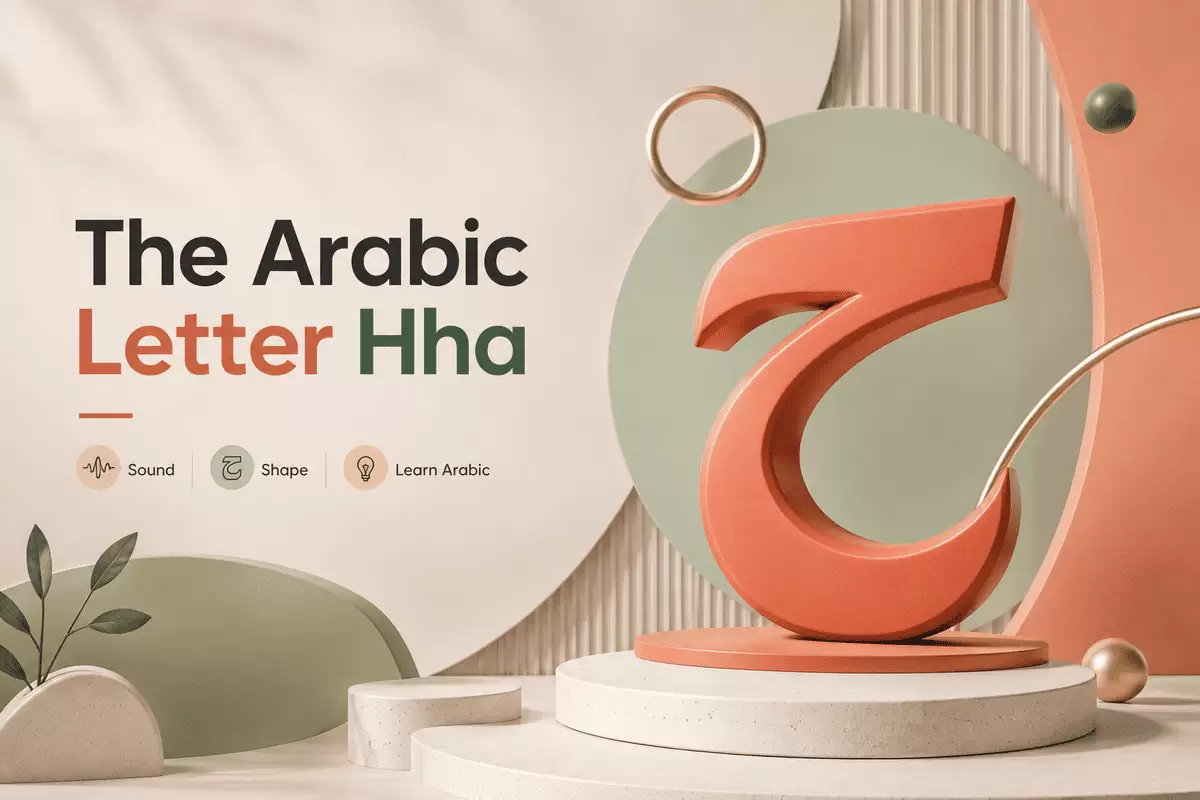
To pronounce this sound correctly, engage the middle of the throat (pharynx) to create a voiceless, breathy friction sound, like a deep, whispered “h.” This requires precise throat muscle control and steady airflow to build new muscle memory.
To achieve this, relax your throat and jaw. Imagine fogging up a mirror, but push the air from deeper in your throat while keeping the back of your tongue low. Exhale a steady, raspy stream of air through the constricted throat without vibrating your vocal cords.
Articulation Point and Breath Control
The articulation point is the middle of the pharynx, behind the mouth. The pharyngeal muscles constrict slightly to create a narrow passage for the air. This controlled, consistent expulsion must be completely voiceless, acting as a strong whisper originating deep within the throat rather than from the mouth.
Common Pronunciation Mistakes and How to Avoid Them
Learners often vocalize the sound, misplace the articulation point, or substitute it with native sounds. A common error is turning it into a voiced sound like the letter ع, or producing it too far forward, making it sound like an English “h” or “ch.”
To avoid these mistakes:
- Keep your vocal cords completely still to ensure the sound is pure breath.
- Push the sound deeper into your pharynx rather than high in the mouth.
- Relax your throat and jaw to prevent a strained or choked sound.
- Keep your tongue down away from the soft palate to avoid the uvular vibration of Kha (خ).
Practice Exercises for Hha Sound Mastery
- Sustained Hha: Hold the voiceless sound for 5–10 seconds with a steady airflow.
- Vowel Combinations: Practice with short vowels (حَ, حُ, حِ) and long vowels (حَا, حُو, حِي).
- Minimal Pairs: Contrast pairs that differ only by this sound (e.g., حار / هار, حلم / هلم).
- Word Integration: Repeat words featuring the letter at the beginning, middle, and end (e.g., حليب, صحة, نجاح).
- Sentence Drills: Incorporate these words into simple sentences to practice speaking naturally.
- Listen and Imitate: Record yourself mimicking native speakers to compare and adjust your technique.
يقول الله تعالى: “وَرَتِّلِ الْقُرْآنَ تَرْتِيلًا” (سورة المزمل: 4).
Allah says: “And recite the Quran with measured recitation.” (Surah Al-Muzzammil 73:4).
How to Differentiate This Letter from Similar Arabic Letters?
Differentiating this letter from similar Arabic letters is crucial for accurate pronunciation and meaning. Subtle differences in articulation can lead to entirely different words, which can be challenging for learners whose native languages lack these pharyngeal and glottal sounds.
| Letter | Articulation Point & Characteristics | Sound Type | Word Example | Meaning |
| Hha (ح) | Middle of the throat (pharynx); breathy, slightly raspy, “deep H.” | Voiceless pharyngeal fricative | حلم
حال |
Dream
Condition |
| Ha (ه) | High in the throat (at the vocal cords); “light H” similar to English “h.” | Voiceless glottal fricative | هلم | Come on |
| Kha (خ) | High in the throat; back of the tongue raised toward the uvula, creating a harsher, guttural sound. | Voiceless uvular fricative | خال | Maternal uncle |
| Jim (ج) | Further forward; middle of the tongue touches the hard palate, releasing air with a slight burst and vocal cord vibration. | Voiced palatal affricate | جمل | Camel |
يقول الله تعالى: “الَّذِينَ آتَيْنَاهُمُ الْكِتَابَ يَتْلُونَهُ حَقَّ تِلَاوَتِهِ” (سورة البقرة: 121).
Allah says: “Those to whom We have given the Book recite it with its true recitation.” (Surah Al-Baqarah 2:121).
The Role of The Arabic Letter Hha (ح) in Gulf Arabic Dialects
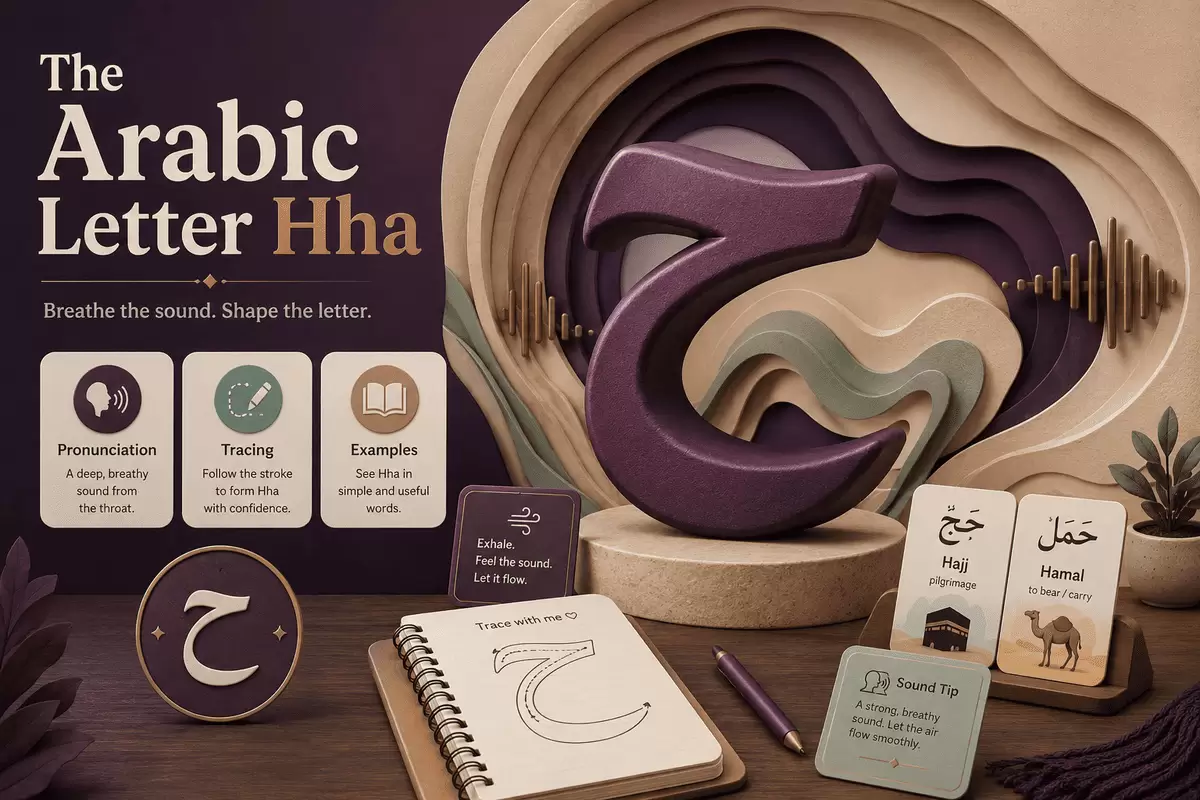
The letter Hha (ح) retains a strong, distinct pronunciation in Gulf dialects, including Saudi and Emirati Arabic. Understanding its regional nuances is crucial for clear communication and cultural authenticity.
Regional Variations in Hha Pronunciation
The core sound remains consistent, but variations exist in emphasis and throat constriction:
- Some Gulf dialects feature a stronger breath expulsion or a more pronounced “scrape” than other regions.
- In fast speech, the sound might soften slightly, but it rarely blends into Ha (ه).
- For example, an Emirati speaker may emphasize the breathiness slightly more than an Egyptian speaker.
Specific Examples from Saudi and Emirati Arabic
The robust presence of Hha is evident in everyday Gulf vocabulary and greetings:
- حلو (sweet/beautiful) & صحة (health): Pronounced with a clear, strong pharyngeal Hha in both Saudi and Emirati accents.
- كيف حالك؟ (How are you?): Features a prominent Hha sound in Saudi Arabic.
- يا حياك الله (Welcoming phrase): Retains a distinct Hha in Emirati expressions.
Impact on Understanding Local Arabic Media
Familiarity with the specific emphasis on Hha is vital for comprehending Gulf news broadcasts, television dramas, and conversations. Misinterpreting this sound can cause minor misunderstandings, whereas recognizing its precise articulation allows for a more natural engagement with local Saudi and Emirati content.
How does the Arabian Tongue shape your journey of learning the Quran and Arabic?
At Arabian Tongue, we help you understand the Quran deeply and connect with its meanings through simple and effective teaching methods. Our courses are designed to make your learning journey clear, engaging, and spiritually enriching.
Guidance from the Quran and Hadith
قال النبي محمد ﷺ: «خَيْرُكُمْ مَنْ تَعَلَّمَ الْقُرْآنَ وَعَلَّمَهُ» (صحيح البخاري، 5027).
The Prophet Muhammad ﷺ said: “The best among you are those who learn the Quran and teach it.” (Sahih al-Bukhari, 5027).
يقول الله تعالى: “وَرَتِّلِ الْقُرْآنَ تَرْتِيلًا” (سورة المزمل: 4).
Allah says: “And recite the Quran with measured recitation.” (Surah Al-Muzzammil 73:4).
FAQs:
Why do non-native speakers struggle to pronounce the Arabic letter Hha (ح)?
Non-native speakers struggle because this deep, voiceless pharyngeal sound lacks a direct equivalent in most European languages. Mastering it requires training entirely new muscle memory within the throat and pharynx.
What are the four written forms of the Arabic letter Hha (ح)?
The letter has four shapes depending on its word position: isolated (ح), initial (حـ), medial (ـحـ), and final (ـح). These distinct forms allow it to connect smoothly with adjacent letters in Arabic script.
What are some common examples of words containing the letter Hha (ح)?
Common examples showing it at the beginning, middle, and end include حليب (milk), صحة (health), and نجاح (success). Other everyday words feature it too, such as حياة (life), حب (love), and مفتاح (key).
How do I tell Hha (ح) apart from Ha (ه)?
You differentiate them by depth: Hha (ح) is a deep, raspy, breathy sound coming from the middle of the throat. In contrast, Ha (ه) is a light sound made higher up at the vocal cords, like the English h.
How do I type Hha (ح) on an Arabic keyboard?
On a standard Arabic keyboard layout, you can type this letter by pressing the key that corresponds to the English letter 'P'. (Note: The original text mentioned 'J', which corresponds to ت, while 'P' or 'H' on standard layouts corresponds to ح).