
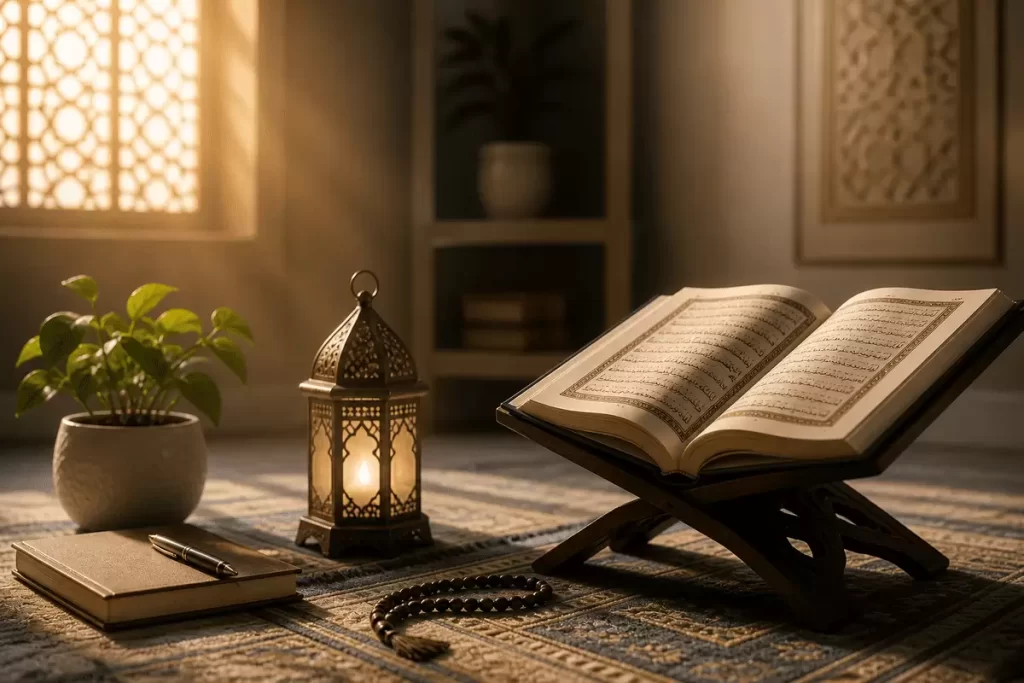
What if the way you recite the Quran could move hearts, bring tears to eyes, and draw listeners closer to Allah? Beautiful Quran recitation is not a gift reserved for a chosen few; it is a skill that can be learned, refined, and perfected by anyone willing to dedicate themselves to the journey. The Prophet (PBUH) himself encouraged his companions to beautify their voices when reciting. So whether you are a beginner or an experienced reciter, these tips and tricks for beautiful Quran recitation will transform the way you engage with the words of Allah forever.
Importance of Reciting the Quran Beautifully
The beauty of the Quran lies not only in its profound meanings but also in the melodious way it is recited. Beautiful recitation transforms the act of reading into an experience that resonates with the heart and soul, making it a spiritual journey rather than a mere task. The Quran itself emphasizes the importance of recitation in Surah Al-Muzzammil, encouraging the Prophet Muhammad (PBUH) to recite in a manner that is both clear and beautiful.
A beautiful recitation enhances the listener’s understanding and emotional engagement. When the words flow with proper Tajweed, the listener can feel the rhythm, the pauses, and the emphasis on certain letters, all of which contribute to a more meaningful experience. Whether reciting for yourself, your family, or an audience, the goal remains the same: to deliver the words of Allah with the utmost beauty and respect.
Moreover, beautiful recitation fosters discipline and dedication. It requires patience, practice, and a willingness to learn continuously. When you commit to improving your recitation, you are not just enhancing your skills; you are also nurturing your spiritual growth.
Tips and Tricks for Beautiful Quran Recitation

Reciting the Quran beautifully is a skill that every Muslim can develop with the right guidance and consistent effort. The following tips and tricks for beautiful Quran recitation will help you refine your technique, strengthen your Tajweed, and transform every session into a deeper act of worship.
1. Master the Basics with Tajweed
- Start with the correct pronunciation of each Arabic letter and the rules of harakat.
- Memorize the Arabic alphabet and practice each sound individually before moving to words and verses.
- Study the rules of noon sakin and tanwin, as these are common points where mistakes occur.
- Apply Qalqalah correctly, as it adds resonance to specific letters.
2. Listen to the Best and Learn
- Listen to renowned reciters like Sheikh Mishary Alafasy, Sheikh Saad Al-Ghamdi, and Sheikh Abdul Rahman Al-Sudais.
- Pay attention to their intonation, speed, and pauses, and notice how they emphasize certain words and letters.
- Try to mimic their style while maintaining your own unique voice.
- Observe how they handle long verses and experiment with different styles to find what works best for you.
3. Practice Consistently and Seek Feedback
- Set aside 15–30 minutes daily for focused practice and break sessions into smaller goals.
- Share your recitation with a trusted teacher or mentor for constructive feedback.
- Record yourself reciting and compare your recording to a professional reciter, noticing differences in tone, speed, and clarity.
4. Enroll in a Structured Quran Recitation Course
- A structured course provides a clear roadmap covering all essential aspects of recitation systematically.
- Look for a course that covers both Tajweed and recitation techniques for all skill levels.
- Learning in a group setting keeps you motivated and inspired by the progress of others.
5. Integrate Spiritual Reflection into Your Practice
- Before reciting, reflect on the meaning, context, and wisdom of the verses.
- Combine recitation with acts of worship, such as making dua before and after each session.
- Reciting with sincerity and devotion naturally makes your voice carry a sense of reverence.
6. Improve Your Pronunciation of Arabic Letters
- The 28 Arabic letters each have a unique point of articulation, and mispronouncing even one can alter the meaning of a verse.
- Practice each letter in isolation using a mirror to observe your mouth and tongue movements.
- Apply Tajweed rules such as idgham, ikhfa, and iqlab in context to reinforce correct articulation.
- Shadow reciting after a professional reciter to correct mistakes and develop muscle memory for accurate pronunciation.
7. Focus on the Intonation for a Beautiful Quran Recitation
- Intonation refers to the rise and fall of your voice, adding melody and emotional depth to recitation.
- Raise your voice to emphasize important words, lower it to create solemnity, and pause strategically to highlight key phrases.
- Mastering Tajweed rules such as madd and waqf helps you control where and how to change your pitch.
- Listen to professional reciters and pay attention to how they vary their pitch, speed, and volume.
8. Learn How to Control Your Breath for a Smooth Recitation
- Proper breath control is essential for maintaining a steady recitation; practice breathing from the diaphragm rather than the chest for stronger and more sustained airflow.
- Identify the natural pause points in verses, known as waqf, and use them strategically to breathe without disrupting the flow or altering the meaning.
- Gradually increase the length of your recitation between breaths as your lung capacity and control improve over time.
How does the Arabian Tongue shape your journey of learning the Quran and Arabic?

At Arabian Tongue, we help you understand the Quran deeply and connect with its meanings through simple and effective teaching methods. Our courses are designed to make your learning journey clear, engaging, and spiritually enriching.
Guidance from the Quran and Hadith
قال الله تعالى: «وَرَتِّلِ الْقُرْآنَ تَرْتِيلاً» — سورة المزمل، الآية 4
Allah (SWT) said: “And recite the Quran with measured recitation.” — Surah Al-Muzzammil, 73:4
قال رسول الله صلى الله عليه وسلم: «لَيْسَ مِنَّا مَنْ لَمْ يَتَغَنَّ بِالْقُرْآنِ» — صحيح البخاري
The Prophet (PBUH) said: “He is not one of us who does not recite the Quran melodiously.” — Sahih Al-Bukhari
FAQs
What role does Tajweed play in beautiful recitation?
Tajweed ensures that every letter, word, and phrase is pronounced with accuracy and precision, preserving both the meaning and beauty of the Quranic text. Without it, even fluent reciters may unknowingly alter the rhythm or meaning of verses.
How can beginners start improving their recitation?
Beginners should start by mastering the correct pronunciation of each Arabic letter before moving on to words and verses. Listening to professional reciters and practicing consistently for 15–30 minutes daily builds a strong foundation over time.
Is melody important in Quran recitation?
Melody plays a significant role in Quranic recitation, as the Prophet (PBUH) encouraged beautifying the voice when reciting. Proper intonation and vocal modulation convey the emotional depth of the verses and make the recitation more impactful for both the reciter and the listener.
How can breath control affect recitation quality?
Poor breath control can disrupt the flow of recitation, leading to unintended pauses or rushed words that affect both clarity and meaning. Breathing from the diaphragm and using natural pause points known as waqf allows for a smoother, more controlled, and more beautiful delivery.